Good For: Challenge assumptions
The REMODEL toolkit is targeted at companies producing products and is focused on developing economically sustainable business models through the principle of open source. While the toolkit is private-sector-oriented, some of the co-creation principles and methods can also apply to some areas of the public sector. The toolkit was published based on the experience of REMODEL with 8 Danish companies in 2018. The toolkit consists of 7 work packages and each part has a step-by-step instruction and a…
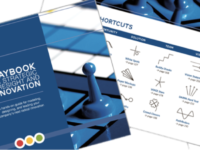
This resource contains a method library and playbook for commonly used strategic foresight tools, organised by a guiding framework of five planning phases (perspective, opportunity, solution, team, and vision). While it does contain the tools themselves, the resource also contains extensive guidance on each method, including overall guidance, examples, instructions, insights, tips, and tool templates. It also contains overall guiding principles, underlying theories, and considerations for using…
This resource is an imagination game that challenges players to collaboratively and competitively describe objects from a range of alternative futures. The object of the game is to come up with the most entertaining and thought-provoking descriptions of hypothetical objects from different near-, medium-, and long-term futures. The card deck can be downloaded and printed and contains cards, instructions, playsheets, and blank cards that you can customize with your own content. The website also…
Australia's BizLab, within the Department of Industry, Innovation, and Science, was established in 2016 and launched BizLab Academy in 2018. The goal of the academy is to teach Human Centred Design (HCD) to department employees, but also the rest of the Australian Public Service. The academy aims to strengthen the public sector's capability for evidence-based policy and service design while at the same time instilling a citizen-centric culture and building an alumni of human centred design…
This resource is focused on collaboration around designs for solving product problems, specifically on the topics of trust, transparency and control concerning the use of personal data. The methodology used was inspired by those from the Stanford d.school and IDEO. The toolkit is split into four sections – Plan, Discover, Ideate and Prototype.
The resource contains over 20 guided activities and supporting materials (including downloadable worksheets) covering materials for planning and running…
The goal of this resource is to elicit conversation, encourage risk evaluation as a team, and catalyze proactive mitigation strategy planning around algorithm use in the public sector. It includes assessments and worksheets for assessing algorithm risk and managing algorithm risk. The publishers assume users have an understanding of their data and a basic understanding of algorithms.
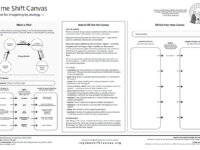
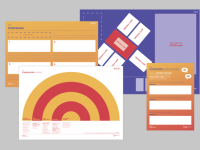
This canvas is a strategic design tool for developing descriptive models of transformative futures. It asks users to name the logics stabilizing the dominant regime — and then imagine how such logics might stabilize an alternative in terms of narratives, goals, core values, governance & practices, and physical inputs.
Requires email address in exchange for download.
The Open Data Board Game is a board game built around the creation of tools using data. A physical board game journey might involve clearing datasets for release as open data, achieving a certain data quality, and ultimately connecting data sets with a start up, SME or government to deliver economic, social and environmental benefits.
It is a Github code repository that contains all the things that are needed to create the game. It is a work in progress, according to the publisher. Requires some…
The resource contains tools for visualizing and anticipating future risk of technology products, acknowledging that once technology is released and reaches scale it may be used for purposes beyond the original intention. The toolkit contains foresight methods, including 14 scenarios, for kicking off important conversations with product teams--including examples of current signals of future trends. It also contains a Risk Mitigation Manual with 8 risk
zones where hard-to anticipate
and unwelcome…
This resource is developed by and for open government influencers - civil servants and civil society representatives seeking to collaboratively make governance processes transparent, participatory and accountable. It is intended for those who want to be an open government influencer.
The original guidance includes recommendations and experiences from experienced leaders in Europe and Central Asia. It follows the publishers' joint journeys in navigating challenges to creating an enabling…