Good For: Compare different possible approaches
The AIA is a questionnaire designed to help assess and mitigate the impacts associated with deploying an automated decision system. It helps identify the impact level of an automated decision system. It was developed with the Canadian Directive on Automated Decision-Making in mind but it can be applied elsewhere. The questions are focused on business processes, data, and system design decisions.
The questionnaire asks around 60 questions and the results will demonstrate impact level as well as a…
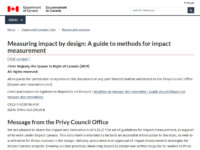
The Privy Council Office's Impact and Innovation Unit’s (IIU) developed this guidance for impact measurement, in support of its work under Impact Canada. This resource provides an introduction to the topic, as well as a reference for those involved in the design, delivery, procurement or appraisal of impact measurement strategies in Canada and beyond. It provides descriptions and considerations of different ways of measuring impact versus traditional methods.
It includes the reasoning for…
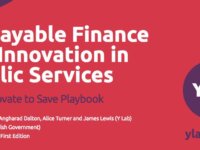
Innovate to Save was launched in February 2017 with funding from Welsh Government. The programme blends grant funding to undertake a Research and Development phase, incorporating prototyping and piloting of the organisations' ideas, followed by the opportunity to apply for an interest-free loan on negotiable terms to implement the project at scale during an implementation phase.
Repayable finance is a tool that governments can use to support innovation in public services - allowing governments…
This resource provides South Australian Government organisations with guidance on the development and format of their digital strategies, which they distinguish separately from an information and communications technology (ICT) strategy. The toolkit contains guidance on the development and format of digital strategies, a digital maturity assessment tool, a digital transformation prioritisation tool, a digital strategy template, and an implementation plan template.
This resource is focused on collaboration around designs for solving product problems, specifically on the topics of trust, transparency and control concerning the use of personal data. The methodology used was inspired by those from the Stanford d.school and IDEO. The toolkit is split into four sections – Plan, Discover, Ideate and Prototype.
The resource contains over 20 guided activities and supporting materials (including downloadable worksheets) covering materials for planning and running…
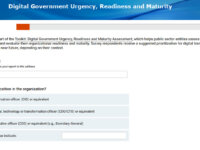
The "Toolkit: Digital Government Urgency, Readiness and Maturity Assessment" helps public sector entities assess urgency for digital transformation and evaluate their organizational readiness and maturity. Respondents of the freely accessible survey receive a suggested prioritization for digital transformation initiatives in the near future, depending on their context, as well as indicative digital maturity levels. An email address is required in order to receive the report.
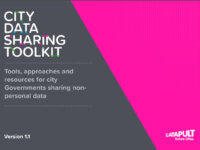
This resource includes tools, approaches and resources for local authorities sharing non-personal data. The publishers intend it for those currently working in city governments as well as those supplying data sharing services to be able to find a common language and process in approaching the sharing of data. It focuses on both the technical and non-technical aspects of sharing data, including building data sharing partnerships, building a team, ecosystem mapping, and proposal and business case…
The goal of this resource is to elicit conversation, encourage risk evaluation as a team, and catalyze proactive mitigation strategy planning around algorithm use in the public sector. It includes assessments and worksheets for assessing algorithm risk and managing algorithm risk. The publishers assume users have an understanding of their data and a basic understanding of algorithms.
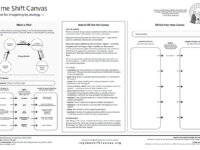
This canvas is a strategic design tool for developing descriptive models of transformative futures. It asks users to name the logics stabilizing the dominant regime — and then imagine how such logics might stabilize an alternative in terms of narratives, goals, core values, governance & practices, and physical inputs.
Requires email address in exchange for download.
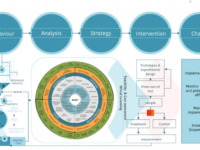
BASIC (Behaviour, Analysis, Strategies, Intervention, and Change) is an overarching framework for applying behavioural insights to public policy from the beginning to the end of the policy cycle. It is built on five stages that guides the application of behavioural insights and is a repository of best practices, proof of concepts and methodological standards for behavioural insights practitioners and policymakers who have become interested in applying behavioural insights to public policy.
The…