
The Danish Design Center created the Ecosystem Mapping tool to help users get an overview of their project stakeholders and potential participants and analyse the motivations, resources and capabilities, that will become valuable for the overall ecosystem.
Through its application, users can map all actors (partners, collaborators, contractors, external stakeholders, etc.) in a given ecosystem in order to accomplish its mission. The tool provides users with "Question Cards" to confirm identified…
Open Government Tags: engagement
The Australian Public Service (APS) Framework for Engagement and Participation provides guidance, principles, and links to interactive tools that support public servants and managers to adopt and improve the participation and engagement of stakeholders and citizens as ways to earn trust and overcome complexity in dealing with society's challenges in the 21st century.
Public servants and managers are invited to subscribe to the principles that underpin this vision and actively use this toolkit…

The U.S. Public Participation Playbook is a resource for government managers to evaluate and build better services through public participation using best practices and performance metrics.
Based on discussions with US Federal Government managers and stakeholders, the publishers identified five main categories that should be addressed in all programs, whether digital or offline. Within each category they identified 12 unifying plays to start with, each including a checklist to consider,…
Toolkit
 CHAMPION:
Can be remixed
OGP’s Participation and Co-creation Toolkit: From usual suspects to business as usual
CHAMPION:Can be remixed
This resource describes open government good practices and presents them to encourage further adoption and innovation. The publisher's goal is to help government reformers and civil society partners in improving the quality and output of co-creation processes across the Open Government Partnership (OGP). The resource was created to aid OGP partners but is applicable to others interested in open government.
The Toolkit contains content organised in a Question & Answer format, a matrix of…
The OGP Toolbox is a collaborative platform that gathers digital tools developed and used throughout the world by organizations to improve democracy and promote transparency, participation and collaboration.
It is designed as a social network and includes use cases and tool "collections," technical criteria informed by the community and recommendations based on the experience of users that have already implemented existing solutions.
The goals of the publisher and platform are to:
- allow actors…
This guidance contains 13 implementation plans laying out practical ways to address corruption. It is divided into 6 issue areas, each with an overview of the problem as well as solutions. The plans emerged from “Smarter Crowdsourcing Anti-Corruption” (2017). The Smarter Crowdsourcing method is an agile process, which begins with problem definition followed by online sourcing of global expertise to surface innovative ideas and then turns them into practical implementation plans. This…
Produced as part of the Making Sense project, which draws on nine citizen sensing campaigns in Holland, Kosovo and Spain in 2016 and 2017. Based on that experience, the publisher developed a framework and methods and tools for citizen participation in environmental monitoring and action. Their approach is bottom-up and participatory, which the publishers call "citizen sensing."
The publishers offer a software platform for collecting data, methodologies for making sense of data, and best…
Toolkit
CHAMPION:
Can be remixed
The Reference Panel Playbook: Eight moves for designing a deliberative process
CHAMPION:Can be remixed

Reference Panels, also known as Citizens' Assemblies, Commissions and Juries, are an example of long-form deliberative processes that are frequently used by governments and public agencies to obtain detailed guidance on important and sometimes controversial policies.
Based on the publisher's experience with reference panels, they offer eight moves from their playbook to help others plan their own deliberative process.
This toolkit is for officials and staff at governments and institutions that are interested in launching a participatory budgeting process. Its purpose is to build understanding of what it takes to start a participatory budgeting process and how to lay a foundation for success.
It answers the questions:
How does a typical PB process work?
What are the impacts of PB?
What budgets can be used for PB?
What staffing and other resources are needed to implement PB?
How do I get started?
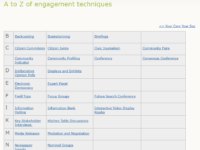
A collection of 55 different public/stakeholder engagement techniques, including an assessment of difficulty, engagement level, cost, when might be used, how many people might be needed to run, timeframes, innovation level and a step by step guide for using each.