
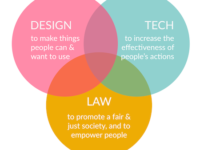
This is a set of resources for designers who are approaching legal challenges with a creative, generative, human-centered approach. The toolbox provides guides, tools, and examples to help you scope & tackle these challenges with design. It includes a Legal Communication Design Toolbox, a Legal Design Pattern Library, and a Legal Product Typology. It covers policy prototyping, visual design, and data visualisation.
Task Type: Problem solving
This is a knowledge base containing existing societal and public sector needs, emerging trends, methods, tools, technologies and applications. They are filterable by asset type, need, and type of trend.
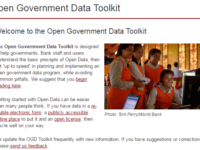
A collection of online guidance and knowledge to assist countries and others in setting up open data strategies and platforms.
The resource is comprised seven sections:
Open Data Essentials, Starting an Open Data Initiative,Technology Options, Demand & Engagement, Supply & Quality of Data, Readiness Assessment Tool, and Technical Assistance and Funding.

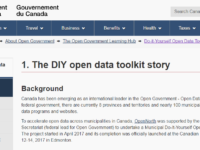
The Do-it-Yourself (DIY) Open Data Toolkit provides a step-by-step guidance on how to develop an open data initiative. The Toolkit is primarily intended for municipalities that have not yet begun an open data project and need some guidance on how to implement one. It can also be referenced by other governments or organizations who are considering initiating an open data initiative.
The toolkit includes: Open data orientation, Planning considerations, Publishing sample data sets, Adopting an open…

The Open Data Toolkit provides guidance intended for South Australia agencies and local councils release open data, although can be adapted to other contexts. It includes guidance on the following steps: Identify, Classify, Approach, Approve, Publish, Maintain.
It includes suggestions on governance decisions and roles as well as privacy, public value, and intellectual property guidance.
Toolkit
 CHAMPION:
Can be remixed
Legal Leaks Toolkit – A Guide for Journalists on How to Access Government Information
CHAMPION:Can be remixed

A toolkit targeting journalists and includes concrete guidance on how to use their rights to access information. It is based on a comparative analysis of the access to information laws in the region covered by the Organization for Security and Cooperation in Europe, which has 56 participating states in Europe, Central Asia and North America; of these 45 have legal provisions on the right of access to information held by public bodies which are reviewed in this analysis. It is available in 13…
This resource aims to enrich the efforts of parliaments and their civil society counterparts to engage in collaborative processes, either as part of the Open Government Partnership National Action Plan or otherwise. The first section focuses on the development of open parliament commitments. The second section shares the experiences of a variety of parliaments and civil society organisations in collaborating in the creation of parliamentary openness commitments and in developing ongoing…

The publisher defines validation as the process of gathering evidence and learnings around business ideas through experimentation and user testing, in order to make faster, informed, de-risked decisions. The Validation Guide contains guidance and several tools, including an Assumption Mapper and Experimentation Execution Card for designing and setting up experiments to test ideas and products in iterative ways. The intended audience is large private companies but the principles and tools can…
The resource is intended for those working in the international development or social impact space to assesses the future impact that innovation can deliver in a system. It focuses on three "systems": The Problem Space, The Innovation Space, The Context.
It's goals are to precipitate better understanding of the problem of focus and the context in which it exists, assess enablers and barriers
to innovation, track system change over time, and assess the impact of a program ex post facto. It…

This step-by-step toolkit describes an inclusive approach to recruiting participants for public consultation or engagement processes. The publishers designed the Civic Lottery process to mitigate the shortcomings and distortions produced by traditional recruitment methods. The approach introduces randomization at multiple stages of the participant recruitment and selection
process. This toolkit is best for those who have decided that a reference panel is right for their situation (see the…