Evolving innovation for humanitarian responses with a portfolio approach: insights from the UK Foreign, Commonwealth and Development Office
 Written by Benjamin Kumpf, Tarah Friend and Lauren Williams | 9 December 2025

This is the third blog of a series on innovation portfolio management for international development organisations. The first blog outlined our approach to designing tailored innovation portfolio management approaches for development funders. The second blog shared insights from our collaboration on innovation portfolio management with the Ministry for Foreign Affairs Iceland. This third blog summarises key takeaways from our collaboration with the UK Foreign, Commonwealth and Development Office (FCDO) on mapping and advancing the humanitarian research and innovation portfolio.
This post focuses on a specific form of innovation portfolio management: how can a development organisation track and adjust all investments related innovation in international development, across sectors and geographies. The post targets mainly professionals working in member institutions of the OECD Development Assistance Committee and other development professionals.
As 2025 unfolds, the humanitarian outlook remains bleak: OCHA estimated that approximately 305 million people would need humanitarian assistance this year, driven by escalating violent conflicts and the climate crisis. To put this into perspective, in 2015, approximately 57.5 million people were in need of assistance. Today, the number is more than five times higher, reflecting the escalation in humanitarian crises over the past decade. At the same time, the gap between the number of people in need and the resources available to assist them has widened. For instance, in 2024, the United Nations raised only 46% of the $49.6 billion required for humanitarian aid, leading to significant shortfalls in assistance. In 2025, a number of funders of humanitarian assistance and development cooperation are reducing the volume of Official Development Assistance. The case for innovation has never been more pressing.
The UK Foreign, Commonwealth and Development Office (FCDO) has long been a champion for research and development initiatives that identify the most effective and scalable innovations to enhance humanitarian response. As the current funding cycle of the Humanitarian Innovation Platform concludes, and with it a phase of significant investment in humanitarian innovation, the FCDO is reflecting on how to optimise limited resources to deliver priority humanitarian objectives and responsibly meet the demands of the evolving international landscape.
The OECD has developed a tailor made approach to innovation portfolio management to help funders of innovation to reflect on their practices related to scaling. The approach helps identify gaps, realise synergies, and maximise the reuse of resources, technologies, and processes. Innovation portfolio management generally is widely used in the private sector, to support strategic innovation management.
Innovation portfolio management describes a systematic approach to optimising and aligning innovation processes, resources, partnerships and performance to achieve organisational objectives. A portfolio approach to innovation can help with the identification of gaps and the realisation of synergies, including possibilities for re-use of resources, technologies, platforms, and processes. It furthermore enables to take stock of the social return of investment across the entire portfolio not limiting assessments on effectiveness and efficiency to single innovations and projects.
In 2024, the OECD and the FCDO started a collaboration to map and evolve the FCDO humanitarian research and innovation portfolio. This engagement aimed to enhance alignment with strategic objectives, optimise how risks and rewards are balanced and further advance scaling efforts. The process followed several key steps.
Step one: clarify the why
A core group was established to lead the process. Initial discussions were focused on reiterating and further specifying the why – the main strategic underpinnings for humanitarian research and innovation. This group identified three main strategic considerations (listed in text box 2) selected from an OECD developed catalogue of assessment criteria.
- Strong or nascent evidence-base: How well established is the evidence supporting the solution? Are there lessons from other contexts that can inform the adaptation to the new context? Or is this an investment in something entirely new and pioneering?
- Reach of target constituencies: Does the innovation aim to deepen impact for people that are already reached, or target previously unreached individuals and communities?
- Targeted solutions or systems practices: Does the investment focus on a distinct, scalable solution or does it entail mainly practices to evoke changes in local systems?
Step two: map what is
To generate insights for future decision-making, we mapped humanitarian innovation initiatives funded by FCDO between 2023-2024, through the following programmes: the Humanitarian Innovation Fund, the UK Humanitarian Innovation Hub, the Community Led Innovation Partnership, the Creating Hope in Conflict Humanitarian Grand Challenge, the GSMA Mobile for Humanitarian (M4H) programme, and humanitarian initiatives supported through the Frontier Tech Hub. The scope of the exercise was not to map the entirety of FCDO’s humanitarian innovation work but to seek insights from work specifically badged as ‘humanitarian innovation’ funded through FCDO’s R&D budget.
Key implementing partners provided information on the individual portfolio items, their funding volume and scaling stages. Through the exercise, we mapped over 272 research and innovation initiatives across the portfolio, totalling 42.2 million GBP.
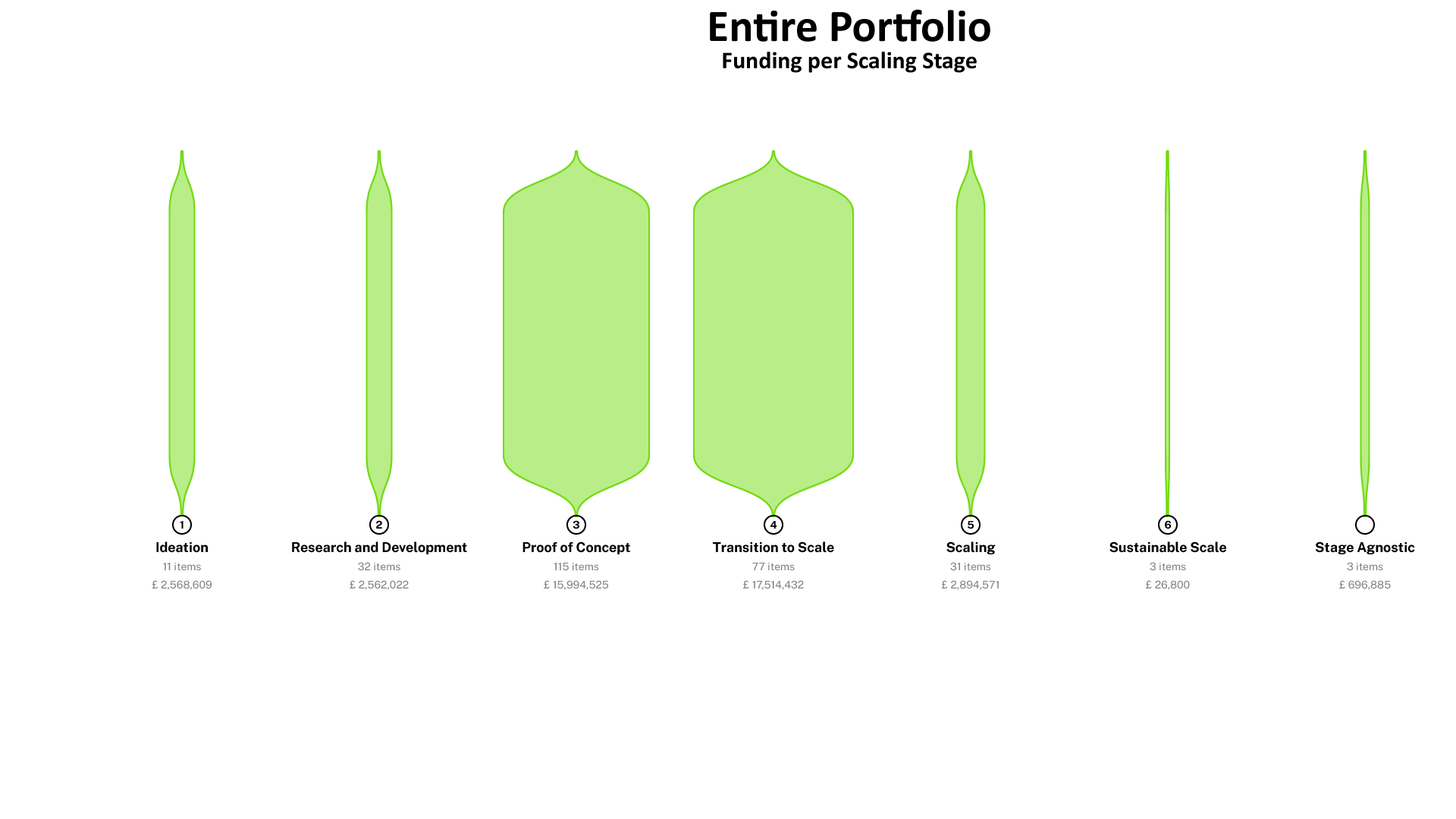
The following month, FCDO colleagues and implementing partners participated in two in-person workshops. Data collected in the preparatory phase enabled the OECD team to create visuals of current investment allocations across scaling stages and other selected criteria. We used the scaling framework of the International Development Innovation Alliance and visualised the portfolio distribution along scaling stages.

At that point in time, the FCDO invested nearly equally in proof-of-concept (£16 million, 115 items) and transition-to-scale stages (£17.5 million, 77 items). Relatively fewer investments were being made in the early stages, with about £2.5 million dedicated to ideation and approximately the same amount invested in research and development stages.
Participants then collaboratively mapped the portfolio items against the selected criteria, including a quick reflection on the strategic intents of each of the various portfolio items. These exercises provided a high-level perspective on the current distribution of funds to enable joint sense-making and strategy discussions.
The role of evidence
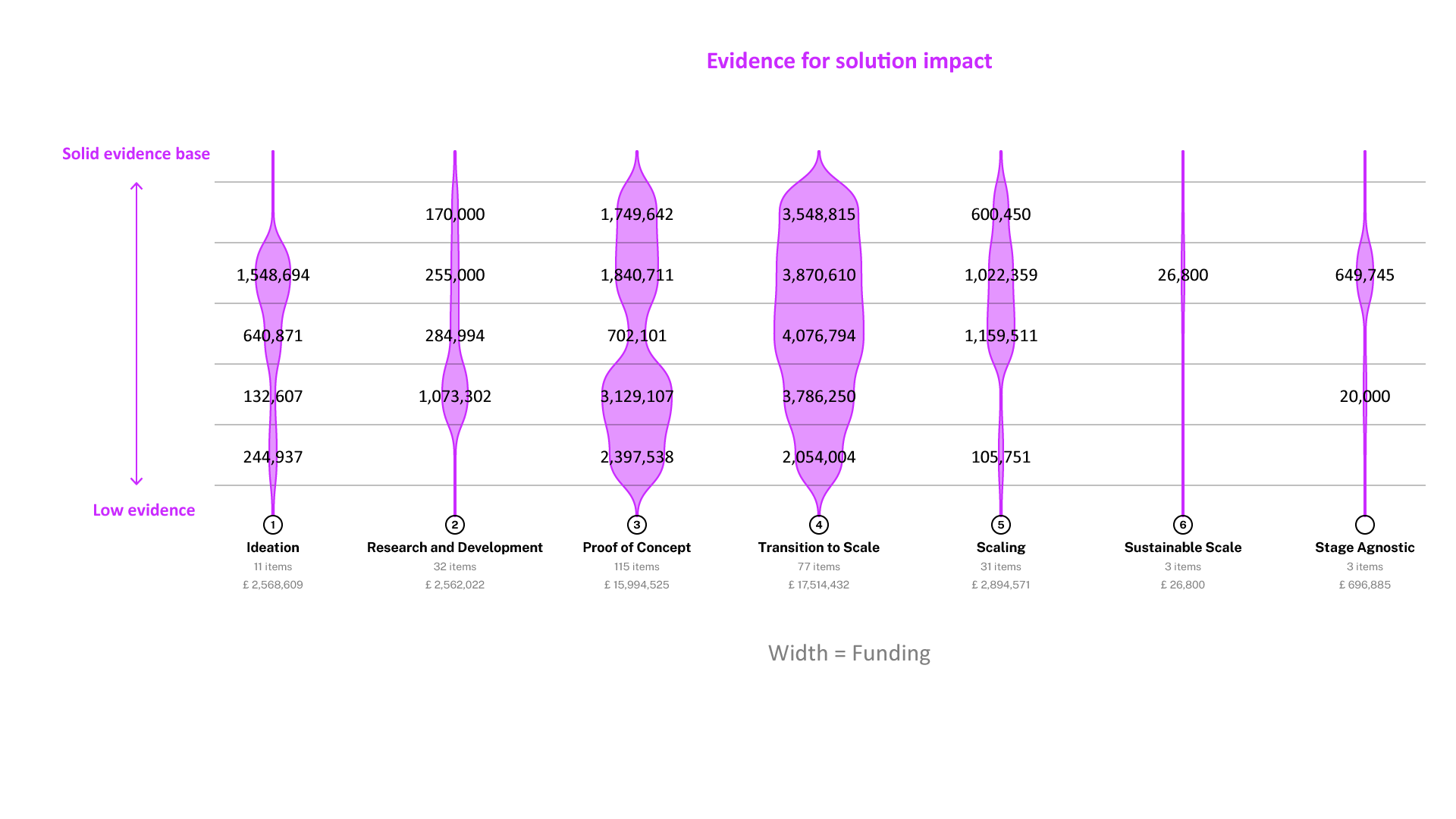
The mapping highlighted that the FCDO’s humanitarian innovation portfolio focussed on innovations with an established or growing evidence base, with relatively fewer resources allocated to solutions with limited or no evidence base. The portfolio items in the transition-to-scale stage with nascent evidence may reflect some of the ‘newer’ transition to scale portfolio where a more solid evidence base is currently being established (beyond established proof of concept), or may reflect challenges in scaling or addressing systemic issues rather than the evidence-base of the solutions themselves.
Reach of target constituencies
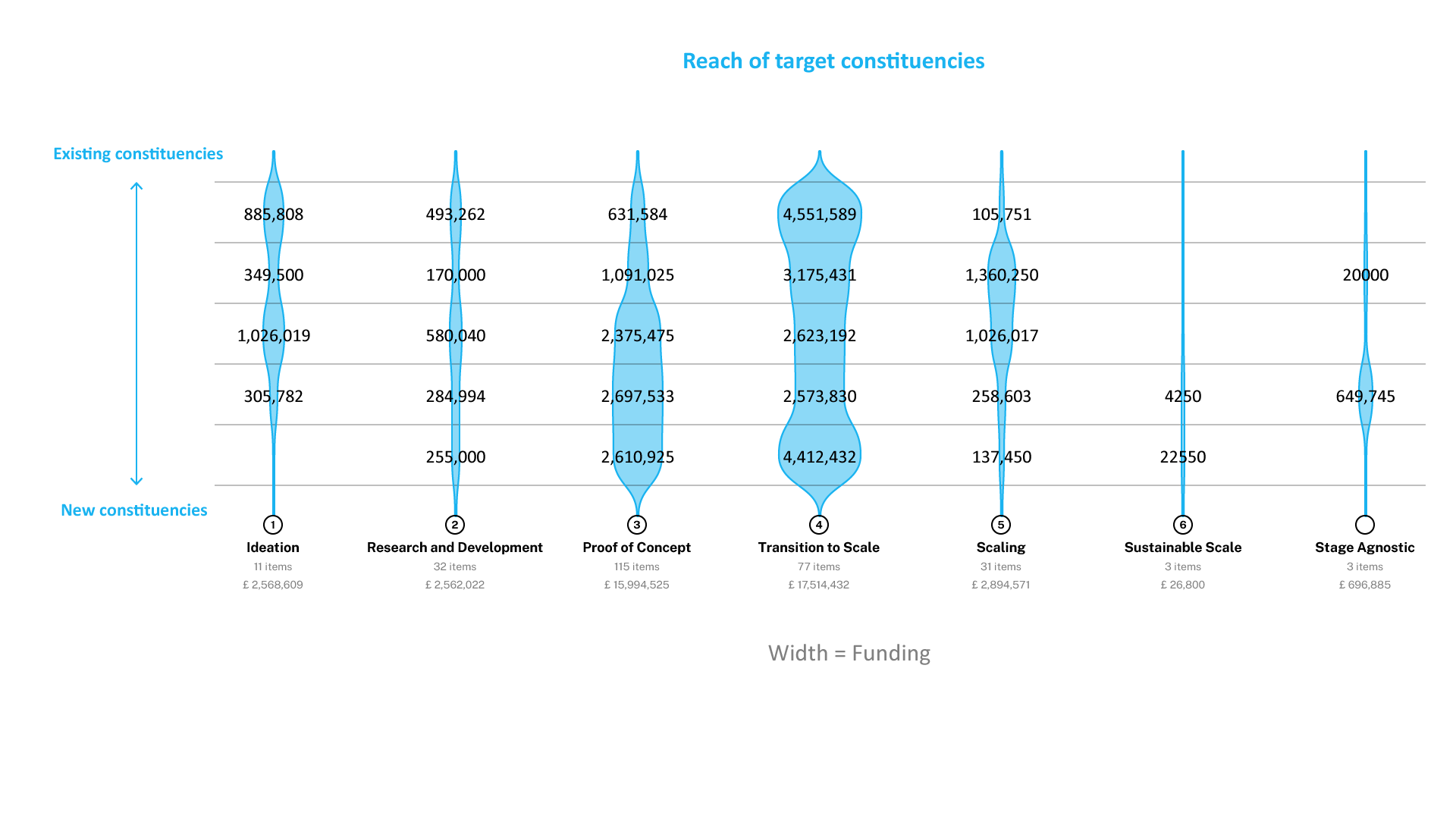
The current portfolio reflects a balanced distribution between deepening impact for existing constituents and reaching previously unreached individuals and communities. However, disaggregated data by scaling stages shows limited early-stage investments aimed at reaching previously unreached constituencies.
Step 3: So what?
The workshop participants’ assessment revealed several key insights:
- A balanced portfolio: the portfolio is well-aligned with the objectives of the individual programmes, and with FCDO’s overall research and innovation risk ambition.
- A focus on evidence: most investments focus on scaling proven innovations, resulting in a relatively strong evidence base and moderate programmatic risk. The assessment of the ‘evidence of solution’ criterion also revealed that most solutions are adaptations of innovations proven in other contexts.
- More clarity is needed on how to drive changes in relevant systems: the exercise revealed that the portfolio seems to be evenly split between investments in specific solutions (e.g. the Safe Water Optimization Tool) and systems practices (e.g. defining and promoting a global standard for humanitarian surgery). This balance was unexpected, as systems practices represented a smaller share of the original Business Case investments. We concluded that the FCDO and implementing partners need to further reflect on the types of systems change and capabilities needed in the sector to continue to support a thriving humanitarian innovation ecosystem.
These findings suggest that early-stage investments since 2018 have matured, and transition-to-scale efforts have increased, addressing a recognised funding gap. The review also underscored the need to revisit the balance between investments in nascent innovations and those aimed at sustainable scale.
There are questions to answer and trade-offs to consider that will shape the future focus of FCDO’s humanitarian innovation investments:
- Should the UK provide more support to nascent stages of innovation or invest more in sustainable scale?
- What constitutes ‘sustainable scale’ in the evolving humanitarian landscape?
- Should UK funding instruments be designed to promote end-to-end innovation rather than the fragmented, projectized funding cycles currently available and if so, how can these best be designed?
- Should the UK’s innovation investment prioritize reaching more previously unreached people, or on improving the quality of the response for those already reached?
Addressing these questions will require the FCDO team to refine its priorities (also in light of available resources) and collaborate with other funders to build a cohesive innovation support ecosystem. While continuing with a portfolio approach for strategic analysis of concurrent work across themes and stages, clearer boundaries on priority areas for innovation and guidance for partners will also help focus efforts on a distinct set of problems, and will help identify opportunities for further long-term collaborative work – while maintaining flexibility to innovate in crisis.
Support the OECD in evolving innovation portfolio management! In 2025, the OECD Innovation for Development Facility will produce a Playbook on Innovation Portfolio Management. This will target development professionals who seek to enhance the strategic alignment of innovation activities across the organisation. We are now inviting development professionals to help us test and evolve our thinking. Add to our consultation page on the portfolio service, specifically on the criteria that matter for innovation investments!
A note of thanks: the programmes included in this exercise were the Humanitarian Innovation Platform, which includes Elrha on the Humanitarian Innovation Fund, the UK Humanitarian Innovation Hub, and the Community Led Innovation Partnership, and Grand Challenges Canada on the Creating Hope in Conflict Humanitarian Grand Challenge. Also included were GSMA’s Mobile for Humanitarian initiative and the Frontier Tech Hub , led by Results for Development. We would like to thank colleagues from these organisations for contributing their time and insights into this exercise.