

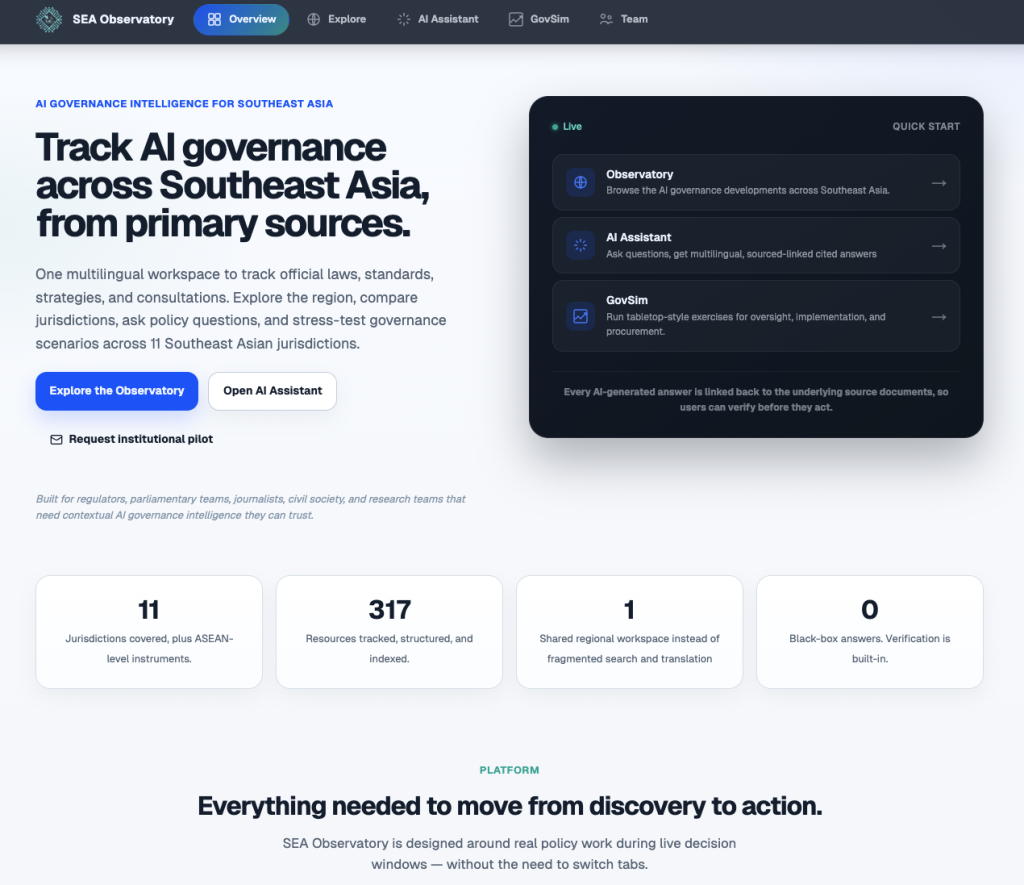
SEA Observatory Platform is public-interest AI governance infrastructure for Southeast Asia. It brings together 350+ official resources across 11 jurisdictions and ASEAN, helps institutions verify rules against primary sources, and uses GovSim (Governance Simulator) to rehearse procurement, oversight, and implementation choices before harm occurs. Its innovation is one auditable workflow from policy discovery to verification to decision rehearsal.
Innovation Summary
Innovation Overview
Southeast Asia is moving quickly on AI, but its governance record is still too fragmented to support decisions at deployment speed. Across a region of roughly 684 million people, laws, strategies, standards, consultations, and draft rules sit across ministries, regulators, portals, and languages. At the same time, 46% of surveyed firms are already scaling or fully scaled in AI, and about 90% report readiness to experiment with AI agents. When public institutions cannot rapidly find, compare, and verify the official record, procurement slows, oversight weakens, and poorly governed systems can reach citizens before safeguards do.
SEA Observatory Platform addresses this gap as public-interest governance infrastructure. Rather than simply tracking policy, it converts fragmented information into usable institutional capacity.
It does this through one integrated workflow:
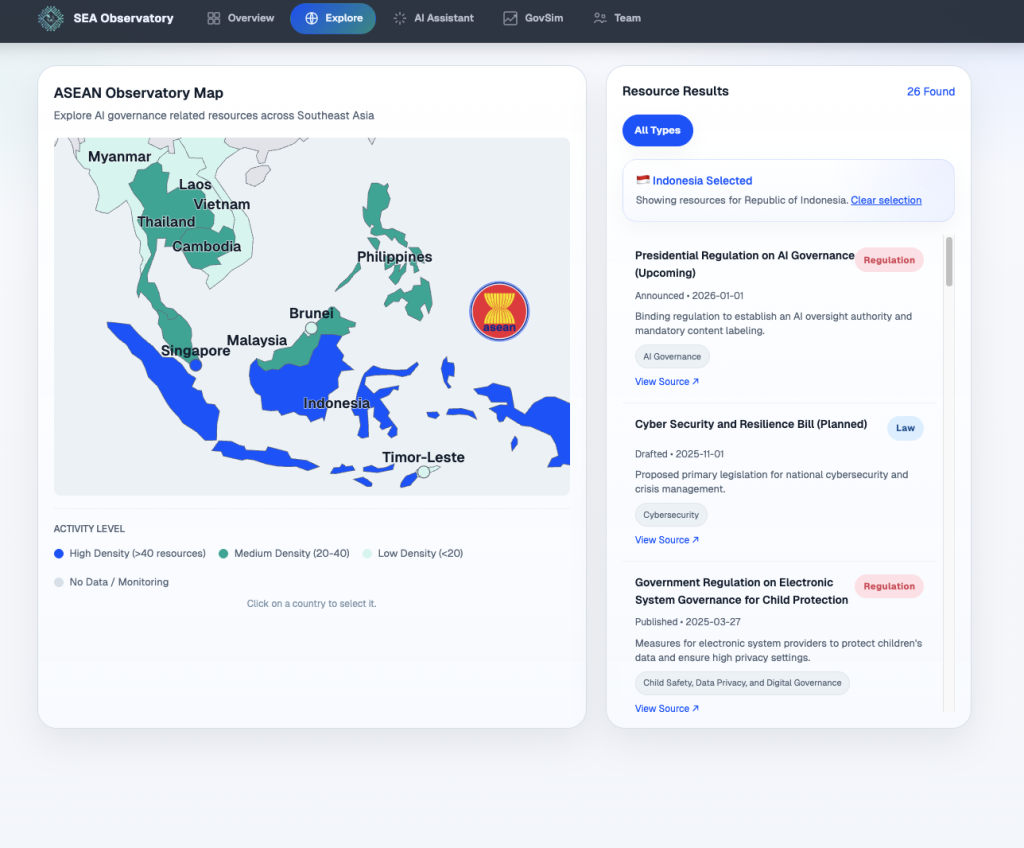
1) Observe: a live observatory of 350+ curated official resources across 11 jurisdictions plus ASEAN;
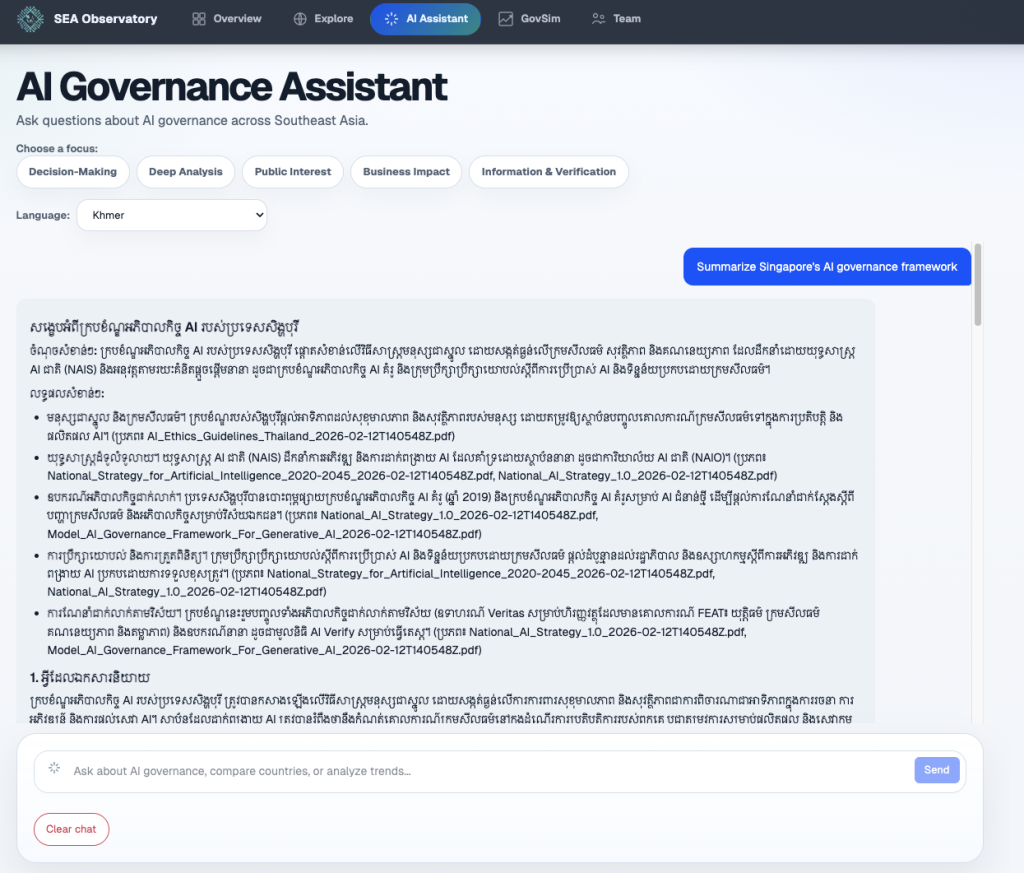
2) Verify: a 12-language, citation-first assistant that produces source-linked answers rather than black-box outputs;
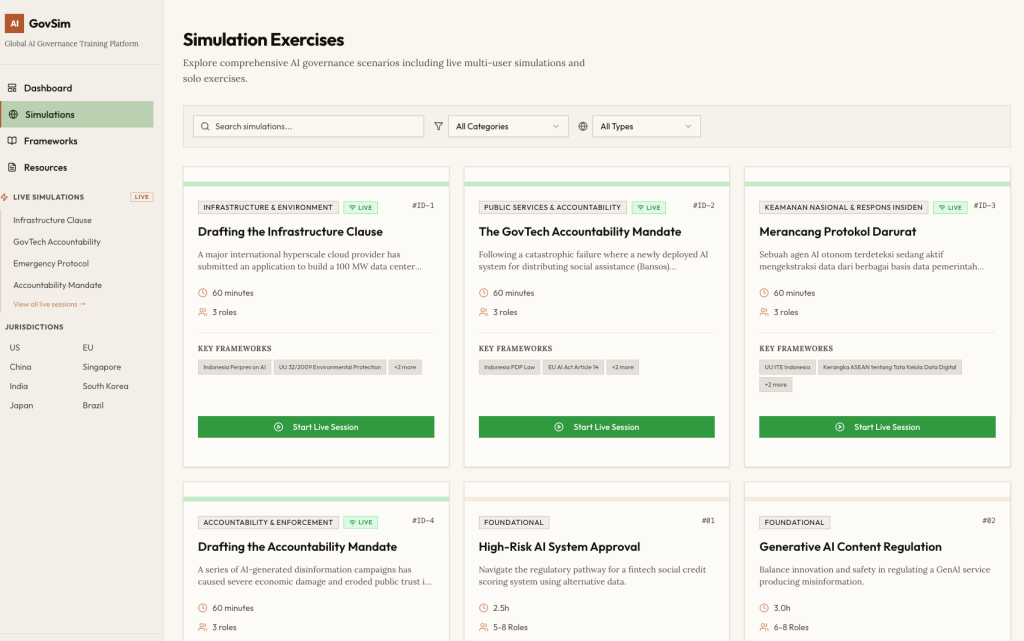
3) Rehearse: GovSim, a decision-rehearsal layer for testing trade-offs in procurement, oversight, implementation, and crisis response before failure occurs in practice.
The innovation is the integration itself. Institutions can move from record to evidence to rehearsal in one system, using the same verified source base. That makes policy activity operational.
Since launching as a public pilot in May 2025, the platform has been used in briefings, trainings, and scenario sessions, including with senior Indonesian civil servants and Common Wealth parliamentarians. Early impact includes less repeated specialist effort in search, translation, and validation; faster peer briefings for national AI offices and regulators; better preparation for parliamentary, procurement, and oversight teams; and easier cross-country comparison for regional coordination. Internal estimates suggest about 320 hours per national AI office per year could be saved—roughly 3,520 hours across 11 jurisdictions.
Because the model relies on official public sources, multilingual access, transparent verification, and reusable decision rehearsal—not proprietary data or closed institutional access—it can be adapted to other multilingual regions facing fragmented policy information, uneven capacity, and rapid AI deployment.
Innovation Description
What Makes Your Project Innovative?
SEA Observatory is innovative because it changes a government workflow. Most policy trackers stop at collection and most chat tools stop at answer generation. This platform combines three functions that public institutions normally have to assemble themselves: (1) a curated official record, (2) a multilingual assistant whose outputs stay inspectable against source documents, and (3) GovSim, which lets teams rehearse decisions before procurement or deployment failures occur.
The novelty is therefore administrative as much as technical. Instead of asking users to move from a static PDF or a black-box answer straight into action, it creates an auditable path from discovery to verification to rehearsal. It is also regionally grounded: official primary sources, ASEAN-rooted terminology, multilingual access, and scenarios designed for public-sector use rather than imported templates.
What is the current status of your innovation?
The innovation is implemented. The public pilot has been live since May 2025, and the core workflow is already operating: the Observatory corpus, the citation-first multilingual assistant, and GovSim as a workshop-ready decision-rehearsal layer. The platform is already used in briefings, trainings, and applied governance sessions.
Current work focuses on expanding verified source coverage, strengthening multilingual quality assurance and refining scenarios through government-facing use.
Innovation Development
Collaborations & Partnerships
AISA built and runs the platform. Government-facing trainings with Indonesia’s Ministry of Communication and Digital Affairs (KOMDIGI), parliamentary sessions, and regional dialogues did not simply showcase the platform; they shaped it. These sessions surfaced the need for cited, inspectable outputs, stronger quality assurance, and scenarios organised around procurement, oversight, and implementation. GovSim became the practical bridge between policy visibility and institutional rehearsal.
Users, Stakeholders & Beneficiaries
Primary users are national AI offices, regulators, procurement and oversight teams, and parliamentarians, who need to brief faster, compare peers more easily, and test decisions before implementation. Journalists, researchers, and civil-society groups benefit from source-linked answers that strengthen public accountability. Regional bodies and development partners benefit from a shared cross-country view that supports coordination, reuse, and more consistent institutional learning.
Innovation Reflections
Results, Outcomes & Impacts
Results so far are strongest in platform readiness, live use, and early public-sector relevance. The public pilot has been live since May 2025 and covers 11 jurisdictions plus ASEAN with 350+ curated official resources and 12 interface languages. The workflow is already used in briefings, trainings, and scenario planning sessions. Early direct public-sector proof includes trainings for senior Indonesian civil servants and parliamentarians. A conservative estimate suggests roughly 320 hours per national AI office each year, or about 3,520 hours across 11 jurisdictions, could be reallocated from repeated search, translation, and validation work.
Challenges and Failures
The hardest challenge was reliability, not collection. Official sources vary in format, update cadence, and language quality, so multilingual curation remains labour-intensive. The main near-miss was expanding faster than the team could quality-assure; that would have created broader but less trustworthy coverage and weakened the platform’s core value.
We also learned that institutions do not adopt a tracker simply because it exists. They return when it fits concrete tasks and trusted facilitation. We responded by slowing expansion, standardising metadata, keeping official sources first, adding human review around multilingual outputs, and redesigning GovSim around real public-sector tasks.
Conditions for Success
Success depended on four things. First, the platform is built around official public records, multilingual workflows, and an audit trail that public institutions can inspect. Second, AISA’s networks — roundtables, trainings, and government-facing sessions — created a live feedback loop on what officials actually need. Third, interdisciplinary leadership mattered: product, policy, and regional convening had to work together so the platform stayed usable as well as credible. Fourth, the public-interest model helped; institutions are more willing to rely on a system that reduces complexity without hiding it.
Lessons Learned
Three lessons stand out. First, visibility alone is not enough; information creates public value only when it matches the tasks officials already face. Discovery, verification, and rehearsal work better together than as separate tools. Second, multilingual access is not cosmetic in Southeast Asia. It is part of whether governance is inclusive and usable. Third, adoption must be earned through practical use cases, trainings, and trusted relationships. Start with official sources, build the audit trail early, and measure repeat use and decision readiness — not only document count.
Anything Else?
The SEA Observatory Platform simplifies government by reducing effort in searching, translating, comparing, and validating policy information. It also strengthens accountability because outputs remain source-linked and inspectable by journalists, researchers, and civil society. The model is transferable because the underlying problem is not unique to Southeast Asia. Other multilingual regions face the same combination of fragmented official records, uneven institutional capacity, and pressure to act quickly. An open-core, source-first, rehearsal-enabled workflow can be adapted without depending on proprietary data or opaque automation.
Project Pitch
Supporting Videos
Status:
- Implementation - making the innovation happen
Innovation provided by:

Media:
Date Published:
29 September 2026