Good For: Acceptance testing
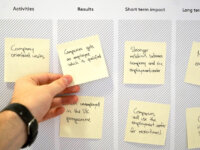
A curated set of 18 canvases that walk you through the steps needed for creating services & products using the combined principles and methodologies of agile development, lean startup, and design thinking. The publisher's intent is for you to reach business objectives in an iterative and human-centric way. In adapting to a public sector context, "customers" may need to be re-framed as stakeholders or service users. GitHub source content available. Includes how-to videos.
The publisher defines validation as the process of gathering evidence and learnings around business ideas through experimentation and user testing, in order to make faster, informed, de-risked decisions. The Validation Guide contains guidance and several tools, including an Assumption Mapper and Experimentation Execution Card for designing and setting up experiments to test ideas and products in iterative ways. The intended audience is large private companies but the principles and tools can…
The term data collaborative refers to a new form of collaboration, beyond the public-private partnership model, in which participants from different sectors — including private companies, research institutions, and government agencies — can exchange data to help solve public problems.
This resource outlines 8 Phases for designing and implementing a data collaborative (partnership) at an institutional level. The online resource includes examples, enablers, tools, and resources for…
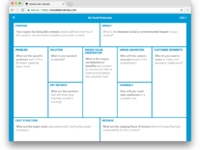
A mashup of the original Business Model Canvas with lean startup methodology built in, this canvas is intended for social entrepreneurs to validate their offering, prioritise what to develop, and message the offering. This could also be used by a government service provider.
The website includes a checklist to evaluate whether you will likely find value in using the canvas.
[Now defunct. Link goes to internet archive from 2018, when MindLab closed]. One of the pioneers of public sector design, Mindlab, developed a set of tools to find and define problems as well as new approaches to solving them. This toolset contains some of the most commonly used in the design practice (user journey, pattern recognition, etc).
This resource focuses on inclusive design, a methodology that enables and draws on the full range of human diversity, including those with limited abilities. The resource includes a guide on inclusive design, multiple short-films and a 20-minute documentary, as well as activity cards that follow 5 phases of a design process.
There is a free and paid version of this toolkit and an associated workshop offered by the publishers. The free version of the kit provides tools to structure your thinking when designing a service that includes machine learning elements. The core idea is that you first describe a user journey in a physical or digital space, and then use the materials from the kit to brainstorm service concepts in that space.
The core materials include:
- A booklet summarising key concepts for designing IA…
The Experiment Co-Creation Platform (ECP) is a model for collaboration and experimenting dedicated in delivering sustainable solutions to wicked urban problems.
The ECP model was developed and prototyped by Demos Helsinki. In the model, cities, higher education institutions and non-academic collaborators such as companies and foundations together define a desirable shared vision to work towards to as well as identify the challenges preventing the vision from happening. Research-based teams…
This is one of the first collections of user experience methods. It describes and analyses user experience design methods by costs expended, time required, resources required, expertise required, and quality of data.
Pixar’s Rules of Storytelling provide guidance on developing and telling a good story, an important skill for building consensus around a new idea or project.