Good For: Idea generation
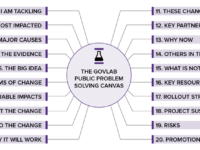
The GovLab's Public Problem Solving Canvas is an online interactive canvas based on twenty questions to create and develop your public interest project. These twenty questions are designed to help you refine your understanding of the problem and those whom it affects; express your Big Idea; and turn that idea into an actionable strategy in the real world to the end of improving people's lives.
[Now defunct. Link goes to internet archive from 2018, when MindLab closed]. One of the pioneers of public sector design, Mindlab, developed a set of tools to find and define problems as well as new approaches to solving them. This toolset contains some of the most commonly used in the design practice (user journey, pattern recognition, etc).
This is one of the first collections of user experience methods. It describes and analyses user experience design methods by costs expended, time required, resources required, expertise required, and quality of data.
Toolkit
Demand for Health Services: A Human-Centred Field Guide for Investigating and Responding to…
This field guide introduces human-centred design as an approach to addressing challenges related to community demand for services (specifically immunization services, but it could be applied to others). This Field Guide exists to help investigate, understand and respond to challenges of demand. It draws on insights from behavioural science and employs human-centred methods to improve immunization outcomes. Includes a 170 page field manual, process map, and workbook with tools. Its process…
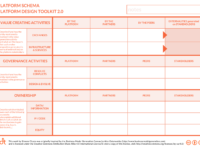
Platform Design Toolkit is based on the tradition of service design thinking and the publishers intend it to overcome the limitations in traditional, linear, business modeling approaches. This methodology is based on a multi-sided, ecosystem based, platform model instead of a traditional product or service design. Those interested in building their "government as a platform" strategy or building a suite of digital or non-digital products or services would likely find value in this approach but…
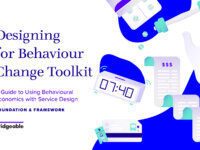
This toolkit outlines Bridgeable’s approach to harnessing behavioural economics (BE) to design better products and services that nudge user behaviour. It combines a service design approach with a BE approach, with the caveat that BE helps identify and tweak pivotal moments of decision making but not overall user experience or strategies.
The toolkit includes an overview of BE as well as an ideation and testing framework incorporating BE principles to move from a current state to an idea future…
A collection of tools that describe how 18F digital service teams put human-centered design into practice. These cards are focused on design in the context of digital services, but can be adapted to non-technical design projects as well.
The resource is online and also available as printable cards.
The card set includes simplified information on various design methods according to an overall methodology: Discover, Decide, Make,Validate. There are also "Fundamentals" cards related to incentives,…
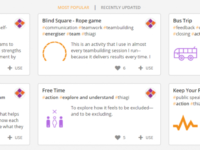
This online library contains over 400 facilitation resources, available with free login. Tools are organised by topic: Team, Energiser, Idea generation, Issue resolution, Explore and understand, Action. They include information such as time required, group size, difficulty, materials, step-by-step instructions, tips, and variations as well as user comments.
This private company also offers free and paid session planner software using the methods in the library.
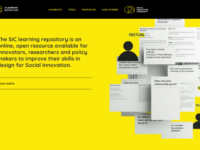
The SIC learning repository is an online, open resource available for innovators, researchers and policy makers to improve their skills in design for Social Innovation.
The tools section is organised by main activities/actions, including:
RECRUITING SOCIAL INNOVATORS
STAKEHOLDER ENGAGEMENT
IDEATION
PRODUCT/SERVICE DEVELOPMENT
PROTOTYPING
SUSTAINABLE GROWTH AND IMPACT
FUNDING OPPORTUNITIES
For each tool, time commitment and team requirements are listed and each can be downloaded as a PDF.
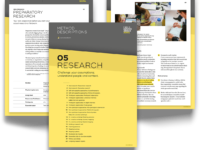
This resource is a method library containing 54 method descriptions for using the key methods in service design. These methods include instructions, guidelines, and-tips-and tricks for activities within research, ideation, prototyping, and facilitation. This collection only contains building blocks. It doesn’t detail how to assemble them into a cohesive design process or how to plan or manage it. The associated (paid) book and curriculum offers this context.