
The Toolkit helps government employees use crowdsourcing and citizen science in their work. It provides five basic process steps for planning, designing and carrying out a crowdsourcing or citizen science project. It also includes a case study library of this process in practice as well as citizen science-related resources (examples, background information, journal articles, tools).
These methods were developed for United States Government staff but could also be used by other governments and…
Good For: Problem framing
The Do-it-Yourself (DIY) Open Data Toolkit provides a step-by-step guidance on how to develop an open data initiative. The Toolkit is primarily intended for municipalities that have not yet begun an open data project and need some guidance on how to implement one. It can also be referenced by other governments or organizations who are considering initiating an open data initiative.
The toolkit includes: Open data orientation, Planning considerations, Publishing sample data sets, Adopting an open…
The resource is intended for those working in the international development or social impact space to assesses the future impact that innovation can deliver in a system. It focuses on three "systems": The Problem Space, The Innovation Space, The Context.
It's goals are to precipitate better understanding of the problem of focus and the context in which it exists, assess enablers and barriers
to innovation, track system change over time, and assess the impact of a program ex post facto. It…

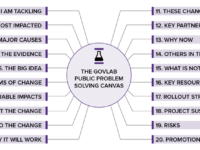
The GovLab's Public Problem Solving Canvas is an online interactive canvas based on twenty questions to create and develop your public interest project. These twenty questions are designed to help you refine your understanding of the problem and those whom it affects; express your Big Idea; and turn that idea into an actionable strategy in the real world to the end of improving people's lives.
[Now defunct. Link goes to internet archive from 2018, when MindLab closed]. One of the pioneers of public sector design, Mindlab, developed a set of tools to find and define problems as well as new approaches to solving them. This toolset contains some of the most commonly used in the design practice (user journey, pattern recognition, etc).
This resource focuses on inclusive design, a methodology that enables and draws on the full range of human diversity, including those with limited abilities. The resource includes a guide on inclusive design, multiple short-films and a 20-minute documentary, as well as activity cards that follow 5 phases of a design process.
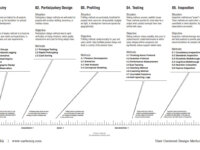
This is one of the first collections of user experience methods. It describes and analyses user experience design methods by costs expended, time required, resources required, expertise required, and quality of data.
Toolkit
 BASIC:
Allows reuse
Demand for Health Services: A Human-Centred Field Guide for Investigating and Responding to…
BASIC:Allows reuse
This field guide introduces human-centred design as an approach to addressing challenges related to community demand for services (specifically immunization services, but it could be applied to others). This Field Guide exists to help investigate, understand and respond to challenges of demand. It draws on insights from behavioural science and employs human-centred methods to improve immunization outcomes. Includes a 170 page field manual, process map, and workbook with tools. Its process…
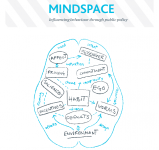
The MINDSPACE report is used by the Behavioural Insights Team as a framework to aid the application of behavioural science to the policymaking process. It is a predecessor of the more simplified EAST framework. It describes four actions that should underpin government‟s attempts to change behaviour: Enable, Encourage, Engage and Exemplify. It includes a users guide for understanding what affects human behavior and describes the MINDSPACE framework through several case studies.
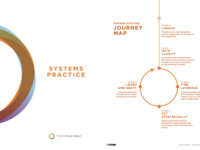
This resource walks you through a systems practice, and describes process phases (Launch, Gain Clarity, Find Leverage, Act Strategically, and Learn and Adapt) and methods for guiding the practice.
This resource has been developed in collaboration with teams across The Omidyar Group. This workbook aims to fill the gap between the promise of a systems approach for making social change and putting it into practice. It was created alongside curriculum as part of a paid course.
For each method,…