Good For: Scanning
This resource is for creating equitable change in schools and learning environments. It helps build the capacity of school communities and learning coordinators to set and pursue equity aspirations, so that every student is future-ready, no matter their background, circumstances, or learning preferences. The resource is based on a design thinking process and includes an overview, methods, and instructions that are specifically tailored to learning environments. The resource includes sections:…
The Design for Policy toolkit PROMPT is targeted toward policymakers who wish to identify where design can add value to the policy cycle process by enhancing user and citizen participation. The majority of the design tools included in the resource are common qualitative research and design methods and follow a gradual shift in emphasis from data-centred policy to people-powered policy, according to the publishers.
PROMPT has been collaboratively developed by PDR - International Design and…
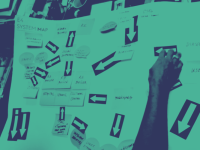
The main goal of the SISCODE Toolbox is to provide support for the co-creation labs in making sense of existing data, tools and toolkits. Co-creation is a non-linear process that involves multiple actors and stakeholders in the ideation, implementation and assessment of product services, policies and systems. The resource aims to improve their efficiency and effectiveness, and the satisfaction of those who take part in the process. The SISCODE Toolbox aims to facilitate the design and…
This toolkit allows organisations to change their mindset and move from a project-oriented approach towards a platform-way-of-working that is designed to tackle complex problems. The toolkit was developed and tested by the Danish Design Centre in collaboration with United Nations Development Programme (UNDP) and 40+ country offices. The toolkit consists of several mapping exercises. After using the integrated Mission Statement Generator to create an ambitious yet realistic mission statement,…
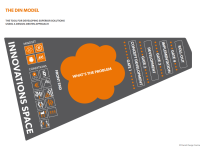
The DIN model is a methodology for developing solutions using a design-driven approach with the goals of achieving better and more innovative processes and outcomes, increasing probability of implementation, and improving user satisfaction. The model helps explore all the potential pitfalls, possibilities and limitations, particularly in the "front end" or early stage of projects. The DIN model consists of a series of phases and four ‘gates’. Each phase contains a variety of activities and…
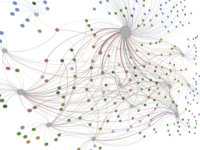
The handbook follows a co-design logic in terms of process, principles and practical tools to support practitioners in the design and implementation of system mapping processes by highlighting the knowledge management component. This resource provides rationale and guidance on the challenge-led system mapping approach, including facilitation guidance for running mapping workshops.
This resource helps mapping practitioners:
• visualise the diversity of innovation projects as a manageable set of…
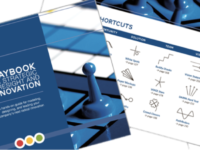
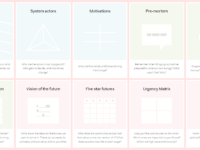
This resource contains a method library and playbook for commonly used strategic foresight tools, organised by a guiding framework of five planning phases (perspective, opportunity, solution, team, and vision). While it does contain the tools themselves, the resource also contains extensive guidance on each method, including overall guidance, examples, instructions, insights, tips, and tool templates. It also contains overall guiding principles, underlying theories, and considerations for using…
This resource is a modular set of tools (10 methods in 3 phases) that can be run in various ways, from a general tool to discover and ideate futures into a premeditated, repeated and ever-focusing exercise to build a vision on one or more lines of work. The resource can also be used to bring transparency and alignment to any organization through repeated exercises. It consists of three types of tools: Worldbuilding, Predictive Analysis and the Optimal Futures. The authors also suggest a process…
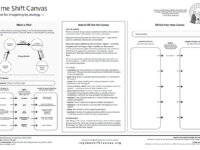
This canvas is a strategic design tool for developing descriptive models of transformative futures. It asks users to name the logics stabilizing the dominant regime — and then imagine how such logics might stabilize an alternative in terms of narratives, goals, core values, governance & practices, and physical inputs.
Requires email address in exchange for download.
This online interactive playbook is intended for teams to work better together in order to get things done. It is organised into Health Monitor (checks and activities for building team health), individual plays (filterable standalone activities), and game plans (series of plays for common use cases). The playbook organises the materials by project, service, and leadership team type, provides detailed instructions on how to run the plays and offers downloads of materials. Since many plays are…