

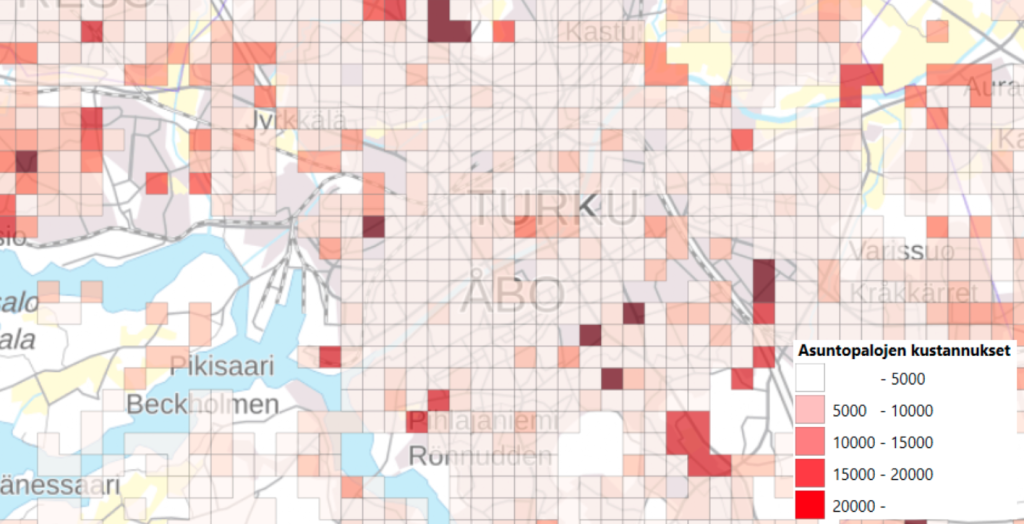
A digital population twin, combined with financial impact analysis, helps governments anticipate how demographic change and shifting risk patterns affect future service needs and costs. Built from real population data and enriched with research and administrative data, it supports precise forecasting, simulation, and planning. In Finland, it has been used to model future accident risks for rescue services at a highly detailed spatial level.
Innovation Summary
Innovation Overview
Governments often lack precise tools for anticipating how demographic change and shifting risk patterns will affect future service needs and costs. Traditional planning methods, often based on forecasting changes in an area’s total population, are too coarse to detect nuanced yet significant demographic shifts.
A digital population twin is a computational replica built from real population data and enriched with statistical data, population research, and organisations’ own administrative data. As a synthetic yet accurate reflection of the real population, it contains information on demographic segments and profiles within the population, along with each segment’s risk factors and service needs. A digital population twin enables detailed insights into how demographic shifts affect public service demand. By integrating the population model with expert analysis of the costs of providing public services – and of not providing them – it creates forecasts of the costs of public service provision. Conversely, it can be used to simulate how changes in service provision models would affect the health and security of inhabitants and public finances.
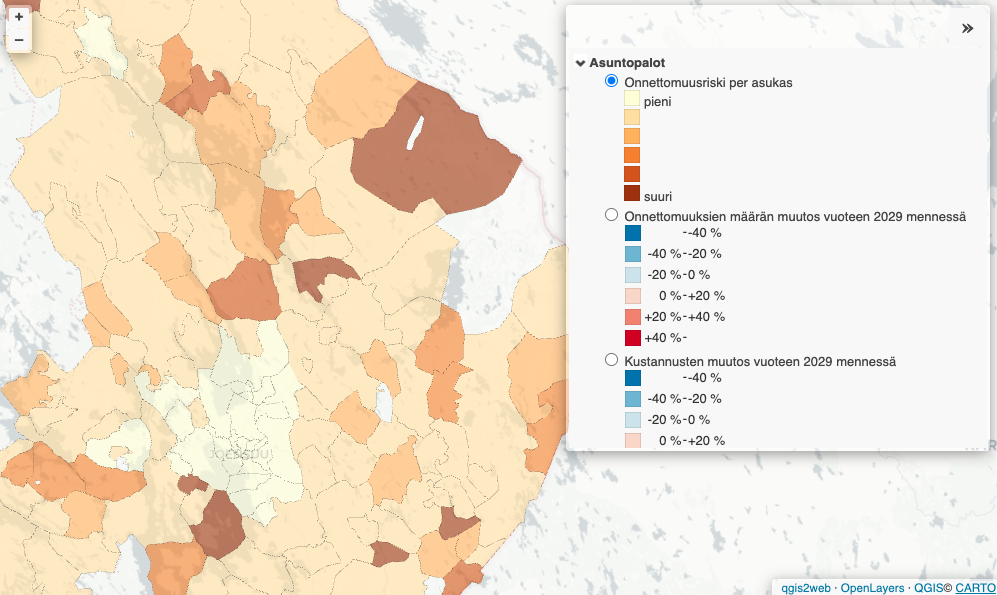
In a project funded by Finland’s Fire Protection Fund, a digital population twin was used to develop a forecasting model for rescue services that predicts the regional occurrence of accidents over the coming ten years. By combining population data with spatial information on services, local economic structure, and cost data, the model offers an integrated geospatial overview of the population and their risk factors, now and in the future. Major innovations of the tool lie in it’s level of detail and specificity: it can analyse change at a grid level as fine as 250 × 250 metres, the level at which people actually live, work, and use services. Also, the model’s cost-benefit analyses identify costs and benefits to different stakeholders within and without the public sector.
The objective is to strengthen anticipatory governance and enable more effective, evidence-based allocation of public resources. The model helps public authorities forecast, at a precise level, where risks, service needs, and cost pressures are likely to grow. The model can be used also to assess and simulate the likely effects of preventive action in advance.
The tool or approach can be used across government to anticipate demand for public services, guide regional policy, support economic planning, and inform long-term investment and service network decisions. It can also be used to benchmark and pre-evaluate service provision models from other countries and regions. The tool’s value lies not only in producing forecasts, but also in creating a common situational picture that can connect multiple authorities and services around the same evidence base.
Because the underlying model is adaptable and scalable, it can be applied to any policy sector or geography, and its level of detail is limited only by the available underlying data.
Innovation Description
What Makes Your Project Innovative?
This approach is innovative because it moves public-sector forecasting beyond coarse administrative averages and isolated sectoral models to a high-resolution, integrated digital twin of the population. Instead of analysing change mainly at municipal level, the model can identify emerging risks, service needs, and cost pressures at a grid level as fine as 250 x 250 metres. This makes it possible to detect highly localised demographic and regional change that traditional planning tools often miss.
The model connects population change, spatial development, service demand, risk modelling, and cost impacts within a shared analytical framework. Previous approaches have often treated these issues separately or focused only on current demand. The model enables authorities to simulate future scenarios, estimate both direct and indirect costs, and use a common evidence base across sectors. This supports evidence-based, preventive, targeted, and strategically coordinated public decision-making
What is the current status of your innovation?
The method has been piloted in three administrative districts in Finland. The accuracy of the model’s predictions has been validated, and its usefulness has been confirmed through dialogue and testing with the leadership of regional rescue departments. We are currently adding new layers and parameters to the model in order to serve new use-cases. These include short-term forecasts to allow resource planning on timescales of one day to several months and identifying high-risk population segments.
Innovation Development
Collaborations & Partnerships
The development of the described population-based modelling was started in 2015 by two Finnish SMEs, Taso Research (digital twin) and Sosped Keskus (cost-benefit analysis). Both organisations have worked widely with public sector organisations in different contexts. The current tool has been developed through continuous dialogue with government officials representing numerous regional rescue services, ministries, interest groups, and researchers and experts from the rescue and security sectors.
Users, Stakeholders & Beneficiaries
The immediate beneficiaries are the providers of government services, who can use the tool’s precise forecasts in the planning of their resource use and operating models at both the operational and strategic levels.
Most importantly citizens benefit from the tool through better-targeted and more cost-effective services.
Innovation Reflections
Results, Outcomes & Impacts
The pilot allowed us to validate the use of the digital population twin and to use rescue services’ own accident history data to produce predictions whose accuracy has been confirmed through comparison to historical data. Feedback from the leadership of regional rescue services has been overwhelmingly positive, and the uptake of the tool in day-to-day planning will commence during the coming months. Stakeholders have identified data sources that could be integrated into the model to enable short-term predictions regarding the impact on service demand of weather conditions, seasonal variation in dwelling and transport and large public events. These viewpoints will be integrated into the model in future development.
Challenges and Failures
A notable challenge is data availability. There has been much variance in the readiness of regional rescue services to grant permission to use their region’s data on accident occurrence and rescue services’ responses.
Another challenge is the opportunity of the leadership of regional rescue services to utilise the information and insight offered by the model. As current regulation and oversight prioritise equal access to services rather than parity of safety outcomes, rescue services have limited leeway to re-allocate their resources in innovative and impactful ways that the model can help identify.
Conditions for Success
The digital population twin is based on the data available for the area in question, and thus the resolution of the resulting overview and predictions depend on the level of detail of data inputted. Even if less precise data is available as the basis for the model, the model can still produce useful results albeit at a less specific level. Finland’s exceptionally broad open data registers have made it possible to build a high-resolution tool which nonetheless does not threaten GDPR and other data protection principles.
Lessons Learned
The project helped validate the usefulness of digital population twins as a novel yet effective tool to produce reliable predictions and a shared overview in policy-making in the rescue sector.
The underlying approach shows promise for application in additional policy areas, such as the healthcare and social services sector. A ongoing lesson relates to the sensitive nature of the model’s outputs: while primarily based on public data sources, the resulting information can reveal security vulnerabilities not only to public officials but also to malicious actors.
For this reason care is taken to ensure that any results made publicly available are of a level of detail that does not comprise local or national security.
Status:
- Implementation - making the innovation happen
- Evaluation - understanding whether the innovative initiative has delivered what was needed
Innovation provided by:

Media:
Date Published:
29 September 2026