Skip to content
An official website of the OECD. Find out more
Created by the Public Governance Directorate

This website was created by the OECD Observatory of Public Sector Innovation (OPSI), part of the OECD Public Governance Directorate (GOV).

How to validate authenticity

Validation that this is an official OECD website can be found on the Innovative Government page of the corporate OECD website.

Toolkit

A Changemaker’s Guide to Storytelling

This resource includes a method and guidance for developing and getting comfortable with storytelling to engage your audience and collaborators in your project. It includes an 8 step process to developing and creating a "sticky" story to inspire and persuade others into action. It includes a downloadable guide with examples and tips and tricks as well as a checklist for evaluating your story.
Toolkit

Co-design Canvas

Champion CHAMPION:
Can be remixed
This is canvas and background guidance around a set of principles for co-design, inspired by the principles developed by the NSW Council of Social Services. The principles are: Outcomes-focused, Inclusive, Participative, Respectful, Adaptive. The canvas includes an example case study.
Toolkit

Mindlab Methods

[Now defunct. Link goes to internet archive from 2018, when MindLab closed]. One of the pioneers of public sector design, Mindlab, developed a set of tools to find and define problems as well as new approaches to solving them. This toolset contains some of the most commonly used in the design practice (user journey, pattern recognition, etc).
Toolkit

Australian Government Guide to Behavioural Economics

Champion CHAMPION:
Can be remixed
This resource contains two guides: one about the general field of behavioural economics and another is on developing behavioural interventions for randomised controlled trials (RCTs). The website also contains an academic directory of researchers working in this field.
Toolkit

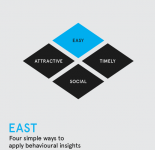
EAST: Four Simple Ways to Apply Behavioural Insights

Basic BASIC:
Allows reuse
EAST is a framework and summary of the Behavioural Insights Team's knowledge of behavioural science, developed for busy policymakers. It is based around principles of making actions Easy, Attractive, Social and Timely (EAST) applied to a 4-step process: 1. Define the outcome, Understand the context, Build your intervention, and Test, learn, adapt. It is a more simplified version of the publisher's prior MINDSPACE framework. The resource includes overall guidance and case studies.
Toolkit

Sonar

Basic BASIC:
Allows reuse
A tool to help cities and public administrations better orient and diagnose themselves regarding their innovation profile and maturity. The tool includes a self-analysis quiz, a map to help navigate concepts and trends and compose your a custom menu. It also includes guidance for setting an innovation strategy. Sonar comes in the form of a newspaper printed in A2 format that can be used in a group setting . This resource is available in French.
Toolkit

Exploring Policy Innovation: Tools, Techniques & Approaches

This resource is an introductory description of a paradigmatic shift in public policy-making from traditional methods to new, innovative approaches. This includes a whole-of-government approach, a refocus on the user, an embrace of complexity, pro-activeness, and collaboration. It describes 7 opportunity areas for innovation in the traditional policy-making process.
Toolkit

Cartilla Co-Crear (Co-create Booklet)

Basic BASIC:
Allows reuse
In this booklet you will find tools to implement the CO-CRE-AR methodology in its three phases: Understanding, Creating and Arming. CO-CRE-AR moves in spaces of divergence and convergence. The first part invites you to UNDERSTAND in detail the challenge you want to face; the second to CREATE with openness and generate ideas without many restrictions, to then land them and make them concrete in work plans, including the necessary communication elements to "sell" the solution in the organization.
Toolkit

Spreading Innovation

Hero HERO:
Editable source files available
The National Centre for Public Sector Innovation in Denmark has developed this guide to help public sector workplaces share their own innovations and reuse others. It is relevant for anyone who wants to collaborate on spreading an innovation from one context to another. The guide consists of six steps with recommended actions to take and associated tools that help structure the dialogue throughout the process.