
Task Type: Approach planning/What could be
The resource was developed for IFRC and National Societies to develop their literacy around data, but it could easily be applied to other organisations. It aims to promote responsible data use and develop data readiness. It has been tailored based on these audiences:
The Data Curious, who needs an ‘on ramp’ to learn and be exposed to the data basics.
The Data Advocate, who sees relevance and and wants to improve their skills and/or offer support.
The Data Active, who are motivated to…
This resource includes tools, approaches and resources for local authorities sharing non-personal data. The publishers intend it for those currently working in city governments as well as those supplying data sharing services to be able to find a common language and process in approaching the sharing of data. It focuses on both the technical and non-technical aspects of sharing data, including building data sharing partnerships, building a team, ecosystem mapping, and proposal and business case…
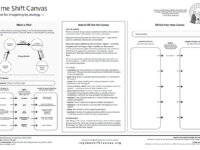
This canvas is a strategic design tool for developing descriptive models of transformative futures. It asks users to name the logics stabilizing the dominant regime — and then imagine how such logics might stabilize an alternative in terms of narratives, goals, core values, governance & practices, and physical inputs.
Requires email address in exchange for download.
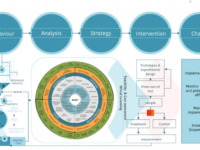
BASIC (Behaviour, Analysis, Strategies, Intervention, and Change) is an overarching framework for applying behavioural insights to public policy from the beginning to the end of the policy cycle. It is built on five stages that guides the application of behavioural insights and is a repository of best practices, proof of concepts and methodological standards for behavioural insights practitioners and policymakers who have become interested in applying behavioural insights to public policy.
The…
This online interactive playbook is intended for teams to work better together in order to get things done. It is organised into Health Monitor (checks and activities for building team health), individual plays (filterable standalone activities), and game plans (series of plays for common use cases). The playbook organises the materials by project, service, and leadership team type, provides detailed instructions on how to run the plays and offers downloads of materials. Since many plays are…
This kit presents the role of transparency within an open government system, including topics like visualisation of data, freedom of information laws, and communication strategies
Principles and guidance for developing digital services in Argentina and beyond. The resource is available in a Github repository and includes 9 principles, indicators, and standards for API's, website, mobile applications, and others.
The Toolkit helps government employees use crowdsourcing and citizen science in their work. It provides five basic process steps for planning, designing and carrying out a crowdsourcing or citizen science project. It also includes a case study library of this process in practice as well as citizen science-related resources (examples, background information, journal articles, tools).
These methods were developed for United States Government staff but could also be used by other governments and…
A playbook of 13 key “plays” drawn from successful practices from the private sector and government that the publisher believes, if followed together, will help governments build effective digital services.
A community sourced set of best practices and principles to help incorporate human-centered design into a product development process.
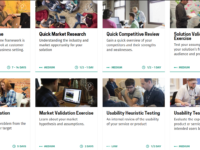
The website contains dozens of methods organised by process, difficulty, time required, and outcomes. Each method contains an overview, detailed, steps, resources, and examples or cases.
The methods are framed in terms of private sector product or service development but can be adapted to a public sector context.