
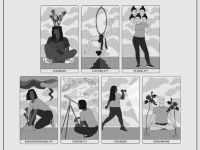
Uncertain Times is a set of tools for navigating uncertainty, harnessing curiosity, and maintaining mental wellbeing on a day-to-day basis. The kit is targeted towards individuals to guide personal reflection and consists of three parts: a set of cards, a workbook, and a weekly planner. The resource is inspired by Dancing at the Edge, by Graham Leicester and Maureen o’Hara and explores the behaviours and competencies required to deal with challenges that the 21st Century is throwing at…
Toolkit Type: Guidance
This is a collection of tools developed through transforming leading innovation management theory into hands-on, easy-to-use, actionable innovation tools. The tools are organized in the categories: Culture, Business model, Validation, Pitching, Technology, Strategy, Problem discovery and Ideation. Each tool contains a description and a step-by-step guide telling how to approach it. The resource also includes guides, videos, posters, quizzes, etc., which provide knowledge within the field of…

The Design Sprint is a methodology for quickly solving problems through developing a hypothesis, prototyping an idea, and testing ideas with users. Design Sprints quickly align teams under a shared vision with clearly defined goals and deliverables. The Design Sprint methodology was developed at Google from a vision to grow user experience (UX) culture and the practice of design leadership across an organisation. The length of time for Design Sprints will be based on the goals and the needs of…

This resource is for creating equitable change in schools and learning environments. It helps build the capacity of school communities and learning coordinators to set and pursue equity aspirations, so that every student is future-ready, no matter their background, circumstances, or learning preferences. The resource is based on a design thinking process and includes an overview, methods, and instructions that are specifically tailored to learning environments. The resource includes sections:…
The main goal of the SISCODE Toolbox is to provide support for the co-creation labs in making sense of existing data, tools and toolkits. Co-creation is a non-linear process that involves multiple actors and stakeholders in the ideation, implementation and assessment of product services, policies and systems. The resource aims to improve their efficiency and effectiveness, and the satisfaction of those who take part in the process. The SISCODE Toolbox aims to facilitate the design and…
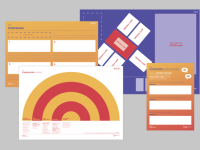
The REMODEL toolkit is targeted at companies producing products and is focused on developing economically sustainable business models through the principle of open source. While the toolkit is private-sector-oriented, some of the co-creation principles and methods can also apply to some areas of the public sector. The toolkit was published based on the experience of REMODEL with 8 Danish companies in 2018. The toolkit consists of 7 work packages and each part has a step-by-step instruction and a…
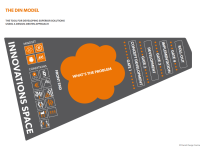
The DIN model is a methodology for developing solutions using a design-driven approach with the goals of achieving better and more innovative processes and outcomes, increasing probability of implementation, and improving user satisfaction. The model helps explore all the potential pitfalls, possibilities and limitations, particularly in the "front end" or early stage of projects. The DIN model consists of a series of phases and four ‘gates’. Each phase contains a variety of activities and…
Toolkit
 BASIC:
Allows reuse
Creating City Portraits: A methodological guide from The Thriving Cities Initiative
BASIC:Allows reuse
Creating City Portraits is a methodological guide for downscaling the Doughnut, and Doughnut Economics (based on the book and model of the same name), to the city and turning it into a tool for transformative action. This guide describes the methodology and introduces principles to consider at the city level as well as the interconnections between different scales, from household to global, to transform a city to a thriving and also ecologically and socially responsible one. The guide focuses on…
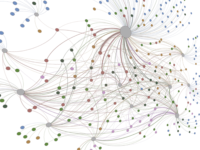
The handbook follows a co-design logic in terms of process, principles and practical tools to support practitioners in the design and implementation of system mapping processes by highlighting the knowledge management component. This resource provides rationale and guidance on the challenge-led system mapping approach, including facilitation guidance for running mapping workshops.
This resource helps mapping practitioners:
• visualise the diversity of innovation projects as a manageable set of…
The AIA is a questionnaire designed to help assess and mitigate the impacts associated with deploying an automated decision system. It helps identify the impact level of an automated decision system. It was developed with the Canadian Directive on Automated Decision-Making in mind but it can be applied elsewhere. The questions are focused on business processes, data, and system design decisions.
The questionnaire asks around 60 questions and the results will demonstrate impact level as well as a…