
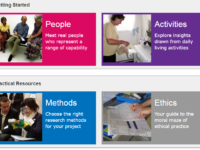
This web-based resource has been created by the Helen Hamlyn Centre for Design at the Royal College of Art to share ways to design inclusively for a range of physical and cognitive abilities. It includes personas representing different abilities, an overview of typical daily activities done by those personas, a selection of design methods, as well as a collection of ethics for designers. The research method selection describes each by input, output, suitability, and characteristics, including…
Toolkit Type: Tool/Toolset
This website and blog containing a toolkit based on the book GameStorming (not free) and intends to bring a playful or game-like atmosphere to group problem solving activities for the purpose of creating an mindset conducive to innovation and change-making. The site contains games for different purposes, including vision and strategy, planning, problem-solving, and decision-making.
The online resources describe each method and technique in terms of: Object of Play, Number of Players, Duration of…
The Policy Methods Toolbox is a repository of policy development methods that helps policy practitioners identify and select the right approach for their policy initiative.
It is organised into four themes:
Start Right: a light touch approach to making the best start in policy projects.
Behavioural insights: the study of human behaviour, often drawing upon the empirical research in fields including economics, psychology and sociology.
Design thinking: also known as human-centred design,…
The MaRS Library contains articles, templates, reports, workbooks, reference guides and videos covering a range of topics, including accounting, funding, governance, intellectual property, leadership, legal issues, marketing, product management, selling, social innovation, strategy and talent.
It is intended for an entrepreneurial context, but it can be adapted for a public sector organisational context.

This is a starter kit covering signal spotting, or detecting early signs of change in several fields: Technology, Policy, Business model, Citizen action, Research finding, Design, Application, Idea / innovation. The online resource includes video guidance, examples of signals in the different fields, and exercises for practice with signal spotting. It also includes exercises for signal spotting in one's own context.


Information and resources to guide United States federal employees working on challenges and prizes. It includes guidance on each challenge phase, from preparation to execution and also provides guidance on different types of challenges. It includes case studies and a list of resources for more detailed guidance and support.

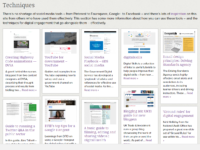
This web-based resource contains ideas and practical help to use digital and social media in the public sector. It is organised by techniwues, strategies, examples, and (user generated) questions. This resource can assist governments with service delivery and stakeholder engagement. The publisher's main website also contains other resources for online communication.
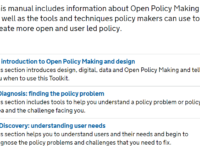
The publisher defines Open Policy Making as developing and delivering policy in a fast-paced and increasingly networked and digital world through collaborative approaches, new analytical techniques, and testing and iteratively improving policy.
The manual includes information about Open Policy Making in the United Kingdom government as well as tools, step-by-step guidance and techniques policy makers can use to create more open and user led policy.
This resource distills the United Nations Development Programme's experience and lessons with running Social Innovation Camps into a "how-to" manual for others. The publisher intends it to broaden a project's results, attract donors, find new partners, source new perspectives on an issue, and/or place beneficiaries at the centre of project design. The resource was created within an international development and social innovation context but can be adapted for public sector use.
It is available…
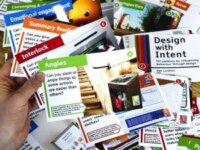
A collection of design patterns, or ‘gambits’, for influencing user behaviour through design. It’s applicable across product, service, interaction and architectural design, aimed particularly at socially and environmentally beneficial behaviour change. The patterns are drawn from a range of disciplines, and are phrased as questions or provocations to enable the toolkit’s use as both a brainstorming tool and a guide for exploring the field of design for behaviour change.
It includes…