
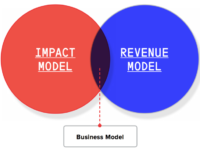
A Role-Playing and Ideation Game That Simulates The Process Of Launching A Social Enterprise. The game walks players through a series of activities in order to simulate the process of ideating and launching a social enterprise in four steps: Learn, Invent, Program, and Report. It is available via a pay-what-you-want digital download, and includes instructions for gameplay, a glossary of 200+ business models, and a suite of other resources.
User Type: Manager


DIY Learn is a set of online modules to help development practitioners understand and embed practical tools to support social innovation in their work. It contains a series of free, 2-hour courses as well as a trainers handbook. It was created for international development practitioners but is applicable for public sector staff as well.


Challenge Prizes: A practice guide provides practical guidance and support to help explore challenge prizes and offers guidance on designing and running a challenge prize.
The resource covers what challenge prizes are, guidance on deciding whether a challenge prize is right for your situation, and scoping and planning a prize--including a Challenge Prize Design Worksheet and Challenge Prize Schedule Worksheet.


Information and resources to guide United States federal employees working on challenges and prizes. It includes guidance on each challenge phase, from preparation to execution and also provides guidance on different types of challenges. It includes case studies and a list of resources for more detailed guidance and support.
This toolkit is for officials and staff at governments and institutions that are interested in launching a participatory budgeting process. Its purpose is to build understanding of what it takes to start a participatory budgeting process and how to lay a foundation for success.
It answers the questions:
How does a typical PB process work?
What are the impacts of PB?
What budgets can be used for PB?
What staffing and other resources are needed to implement PB?
How do I get started?

A guide intended for the Australian government for designing public services in user-centered and iterative ways. This resource is intended to help teams start small and learn fast, and to create services that can be delivered quickly and to save money by reducing service failure.
It is organised into 4 design and delivery stages, each with an associated guide: Discovery, Alpha, Beta, Live.
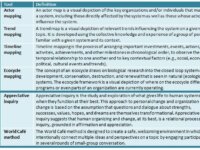
A blog series introducing and sharing guidance for using different tools to support systems thinking and practice, including actor mapping, trend mapping, timeline mapping, ecocycle mapping, appreciative inquiry, and world cafe. Each offers a downloadable guide in exchange for an email address.
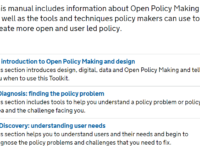
The publisher defines Open Policy Making as developing and delivering policy in a fast-paced and increasingly networked and digital world through collaborative approaches, new analytical techniques, and testing and iteratively improving policy.
The manual includes information about Open Policy Making in the United Kingdom government as well as tools, step-by-step guidance and techniques policy makers can use to create more open and user led policy.
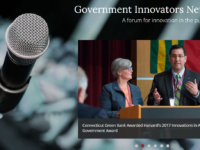
The Government Innovators Network is a collection of ideas and examples of government innovation for policymakers, policy advisors, and practitioners. It contains news, articles, reports, descriptions of award-winning innovative programs, and events as well as online communities of practice. The publisher's goal is to stimulate new ideas and bring people and ideas together around innovations in government for the purpose of stimulating discourse on the principles and practices of innovation and…

A collection of design patterns, or ‘gambits’, for influencing user behaviour through design. It’s applicable across product, service, interaction and architectural design, aimed particularly at socially and environmentally beneficial behaviour change. The patterns are drawn from a range of disciplines, and are phrased as questions or provocations to enable the toolkit’s use as both a brainstorming tool and a guide for exploring the field of design for behaviour change.
It includes…