User Type: Manager
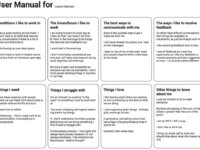
A canvas for individual sharing about work preferences, meant for building good teams and working relationships. The publisher intends for this to be used for making preferences explicit but not for making demands. PDF and Adobe Illustrator file available.
This playbook defines smart cities through human experiences, including 3 "mindsets" (lenses to understand) and 6 "plays" (ways to start). Originally developed for the City of Calgary, Canada, it offers ways to document, prioritize and advocate for individual human experiences at the nexus of networked technology, data and urbanism. It promotes embracing complexity and designing responsive systems, policies and governance around people for people-centered smart cities. Both PDF and slide deck…
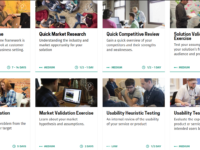
A community sourced set of best practices and principles to help incorporate human-centered design into a product development process.
The website contains dozens of methods organised by process, difficulty, time required, and outcomes. Each method contains an overview, detailed, steps, resources, and examples or cases.
The methods are framed in terms of private sector product or service development but can be adapted to a public sector context.
Principles and guidance for developing digital services in Argentina and beyond. The resource is available in a Github repository and includes 9 principles, indicators, and standards for API's, website, mobile applications, and others.
This resource gives the real story of how government innovation labs develop in the development context in Eurasia, Asia and Middle East: organic and people-driven, often operating under the radar until safe to emerge. It shares a truthful examination of the twists and turns of seeding, starting up and scaling labs, covering the challenges UNDP faced and their failures, as much as their successes. It includes in-depth histories and lessons regarding 4 UNDP innovation labs.
The resource is meant…
This resource is a series of tools to help clarify, plan, collect, and use data, information and evidence to evaluate an innovation as well as spread the learnings and results. It is intended to be used throughout a project to incorporate evaluative and intentional processes and feedback loops.
This online repository contains knowledge products, tools, inspiring practices, and projects to guide those interested in developing a research and innovation system that puts societal needs and desires at its center. The repository can be filtered by who it is useful for, topic, expertise required, related social challenge, category, and language.
The site also offers a self-reflection tool to assess your research and innovation practice on the basis of Ethics, Gender Equity, Governance, Open…
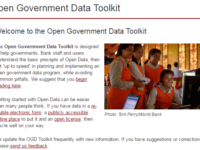
A collection of online guidance and knowledge to assist countries and others in setting up open data strategies and platforms.
The resource is comprised seven sections:
Open Data Essentials, Starting an Open Data Initiative,Technology Options, Demand & Engagement, Supply & Quality of Data, Readiness Assessment Tool, and Technical Assistance and Funding.
The Do-it-Yourself (DIY) Open Data Toolkit provides a step-by-step guidance on how to develop an open data initiative. The Toolkit is primarily intended for municipalities that have not yet begun an open data project and need some guidance on how to implement one. It can also be referenced by other governments or organizations who are considering initiating an open data initiative.
The toolkit includes: Open data orientation, Planning considerations, Publishing sample data sets, Adopting an open…
The Open Data Toolkit provides guidance intended for South Australia agencies and local councils release open data, although can be adapted to other contexts. It includes guidance on the following steps: Identify, Classify, Approach, Approve, Publish, Maintain.
It includes suggestions on governance decisions and roles as well as privacy, public value, and intellectual property guidance.