Skip to content
An official website of the OECD. Find out more
Created by the Public Governance Directorate

This website was created by the OECD Observatory of Public Sector Innovation (OPSI), part of the OECD Public Governance Directorate (GOV).

How to validate authenticity

Validation that this is an official OECD website can be found on the Innovative Government page of the corporate OECD website.

Toolkit

Inclusion Toolkit

Champion CHAMPION:
Can be remixed
The toolkit includes 5 methods for designing a more inclusive lab. The toolkit begins by guiding users through basic user observation, identification, and categorization processes (observation, interviews, and personas). It then moves into problem definition and stakeholder prioritization, and finally defines a concrete suggestion for increased diverse stakeholder governance. It includes templates and examples for each method.
This is a report from the Workshop ‘How might we approach transformational change for complex challenges in the future?’, held in London 30-31 August 2017. It provides 18 insights and considerations for playing the enabler, catalyst, and convenor roles in creating a mindset of long-termism.
Toolkit

Open Data Innovation Week tools

Champion CHAMPION:
Can be remixed
A collection of tools created during the Open Data Innovation Week, which was a gathering of innovators from across the Asia-Pacific region to build a box of tools and methods for improving the design, practice and implementation of open data initiatives to help solve the region’s key political, economic, and social problems. Tools range from ethnography to mapping and analysis. Each tool contains instructions: purpose, prerequisites, who to involve, difficulty, time-frame, and step-by-step…
Toolkit

A Field Guide to Ethnographic Experiential Futures

Champion CHAMPION:
Can be remixed
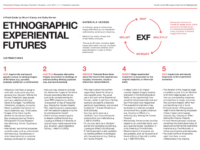
Ethnographic Experiential Futures, is a protocol for surfacing and documenting existing images of the future. It combines Ethnographic futures research, EFR, a protocol for surfacing and documenting existing images of the future. Experiential futures, XF, is a family of approaches for vivid multisensory, transmedia, and diegetic representations of images of the future. The hybrid approach puts together two modes of futures research and practice in a step-by-step guide. Its intent is to help…
Toolkit

Ideas to Impact

Basic BASIC:
Allows reuse
A curated set of resources on innovation by Tim Kastelle. This resource is primarily framed around private entrepreneurship, but some elements are transferable to a public sector context (i.e. cultivating a growth mindset). The resource is associated with a masterclass offered at the University of Queensland.
Toolkit

User Centred Design Toolkit

Champion CHAMPION:
Can be remixed
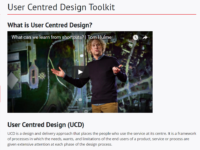
This resource contains a framework and guidance regarding the use of user-centred design. The publisher defines the UCD process in six phases - two planning and four delivery phases. The two planning phases focus on typical project planning aspects such as problem space, resources, agency readiness, team logistics, governance, etc. The four delivery phases are about action, talking to users to understand their real needs, prototyping potential solutions, and building the minimum viable product…
Toolkit

Adobe Kickbox

Champion CHAMPION:
Can be remixed
Kickbox is an innovation process that Adobe developed for its own use and then open-sourced so everyone can use it. It is both a process for individuals and a system for deploying that process across an organization at scale. It’s designed to increase innovator effectiveness, accelerate innovation velocity, and measurably improve innovation outcomes. It can also optimize innovation investments by reducing costs compared to traditional approaches. Adobe distributed 1000 physical boxes…
Toolkit

Design Method Toolkit

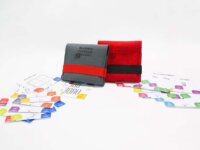
A collection of cards describing methods for planning and executing design research, ideation, experimentation and creation within short iterations (sprints). They split the methods into tasks that follow SCREAM; a methodology which is a modified version of SCRUM, tailored to fit within the publisher's design process. The card fronts contain basic information, such as activity type, category, and duration. The backs contain basic overviews of the methods and how-to instructions. These are…
Toolkit

Government Digital Service Design Principles

Hero HERO:
Editable source files available
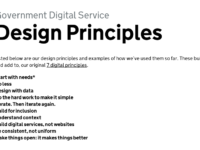
The United Kingdom government's design principles and examples of how they have been used. Each principle includes links to articles with additional explanation and reflections. 1. Start with user needs 2. Do less 3. Design with data 4. Do the hard work to make it simple 5. Iterate. Then iterate again 6. This is for everyone 7. Understand context 8. Build digital services, not websites 9. Be consistent, not uniform 10. Make things open: it makes things better
Toolkit

JAMK Service Design Toolkit

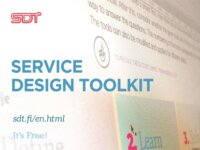
A guided introduction to 14 common service design tools, such as empathy maps, personas, and customer journeys. They are organised by the publisher's methodology: Define, Learn, Solve, Test. Toolkit. The publisher offers a suggested path through the tools but the publisher suggests that each can be used on their own. The toolkit is available via website in exchange for your email address.