User Type: Practitioner
This Field Guide is a systems take on typical design thinking methodology. It demonstrates how to design something with a greater emphasis on creativity and humour. The Guide goes through a systemic design project from concept to implementation. It takes you through the workshop planning process, and discusses workshop roles and client relations. In the FAQs, you’ll find explanations to some commonly asked questions about systemic design concepts to help you introduce others to SD and bring…

This Field Guide is designed to support new-to-foresight practitioners in incorporating future thinking and foresight into everyday projects. In addition to describing methods (including purpose, pros, cons and considerations for each), it also provides guidance on how to advocate for a foresight related project or approach in your organistion, cultivate a futures/foresight mindset, and build a team.
The ""zombies" referenced represent an unexpected and unlikely event for humanity. Stories about…
Toolkit
Innovation Tool Kit: A practical guide: Introduction to horizon scanning in the public sector
A part of the Australian Public Sector Innovation Toolkit, this provides guidance on what horizon scanning is and how to do it. It includes assessments, checklists, and specialised information about techniques.
The toolkit includes 5 methods for designing a more inclusive lab. The toolkit begins by guiding users through basic user observation, identification, and categorization processes (observation, interviews,
and personas). It then moves into problem definition and stakeholder prioritization, and finally defines a concrete suggestion for increased
diverse stakeholder governance. It includes templates and examples for each method.
This is a report from the Workshop ‘How might we approach transformational change for complex challenges in the future?’, held in London 30-31 August 2017. It provides 18 insights and considerations for playing the enabler, catalyst, and convenor roles in creating a mindset of long-termism.
A collection of tools created during the Open Data Innovation Week, which was a gathering of innovators from across the Asia-Pacific region to build a box of tools and methods for improving the design, practice and implementation of open data initiatives to help solve the region’s key political, economic, and social problems. Tools range from ethnography to mapping and analysis. Each tool contains instructions: purpose, prerequisites, who to involve, difficulty, time-frame, and step-by-step…
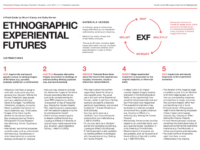
Ethnographic Experiential Futures, is a protocol for surfacing and documenting existing images of the future. It combines Ethnographic futures research, EFR, a protocol for surfacing and documenting existing images of the future. Experiential futures, XF, is a family of approaches for vivid multisensory, transmedia, and diegetic representations of images of the future. The hybrid approach puts together two modes of futures research and practice in a step-by-step guide. Its intent is to help…
A curated set of resources on innovation by Tim Kastelle. This resource is primarily framed around private entrepreneurship, but some elements are transferable to a public sector context (i.e. cultivating a growth mindset). The resource is associated with a masterclass offered at the University of Queensland.
This resource contains a framework and guidance regarding the use of user-centred design. The publisher defines the UCD process in six phases - two planning and four delivery phases. The two planning phases focus on typical project planning aspects such as problem space, resources, agency readiness, team logistics, governance, etc. The four delivery phases are about action, talking to users to understand their real needs, prototyping potential solutions, and building the minimum viable product…
Kickbox is an innovation process that Adobe developed for its own use and then open-sourced so everyone can use it. It is both a process for individuals and a system for deploying that process across an organization at scale. It’s designed to increase innovator effectiveness, accelerate innovation velocity, and measurably improve innovation outcomes. It can also optimize innovation investments by reducing costs compared to traditional approaches. Adobe distributed 1000 physical boxes…