
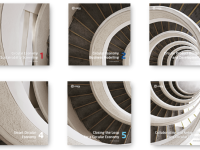
This is a collection of six workbooks containing tools and guides for transitioning towards a Circular Economy. The workbooks relate to the six focus areas:
1) Circular Economy Sustainability Screening
2) Circular Economy Business Modelling
3) Circular Product Design and Development
4) Smart Circular Economy
5) Closing the Loop for a Circular Economy and
6) Collaborating and Networking for a Circular Economy.
Each workbook contains an introduction to each Circular Economy topic followed by…
User Type: Researcher/academic

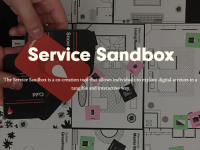
The Service Sandbox is a visual, playful, co-creation tool that allows individuals to explore digital services in a tangible and interactive way. The sandbox can be used to test an existing service or to create new ones. The resource is oriented toward designing interior environments, especially digitalising environments, but could be used more broadly. The tool consists of three phases (build, ideate and define), plus a pitch template for taking the process one step further. According to the…
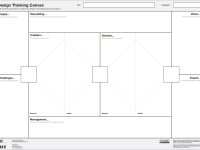
The Design Thinking Canvas is a template and a structured approach to plan a design-led strategy and process. It provides an overview of the different elements in a design process and is a systemic technique to collect inputs from a project. This is helpful for the internal communication within a project team as well as externally towards stakeholders. The tool contains 8 elements: People, Storytelling, Challenges, Vision, Impact, Management, Problem, and Solution. The latter two refers to the…
The Design Thinking Handbook is a comprehensive guide to the practice of design thinking and framework popularized by the Stanford d.school. The resource is organised into sections Why We Need Design Thinking, Empathize, Define, Ideate, Prototype, Test and it can be downloaded as an epub, PDF, or audiobook, or can be read in a web-based format. The text is supplemented with links to podcasts, videos, interactive exercises, and other related resources to build practice along with knowledge of…
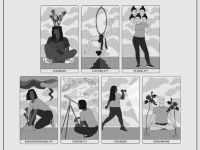
Uncertain Times is a set of tools for navigating uncertainty, harnessing curiosity, and maintaining mental wellbeing on a day-to-day basis. The kit is targeted towards individuals to guide personal reflection and consists of three parts: a set of cards, a workbook, and a weekly planner. The resource is inspired by Dancing at the Edge, by Graham Leicester and Maureen o’Hara and explores the behaviours and competencies required to deal with challenges that the 21st Century is throwing at…
This is a collection of tools developed through transforming leading innovation management theory into hands-on, easy-to-use, actionable innovation tools. The tools are organized in the categories: Culture, Business model, Validation, Pitching, Technology, Strategy, Problem discovery and Ideation. Each tool contains a description and a step-by-step guide telling how to approach it. The resource also includes guides, videos, posters, quizzes, etc., which provide knowledge within the field of…
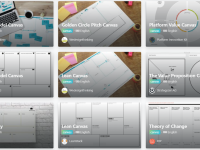
A library with over 150 different canvases and tools, all in relation to the Business Model Canvas and other visual design canvases. The canvases within the library focus on generating insights, strategic business development, value creation, value chains and user insight. The library contains quick tutorials and canvases in many languages and organises canvases by how they are licensed for reuse and remixing. The tools themselves are accessed by the canvas publisher's websites, which are linked…


Our Futures is a game for discovering new ways of engaging the public in thinking about alternative futures. The basic premise of Our Futures is that participants are randomly offered a series of constraints by drawing cards and rolling a dice, which serve as a primer for imagining a participatory futures activity. The game is played either with a group of individuals competing against each other or in teams in 30-75 minutes. The game has three different gameplay models of varying scope and…
This resource is for creating equitable change in schools and learning environments. It helps build the capacity of school communities and learning coordinators to set and pursue equity aspirations, so that every student is future-ready, no matter their background, circumstances, or learning preferences. The resource is based on a design thinking process and includes an overview, methods, and instructions that are specifically tailored to learning environments. The resource includes sections:…
The main goal of the SISCODE Toolbox is to provide support for the co-creation labs in making sense of existing data, tools and toolkits. Co-creation is a non-linear process that involves multiple actors and stakeholders in the ideation, implementation and assessment of product services, policies and systems. The resource aims to improve their efficiency and effectiveness, and the satisfaction of those who take part in the process. The SISCODE Toolbox aims to facilitate the design and…