User Type: Stakeholder outside of government
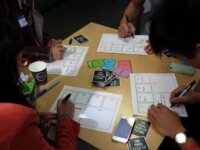
This resource is an imagination game that challenges players to collaboratively and competitively describe objects from a range of alternative futures. The object of the game is to come up with the most entertaining and thought-provoking descriptions of hypothetical objects from different near-, medium-, and long-term futures. The card deck can be downloaded and printed and contains cards, instructions, playsheets, and blank cards that you can customize with your own content. The website also…
The goal of this resource is to elicit conversation, encourage risk evaluation as a team, and catalyze proactive mitigation strategy planning around algorithm use in the public sector. It includes assessments and worksheets for assessing algorithm risk and managing algorithm risk. The publishers assume users have an understanding of their data and a basic understanding of algorithms.
This playbook shares lessons the publisher has learned while working with vulnerable populations as they access digital services, with the aim of improving access and awareness to those services.
This playbook is for nonprofits, community-based organizations, and governments who serve people who are eligible for government safety-net and criminal justice services, people with low incomes, and people in contact with the justice system.
It includes guidance in the form of principles and best…
This is a free, self-paced, 3-5 hour course designed to build your capacity for bringing a design approach to complex problems. The course is intended to: develop a design mindset, define a problem, and dig deep and clarify problems. The publisher also includes downloadable toolkits as part of the course.
The resource was developed for IFRC and National Societies to develop their literacy around data, but it could easily be applied to other organisations. It aims to promote responsible data use and develop data readiness. It has been tailored based on these audiences:
The Data Curious, who needs an ‘on ramp’ to learn and be exposed to the data basics.
The Data Advocate, who sees relevance and and wants to improve their skills and/or offer support.
The Data Active, who are motivated to…
This resource includes tools, approaches and resources for local authorities sharing non-personal data. The publishers intend it for those currently working in city governments as well as those supplying data sharing services to be able to find a common language and process in approaching the sharing of data. It focuses on both the technical and non-technical aspects of sharing data, including building data sharing partnerships, building a team, ecosystem mapping, and proposal and business case…
The Toolkit helps government employees use crowdsourcing and citizen science in their work. It provides five basic process steps for planning, designing and carrying out a crowdsourcing or citizen science project. It also includes a case study library of this process in practice as well as citizen science-related resources (examples, background information, journal articles, tools).
These methods were developed for United States Government staff but could also be used by other governments and…
The U.S. Public Participation Playbook is a resource for government managers to evaluate and build better services through public participation using best practices and performance metrics.
Based on discussions with US Federal Government managers and stakeholders, the publishers identified five main categories that should be addressed in all programs, whether digital or offline. Within each category they identified 12 unifying plays to start with, each including a checklist to consider,…
A playbook of 13 key “plays” drawn from successful practices from the private sector and government that the publisher believes, if followed together, will help governments build effective digital services.
A community sourced set of best practices and principles to help incorporate human-centered design into a product development process.
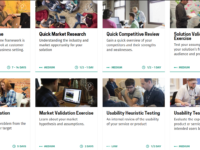
The website contains dozens of methods organised by process, difficulty, time required, and outcomes. Each method contains an overview, detailed, steps, resources, and examples or cases.
The methods are framed in terms of private sector product or service development but can be adapted to a public sector context.