
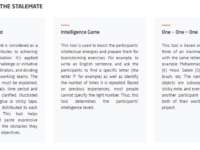
This resource includes a variety of tools and techniques, enabling government entities to develop initiatives and come up with innovative solutions to enhance the efficiency of the government sector, and improve the services provided by the government to individuals and entities.
Adaptability: None
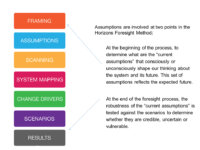
This guide is a facilitation toolkit for staff at Horizons and others interested in practising the Horizons Foresight Method in their own organizations. Its aims are to build foresight literacy in general, to explain the Horizons Foresight Method in particular, and to build capacity for horizon scanning in the Canadian federal government and other organizations. It provides a detailed description of concepts and processes, divided into 6 modules. Modules include facilitation guides, tip sheets,…
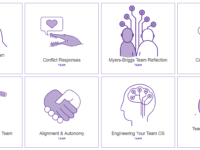
This is a collection of methods and activities, based on Hyper Island’s core methodology, for creative collaboration and realising potential in teams or organisations. It’s a collection of methods and activities, based on Hyper Island’s core methodology and is focused on Learning-by-doing (or Experiential Learning), Reflection (or Reflective Practice), and workshop or group facilitation. It includes Hyper Island tools as well as tools from others.
The publishers describe the PD concept as: based on the observation that in every community or organization, there are a few individuals or groups whose uncommon but successful behaviors and strategies have enabled them to find better solutions to problems than their neighbors who face the same challenges and barriers and have access to same resources.
This resource orients newcomers to the Positive Deviance (PD) approach and provide the essential tools to get started. It includes a brief…
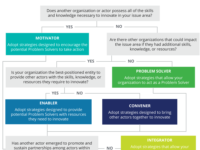
This resource covers five key roles in a public innovation ecosystem: Problem Solver, Enabler, Motivator, Convener, and Integrator. For public administrations wanting to make an impact on a societal challenge, it helps identify where to start, and how the administration fits in with other actors already focused on the same or similar challenges. By understanding which of these five roles to assume when launching an initiative, organisations may be able to more effectively deploy their resources,…
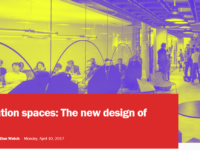
Authors Julie Wagner and Dan Watch draw from nearly 50 in-depth interviews with global-reaching and local-serving architects and innovation space managers to analyze the continuum of modern innovation-oriented workspaces. They find the role of well-designed innovation spaces in improving firm competitiveness, company culture, and the formulation of new products and ideas, offers important lessons for companies, universities and other drivers of the innovation economy on how to re-imagine space…
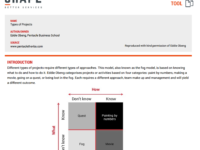
The stated aim of the resource is to enable public sector organisations to use design management thinking and methods currently used by leading companies in the private sector. There is a library tools that are available for free (one must subscribe to access the case studies.) Many of these are commonly-used design methods which have been tweaked and re-branded as Shape Better Services resources. The library content is free to view but using their online guidance requires a paid subscription.