From Recommendations to Real Change: How the Innovation Booster Helps Public Servants Transform Services
 Written by Kenjiro Taniguchi and Ana Luiza FLORES | 9 December 2025

A challenge every government faces
Every citizen has a story about a time when public services felt distant, bureaucratic, or designed for the system rather than for them. We’ve all been there — facing a form we can’t understand, an office we can’t access, or a process that seems to serve itself rather than its purpose.
Governments across the OECD know this too. That is why, one year ago, OECD countries came together to adopt the Recommendation on Human-Centred Public Administrative Services. Its ambition was bold yet simple: to put people—not bureaucracy — at the centre of public administration.
But adopting a recommendation is one thing; living it every day is another. Policies and frameworks can set the direction, but change happens through the thousands of frontline public servants who meet citizens daily. The question is: how can they act on such principles when most innovation tools are written in technical language, designed for experts, or disconnected from their realities?
This is the question that led to the creation of the Public Service Innovation Booster, which is launched on 2 December 2025. This blog takes you behind the scenes of how it was co-created with countries and how it is already being used in practice.
🔗 Explore the Booster here👉 Public Service Innovation Booster
Enter the Public Service Innovation Booster
“This tool was made to onboard every public servant who ever wondered whether innovation belongs to their context.”
— OECD Observatory of Public Sector Innovation
The Booster was born out of a shared challenge: to make human-centred innovation tangible and accessible for public servants. Developed by the OECD Observatory of Public Sector Innovation (OPSI), together with a task force of ten countries, the Booster is a hands-on toolkit designed for those who design and deliver services.
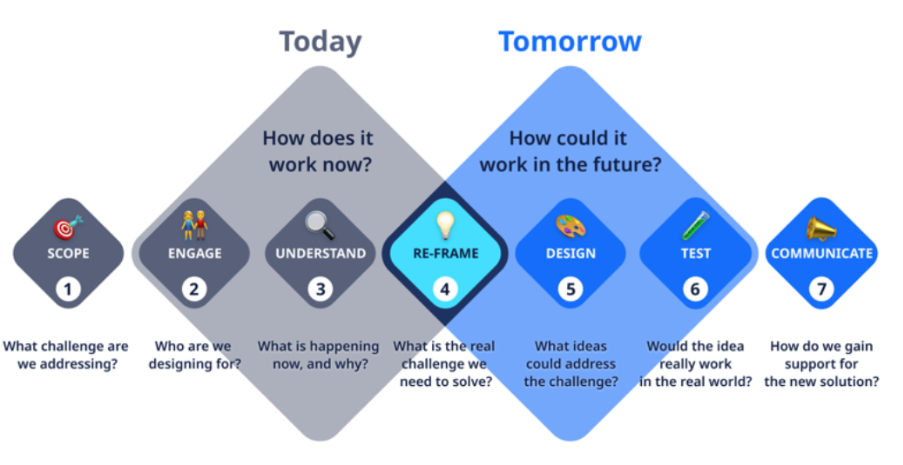
The Booster offers seven simple steps to guide teams through an innovation process:
- Scope – What challenge are we addressing?
- Engage – Who are we designing for?
- Understand – What is happening now, and why?
- Reframe – What is the real challenge we need to solve?
- Design – What ideas could address the challenge?
- Test – Would the idea really work in the real world?
- Communicate – How do we gain support for the new solution?
Each step is accompanied by practical tools, downloadable templates, recipe-style guides, and tips for facilitators and team leads. Unlike conventional manuals, the Booster is built for iteration: users can move back and forth between steps, revisit earlier insights, and adapt tools to their own context.
And crucially, it is not static. Through a collaborative online platform, users can share examples, upload photos, and contribute improvements — keeping the Booster alive and evolving with real-world practice.
Field experiences: innovation from the ground up
The Booster is the outcome of collective design. Led by Brazil, ten countries — Australia, Austria, Belgium, Brazil, Greece, Indonesia, Japan, Luxembourg, Romania, and Spain — came together in a co-creation process that included challenge iteration, mock-up workshops, peer reviews, and live testing sessions.
Piloting took place in Brazil, Greece, and Indonesia, engaging 93 frontline public servants from 46 public institutions, and peer- and independent-reviews took place in Luxembourg and Australia. Each country approached the Booster differently — testing not only the tools but also how they could fit into existing structures and cultures.
Brazil: From pilot to practice
Brazil tested the Booster digitally with public servants providing social protection services to riverside communities in the Amazon. What began as a pilot quickly evolved into a working session for real service redesign.
Through the exercises, participants reflected on how their existing procedures affected citizens’ access to services, prompting them to consider challenges from the users’ point of view. The session helped bridge the gap between administrative design and citizens’ everyday realities. As Pedro later remarked:
“The practicality of the tools is what makes people want to use them in their daily activities.”
— Pedro Marcante, Head of GNova Lab, Brazil
Greece: Embedding a culture of innovation
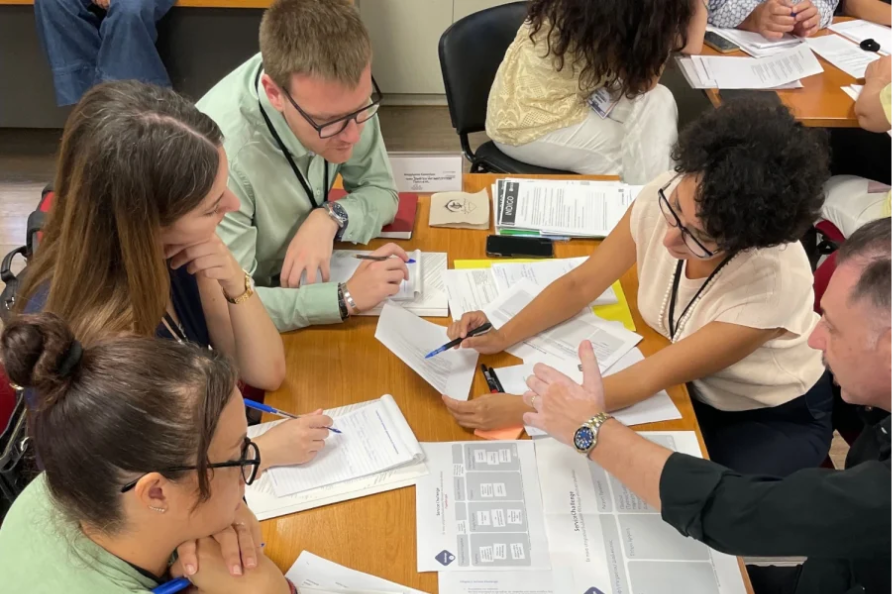
In Greece, the Department of Innovation and Best Practices of the General Secretariat of Public Administration of the Ministry of Interior, in collaboration with the Institute of Documentation, Research and Innovation (ITEK) ran two full-day, in-person workshops across ministries, regional governments, and local institutions. Participants worked through multiple canvases and were encouraged to bring real challenges from their organisations.
What began as an unfamiliar exercise soon became an empowering experience. By the end of the sessions, participants expressed ownership of their solutions and confidence in applying the methods to new challenges.
“We didn’t just test a toolkit — we saw people empowered with new skills. Participants felt more confident and began to embed a culture of innovation in Greece’s public sector.”
— Georgia Kokosi, Ministry of Interior, Greece
Source: Ministry of Interior, Greece
Indonesia: Building capability through application
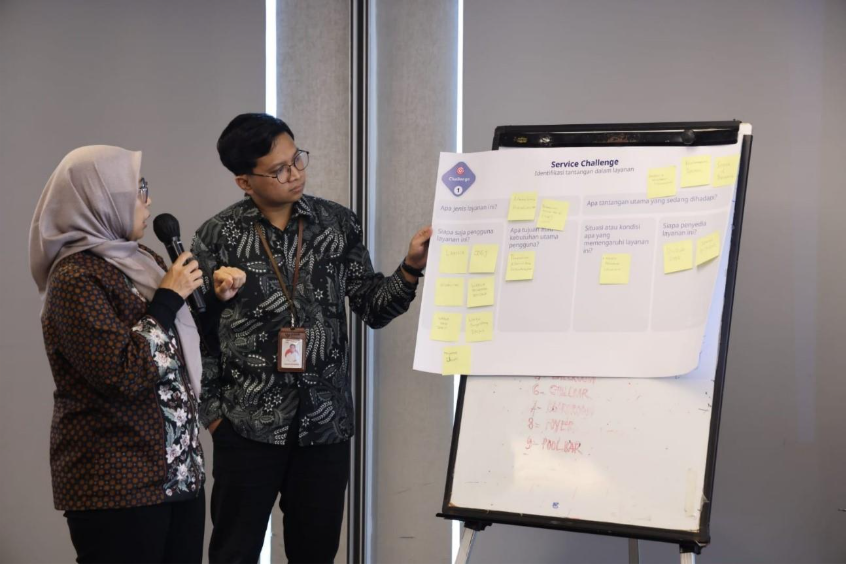
Ministry of Administrative and Bureaucratic Reform of Indonesia (PANRB) brought together national, regional, and city officials for an in-person testing session. The session focused on immigration and civil registration services — areas that directly engage citizens and often involve complex administrative processes. These services were chosen to reflect both national systems and local service delivery. Throughout the session, participants explored ways to improve alignment and coordination across government levels to make services more seamless and accessible. Using the Booster, they viewed these challenges through the eyes of citizens, asking how public services could feel simpler and more coherent in practice.
By reframing each step into a simple guiding question — “What challenge are you facing?” instead of just “Challenge” — the Indonesian team demonstrated how language itself can unlock engagement and understanding among public servants.
“The Booster helped us look at our services from a new perspective. Even small reframing can unlock engagement and better insights.”
— Insan Fahmi, Ministry of Administrative and Bureaucratic Reform, Indonesia
The results were impressive: 90% of participants said the Booster helped them identify challenges, 88% found it easy to apply, and 100% wanted to continue using it. It was not just a test — it was on-the-job capability development.
Source: Ministry of Administrative and Bureaucratic Reform, Indonesia
Luxembourg: Contextualisation as co-creation
While Luxembourg did not run a pilot per se, it took a crucial step: translating and integrating the Booster into its national service design framework. This effort demonstrated how adaptation is not mere translation — it is interpretation.
“We were missing a bit of structure — something tangible. The Booster gave us that. We adapted it, translated it, and used it to bring everyone onto the same page.”
— Steve Glangé, Luxembourg
For ministries and agencies responsible for redesigning and simplifying public services, this shared structure has made the process more actionable. By providing a clear sequence and common vocabulary, the Booster helped officials move from abstract discussions about innovation to concrete, citizen-oriented redesign work.
Australia: Independent review for global usability
Australian Public Service Commission provided an independent, highly detailed review that went beyond general impressions. Their team gave line-by-line feedback on wording and usability, offering practical suggestions that helped strengthen the clarity and autonomy of the platform for future users.
Lessons from collaboration
Across all these experiences, a common pattern emerged: collaboration was not only a method—it was the outcome.
- Iteration with users is essential. Innovation tools must be refined through use, not theory. The Booster evolved because public servants tested, critiqued, and improved it.
- Ownership builds confidence. Participants across countries moved from curiosity to mastery as they applied the tools themselves.
- Language and culture matter. Effective localisation requires more than translation—it demands contextual understanding.
- Peer learning multiplies value. The joint peer review between Indonesia and Luxembourg revealed how countries with different realities can complement each other’s learning.
- Facilitation bridges the gap. Templates alone are not enough; guided use turns knowledge into action.
These are not just lessons for this project—they are principles for how international collaboration on innovation should work.
A new dynamic: shared ownership and mutual learning
Perhaps the most profound impact of the Booster so far is cultural. It has introduced a new dynamic of shared ownership among countries. Rather than a top-down transfer of tools, the Booster has become a platform for mutual learning — a living ecosystem where every contributor shapes its evolution.
Countries are already taking the next steps: Brazil is embedding the Booster in its training programmes; Indonesia is translating it into Bahasa Indonesia and developing a national train-the-trainer model; Luxembourg is integrating it into its simplification framework; and Greece is expanding its use to other ministries.
Now that the Booster is publicly available, if your institution is interested in adapting it, translating it, or contributing your own examples, we invite you to join this collaboration.
For inquiries or collaboration opportunities regarding the Public Service Innovation Booster, contact: [email protected]
This blog is funded by the European Union. Its contents are the sole responsibility of the authors and do not necessarily reflect the views of the European Union.