
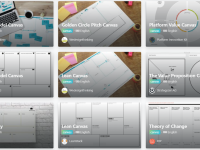
A library with over 150 different canvases and tools, all in relation to the Business Model Canvas and other visual design canvases. The canvases within the library focus on generating insights, strategic business development, value creation, value chains and user insight. The library contains quick tutorials and canvases in many languages and organises canvases by how they are licensed for reuse and remixing. The tools themselves are accessed by the canvas publisher's websites, which are linked…
Good For: Compare different possible approaches

The Design Sprint is a methodology for quickly solving problems through developing a hypothesis, prototyping an idea, and testing ideas with users. Design Sprints quickly align teams under a shared vision with clearly defined goals and deliverables. The Design Sprint methodology was developed at Google from a vision to grow user experience (UX) culture and the practice of design leadership across an organisation. The length of time for Design Sprints will be based on the goals and the needs of…
Toolkit
Servitization Mapping – A practical tool to explore strategic directions in a servitization…
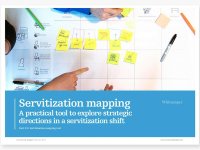
The Servitization Mapping canvas is a practical tool intended for business-to-business manufacturers to explore strategic directions in a servitization shift, that is shifting from a product focus to a service focus. While this resource is oriented toward the private sector, public sector organisations, being primarily service organisations, may find it helpful for refining their service portfolios and being more service user-focused. The canvas is a template to map an existing product and…

The main goal of the SISCODE Toolbox is to provide support for the co-creation labs in making sense of existing data, tools and toolkits. Co-creation is a non-linear process that involves multiple actors and stakeholders in the ideation, implementation and assessment of product services, policies and systems. The resource aims to improve their efficiency and effectiveness, and the satisfaction of those who take part in the process. The SISCODE Toolbox aims to facilitate the design and…

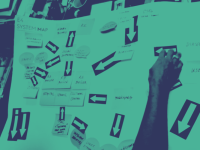
This toolkit allows organisations to change their mindset and move from a project-oriented approach towards a platform-way-of-working that is designed to tackle complex problems. The toolkit was developed and tested by the Danish Design Centre in collaboration with United Nations Development Programme (UNDP) and 40+ country offices. The toolkit consists of several mapping exercises. After using the integrated Mission Statement Generator to create an ambitious yet realistic mission statement,…
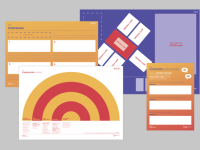
The REMODEL toolkit is targeted at companies producing products and is focused on developing economically sustainable business models through the principle of open source. While the toolkit is private-sector-oriented, some of the co-creation principles and methods can also apply to some areas of the public sector. The toolkit was published based on the experience of REMODEL with 8 Danish companies in 2018. The toolkit consists of 7 work packages and each part has a step-by-step instruction and a…
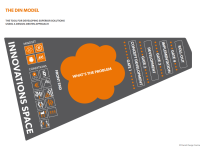
The DIN model is a methodology for developing solutions using a design-driven approach with the goals of achieving better and more innovative processes and outcomes, increasing probability of implementation, and improving user satisfaction. The model helps explore all the potential pitfalls, possibilities and limitations, particularly in the "front end" or early stage of projects. The DIN model consists of a series of phases and four ‘gates’. Each phase contains a variety of activities and…
Toolkit
 BASIC:
Allows reuse
Creating City Portraits: A methodological guide from The Thriving Cities Initiative
BASIC:Allows reuse
Creating City Portraits is a methodological guide for downscaling the Doughnut, and Doughnut Economics (based on the book and model of the same name), to the city and turning it into a tool for transformative action. This guide describes the methodology and introduces principles to consider at the city level as well as the interconnections between different scales, from household to global, to transform a city to a thriving and also ecologically and socially responsible one. The guide focuses on…
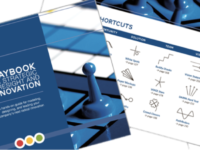
This resource contains a method library and playbook for commonly used strategic foresight tools, organised by a guiding framework of five planning phases (perspective, opportunity, solution, team, and vision). While it does contain the tools themselves, the resource also contains extensive guidance on each method, including overall guidance, examples, instructions, insights, tips, and tool templates. It also contains overall guiding principles, underlying theories, and considerations for using…
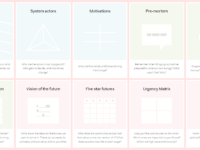
This resource is a modular set of tools (10 methods in 3 phases) that can be run in various ways, from a general tool to discover and ideate futures into a premeditated, repeated and ever-focusing exercise to build a vision on one or more lines of work. The resource can also be used to bring transparency and alignment to any organization through repeated exercises. It consists of three types of tools: Worldbuilding, Predictive Analysis and the Optimal Futures. The authors also suggest a process…