Good For: Deployment
The Do-it-Yourself (DIY) Open Data Toolkit provides a step-by-step guidance on how to develop an open data initiative. The Toolkit is primarily intended for municipalities that have not yet begun an open data project and need some guidance on how to implement one. It can also be referenced by other governments or organizations who are considering initiating an open data initiative.
The toolkit includes: Open data orientation, Planning considerations, Publishing sample data sets, Adopting an open…
The Open Data Toolkit provides guidance intended for South Australia agencies and local councils release open data, although can be adapted to other contexts. It includes guidance on the following steps: Identify, Classify, Approach, Approve, Publish, Maintain.
It includes suggestions on governance decisions and roles as well as privacy, public value, and intellectual property guidance.
This step-by-step toolkit describes an inclusive approach to recruiting participants for public consultation or engagement processes. The publishers designed the Civic Lottery process to mitigate the shortcomings and distortions produced by traditional recruitment methods. The approach introduces randomization at multiple stages of the participant recruitment and selection
process. This toolkit is best for those who have decided that a reference panel is right for their situation (see the…
The term data collaborative refers to a new form of collaboration, beyond the public-private partnership model, in which participants from different sectors — including private companies, research institutions, and government agencies — can exchange data to help solve public problems.
This resource outlines 8 Phases for designing and implementing a data collaborative (partnership) at an institutional level. The online resource includes examples, enablers, tools, and resources for…
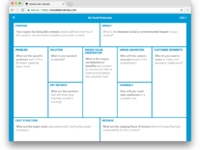
A mashup of the original Business Model Canvas with lean startup methodology built in, this canvas is intended for social entrepreneurs to validate their offering, prioritise what to develop, and message the offering. This could also be used by a government service provider.
The website includes a checklist to evaluate whether you will likely find value in using the canvas.
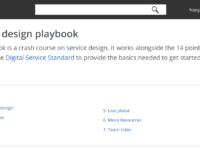
This playbook is an online crash course on service design. It works alongside the 14 points set out in the Digital Service Standard to provide the basics needed to get started on a digital service.
It covers: About service design, Discovery phase, Alpha phase, Beta phase, Live phase, and Team roles
This toolkit provides guidance for public servants on how to communicate with the public using the simplest and clearest language possible and to ensure that all services are accessible, and meets the diverse needs of all our customers. The guidance is based on Universal Design principles.
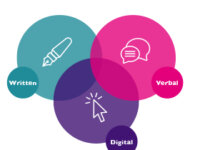
The toolkit contains advice on general writing style principles, verbal and non-verbal communications, design of forms and documents, web and social media content and how to display signage. It features a…
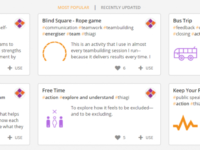
This online library contains over 400 facilitation resources, available with free login. Tools are organised by topic: Team, Energiser, Idea generation, Issue resolution, Explore and understand, Action. They include information such as time required, group size, difficulty, materials, step-by-step instructions, tips, and variations as well as user comments.
This private company also offers free and paid session planner software using the methods in the library.
The SIC learning repository is an online, open resource available for innovators, researchers and policy makers to improve their skills in design for Social Innovation.
The tools section is organised by main activities/actions, including:
RECRUITING SOCIAL INNOVATORS
STAKEHOLDER ENGAGEMENT
IDEATION
PRODUCT/SERVICE DEVELOPMENT
PROTOTYPING
SUSTAINABLE GROWTH AND IMPACT
FUNDING OPPORTUNITIES
For each tool, time commitment and team requirements are listed and each can be downloaded as a PDF.