Good For: Fact finding
The Shift Surrey guide provides an overview of Surrey's design approach to date, including a summary of projects and suggestions for building an internal community of practice inside government. At the end of the guide, there are several typical design tools, tips and tricks learned through Surrey's experience and suggestions for related design resources.
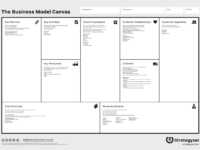
This canvas and associated guidance is is a strategic management and lean startup template that can be used the to describe, design, challenge, and pivot a business model to deliver different values or in different ways. It consists of 9 elements: value proposition, customer segments, customer relationships, channels, key partners, key resources, key activities, cost structure, and revenue streams.
It can be used individually or in a group. It works in conjunction with the Value Proposition…
This resource describes a comprehensive method for the BC Public Service (BCPS) to design services for British Columbians, although it is also applicable to other governments.
The Playbook is intended to help ensure public service designers have the necessary tools and corporate support to make change.
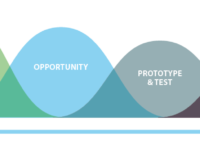
It includes an overview of service design, a discussion of when and how to use it, as well as detailed guidance and tools for the various methods used in service design. The methods are organised…
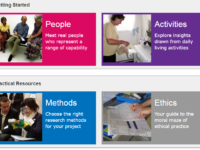
This web-based resource has been created by the Helen Hamlyn Centre for Design at the Royal College of Art to share ways to design inclusively for a range of physical and cognitive abilities. It includes personas representing different abilities, an overview of typical daily activities done by those personas, a selection of design methods, as well as a collection of ethics for designers. The research method selection describes each by input, output, suitability, and characteristics, including…
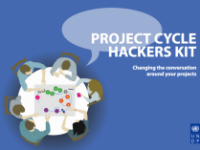
The Hackers’ Kit supports different types of discussions around project and program design. It's aim is to normalise innovation in a large organization by embedding new practices in key project management business processes. Worked on and tested with over 25 project teams in the United Nations Development Programme, the toolkit is intended for an international development context but could be applied to any large organisation with a desire to innovate.
It includes a wall map of the process,…
A guide intended for the Australian government for designing public services in user-centered and iterative ways. This resource is intended to help teams start small and learn fast, and to create services that can be delivered quickly and to save money by reducing service failure.
It is organised into 4 design and delivery stages, each with an associated guide: Discovery, Alpha, Beta, Live.
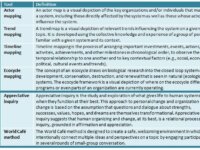
A blog series introducing and sharing guidance for using different tools to support systems thinking and practice, including actor mapping, trend mapping, timeline mapping, ecocycle mapping, appreciative inquiry, and world cafe. Each offers a downloadable guide in exchange for an email address.
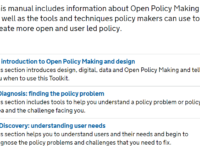
The publisher defines Open Policy Making as developing and delivering policy in a fast-paced and increasingly networked and digital world through collaborative approaches, new analytical techniques, and testing and iteratively improving policy.
The manual includes information about Open Policy Making in the United Kingdom government as well as tools, step-by-step guidance and techniques policy makers can use to create more open and user led policy.
The Government Innovators Network is a collection of ideas and examples of government innovation for policymakers, policy advisors, and practitioners. It contains news, articles, reports, descriptions of award-winning innovative programs, and events as well as online communities of practice. The publisher's goal is to stimulate new ideas and bring people and ideas together around innovations in government for the purpose of stimulating discourse on the principles and practices of innovation and…
A hands-on resource that provides practical advice, guidance, and an 8-phase process from concept development to implementation for building an open government program, with each step referencing principles, lessons learned, case studies, and a checklist for determining whether you are at the right phase. This resource complements Open Government Partnership Action Plans and and was developed as part of a year-long project with the Mexican government.