

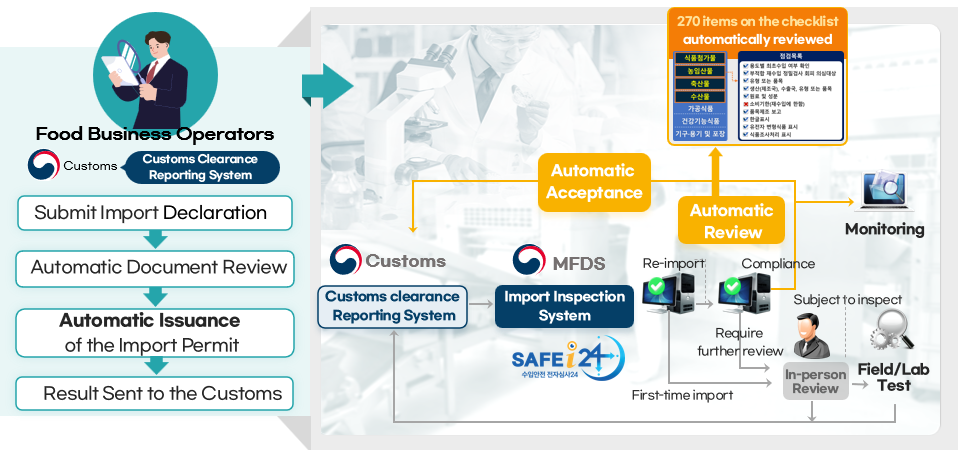
The Korean Ministry of Food and Drug Safety (MFDS) has developed SAFE-i24, an automated digital review system, to handle the growing number of imported food declarations. This allows inspectors to perform their duties more efficiently, and it has reduced unnecessary complaints. Additionally, importers can now process their declarations within five minutes, 24/7, saving both time and money during the customs clearance process.
Innovation Summary
Innovation Overview
To ensure the safety of imported foods, inspectors at the Ministry of Food and Drug Safety (MFDS) invest considerable time and effort in reviewing and processing declarations for a wide range of items and numerous declaration contents. Over the last five years (2020-2024), the number of food imports has increased by an annual average of 3%, leading to a continuously growing inspection workload. However, the number of inspectors has not kept pace, resulting in an overwhelmed workforce. All imported products undergo a 'document review,' which involves evaluating submitted declaration contents to determine compliance. While 65% of all import inspections are cleared solely through this document review, the non-compliance rate is a mere 0.002%.
Inspectors have felt burdened by the repetitive and standardized nature of this document review work. Furthermore, for importers, the document review process, which is only possible during business hours, takes an average of one day, leading to significant time and financial costs.
To solve these issues, MFDS decided to introduce SAFE-i24, an import inspection system that automatically processes document reviews using consistent rules. SAFE-i24 automatically reviews about 270 items in the submitted documents that can be mechanically judged for compliance. If the result is compliant, the system automates the issuance of the import declaration certificate without a separate approval process.
MFDS aims not only to provide fast and efficient digital support for inspectors' document review tasks but also to enable rapid customs clearance for safe foods imported by businesses. MFDS is the first government agency in Korea to implement a disposition carried out through a fully automated system. It has also acquired the international standard certification for AI Management Systems (ISO/IEC 42001) and continues to expand the scope of applicable items and improve functionality annually to enhance work efficiency.
Innovation Description
What Makes Your Project Innovative?
First, SAFE-i24 automates the entire clearance process without human intervention for low-risk, frequently imported foods. This has eased the workload for inspectors, allowing them to focus on examining foods with potential risks.
Second, document reviews, which were previously only possible during business hours, can now be done 24/7, all year round. The processing time has been significantly reduced from an average of one day to within five minutes. According to a satisfaction survey of importers, approximately 95% of them found the system to be a substantial benefit to their import operations, with the reduction in processing time being the most valuable aspect.
Third, because of this innovation, importers can now enjoy economic benefits, such as reduced warehouse storage fees, as the time required for customs clearance has been shortened. This has earned the system strong support from business operators.
What is the current status of your innovation?
Stages of Innovation:
SAFE-i24, which automatically inspects and approves declared imported foods, was developed in September 2023. To ensure its stable operation, the automatic approval process was expanded from food additives in 2023 to include all imported foods in May 2024. In 2024, SAFE-i24 automatically approved 14.0% of document reviews (80,158 out of 573,937 cases). Additionally, 19.6% of these automatic approvals were processed at night and on weekends, improving administrative efficiency.
Following the excellent results confirmed in 2024, the application of SAFE-i24 was expanded to oral care products, such as toothbrushes, with an annual import volume of 130,000 cases (based on 2024 data). A pilot program for these products began in June 2025. This is expected to allow more inspectors and importers to benefit from the e-review system.
Innovation Development
Collaborations & Partnerships
1. Ministry of Government Legislation (MOLEG): Establishes the legal grounds for introducing automated administrative dispositions that utilize advanced technologies like AI.
2. Korea Customs Service (KCS): Enhances the functions and connectivity between the KCS import declaration single-window system and the MFDS system.
3. National Food Safety Information Service (NFSI): Conducts monitoring to verify the appropriateness of automatic import clearance and manages the operation of the SAFE-i24.
Users, Stakeholders & Beneficiaries
For Imported Food Inspectors: In 2024, approximately 80,000 cases were automatically approved, which helped reduce their workload. This has allowed them to focus more on inspecting high-risk imported foods.
For Imported Food Business Operators: The processing time has been significantly shortened from an average of one day to within five minutes. This allows for a reduction in logistics costs during customs clearance. This is also expected to help maintain the quality of fresh foods.
Innovation Reflections
Results, Outcomes & Impacts
Through the implementation of SAFE-i24 in 2024, approximately 80,000 imported food declarations were automatically processed, which significantly enhanced the efficiency of document review and administrative procedures. It is projected that 120,000 cases will be automatically approved in 2025. As a result, the administrative burden on inspectors has been reduced, allowing them to concentrate more on field and lab tests. Furthermore, with import declarations now being processed 24/7 and within five minutes, importers are expected to save on economic costs, such as warehouse storage fees, by shortening the customs clearance period.
Challenges and Failures
The 'Korean Labeling' review item was the top cause of input errors for importers. In 2023, there were approximately 39,000 corrections to import declarations, with 'Korean Labeling' accounting for about 10.7% of those corrections (4,225 cases). This highlighted the need to introduce AI technology to help declarants with correct input during the import declaration process. To achieve this, a project to develop a feature that reads content from Korean labeled photos and automatically enters it into each declaration field is planned from this year until 2027 with financial support from the Ministry of Science and ICT.
Conditions for Success
To successfully build the system, it was most important to organize the data into a format that the system could read and to revise the relevant laws and regulations to allow for automated approval without human intervention. After the system was established, on-site feedback on satisfaction and necessary improvements were gathered and reflected in policy. Thanks to this foundation and communication with the field, the innovation was able to achieve its full synergy in the actual import customs environment.
Replication
This innovative technology can be applied and utilized by governments in various other countries. However, challenges related to the quantity and quality of data required for automated inspection, as well as the revision of laws for automated dispositions, must be addressed first. These challenges can be resolved by establishing the necessary IT infrastructure and revising the legal framework. We are also applying SAFE-i24 to non-food sectors (such as oral care products) by identifying administrative tasks that can be handled through automated dispositions. The Ministry of Government Legislation highly regards SAFE-i 24 as a case of innovation and has featured it in its legislative guidelines for automated dispositions.
Lessons Learned
SAFE-i24 is a concrete example of a successful innovation that not only ensures imported food safety but also uses digital technology to rationally improve regulations. Through this case, we learned a vital lesson: implementing regulatory improvements with digital technology can satisfy the industry's need for swift administrative processes while simultaneously securing socio-economic benefits.
Anything Else?
1. Since the enactment of the Framework Act on Administrative Affairs in March 2021, SAFE-i24 is the first case of an automated disposition by a Korean government agency to automate administrative action with legal grounds and digital technology.
2. In March 2025, the SAFE-i24 system became the first Korean government agency to acquire the AI Management System (ISO/IEC 42001) certification. This certification is a case in which the Ministry of Food and Drug Safety has been recognized for having international-level capabilities in the management of AI systems in the imported food sector.
3. SAFE-i24 was introduced to member countries at the APEC Food Safety Cooperation Forum (FSCF) as a case of digital innovation in imported food safety management.
Status:
- Implementation - making the innovation happen
- Evaluation - understanding whether the innovative initiative has delivered what was needed
- Diffusing Lessons - using what was learnt to inform other projects and understanding how the innovation can be applied in other ways
Innovation provided by:

Media:
Date Published:
4 March 2026