Level: Intermediate
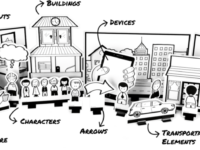
“Scenes” is a tool and a method to create visual stories about products and services fast, collaboratively and iteratively. It is intended for leaders and professionals of all industries to shape their ideas and scenarios in the form of fun illustrative storyboards without the need of refined drawing skills. It uses storytelling instead of long functional specifications for new or redesigned services or concepts.
It contains free, downloadable and printable templates for professionals to…
This kit explains how to evaluate a public policy approach/initiative, through the lens of several methodologies, including theory of change, agile (agilismo), deep dives ("Inmersiones profundas"), adaptive planning and adaptive management.
This is a collection of tools for an Open Government Partnership communications team, including the OGP's tips on blogging, branding, talking points, press guide, etc.
While this is specifically created for Open Government Partnership partners, it it can be adapted for other public sector initiatives, services, or programs.
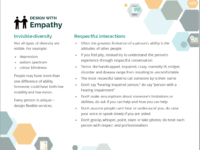
Inclusive design is designing for the full range of human diversity in ability, language, income, culture, gender, age and other characteristics. This toolkit includes a series of cards to use early in a design process to help sketch, plan, prototype and design content, interactions and processes. It covers inclusive physical, audio, visual, and thought experiences. PDF and editable Word document available via the publisher's Github page.
This resource aims to enrich the efforts of parliaments and their civil society counterparts to engage in collaborative processes, either as part of the Open Government Partnership National Action Plan or otherwise. The first section focuses on the development of open parliament commitments. The second section shares the experiences of a variety of parliaments and civil society organisations in collaborating in the creation of parliamentary openness commitments and in developing ongoing…
The resource is intended for those working in the international development or social impact space to assesses the future impact that innovation can deliver in a system. It focuses on three "systems": The Problem Space, The Innovation Space, The Context.
It's goals are to precipitate better understanding of the problem of focus and the context in which it exists, assess enablers and barriers
to innovation, track system change over time, and assess the impact of a program ex post facto. It…
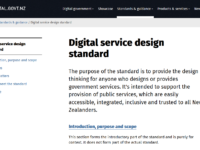
The purpose of the standard is to provide guidance for those in the New Zealand government or anyone who designs or provides government services regarding the provision of accessible, integrated, inclusive public services. It includes principles, rationale, information on how to meet the standard, related implementation guidance and resources, and a glossary.
The purpose of the standard is to provide guidance for those in the Australian government or anyone who designs or provides government digital services regarding the provision of simple, clear and fast services. It includes 13 criteria, rationale, information about meeting the standard, design principles, service design and delivery process, related training and guides, and a glossary.
The resource also includes downloadable posters.
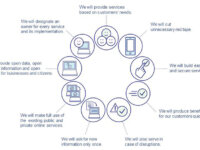
Established in 2016, these 9 principles provide guidelines for information sharing and interfaces, operating models, rapid service development and preparedness within the Finnish government and beyond.
The resource contains tools for visualizing and anticipating future risk of technology products, acknowledging that once technology is released and reaches scale it may be used for purposes beyond the original intention. The toolkit contains foresight methods, including 14 scenarios, for kicking off important conversations with product teams--including examples of current signals of future trends. It also contains a Risk Mitigation Manual with 8 risk
zones where hard-to anticipate
and unwelcome…