
The resource is intended for those working in the international development or social impact space to assesses the future impact that innovation can deliver in a system. It focuses on three "systems": The Problem Space, The Innovation Space, The Context.
It's goals are to precipitate better understanding of the problem of focus and the context in which it exists, assess enablers and barriers
to innovation, track system change over time, and assess the impact of a program ex post facto. It…
Level: Intermediate
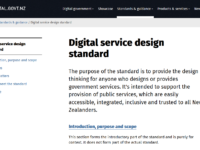
The purpose of the standard is to provide guidance for those in the New Zealand government or anyone who designs or provides government services regarding the provision of accessible, integrated, inclusive public services. It includes principles, rationale, information on how to meet the standard, related implementation guidance and resources, and a glossary.

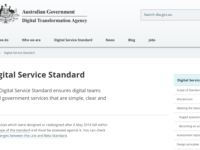
The purpose of the standard is to provide guidance for those in the Australian government or anyone who designs or provides government digital services regarding the provision of simple, clear and fast services. It includes 13 criteria, rationale, information about meeting the standard, design principles, service design and delivery process, related training and guides, and a glossary.
The resource also includes downloadable posters.

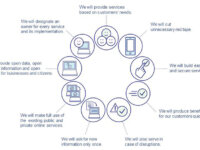
Established in 2016, these 9 principles provide guidelines for information sharing and interfaces, operating models, rapid service development and preparedness within the Finnish government and beyond.
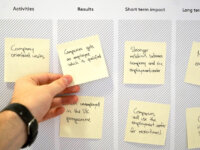
[Now defunct. Link goes to internet archive from 2018, when MindLab closed]. One of the pioneers of public sector design, Mindlab, developed a set of tools to find and define problems as well as new approaches to solving them. This toolset contains some of the most commonly used in the design practice (user journey, pattern recognition, etc).
This resource focuses on inclusive design, a methodology that enables and draws on the full range of human diversity, including those with limited abilities. The resource includes a guide on inclusive design, multiple short-films and a 20-minute documentary, as well as activity cards that follow 5 phases of a design process.
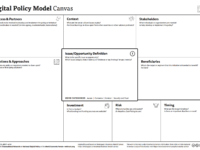
This canvas guides policy makers to derive specific policies and regulatory mechanisms in an agile and iterative manner – integrating both design thinking and evidence based policy making. An associated White Paper provides background on the approach.
14 methods and 3 recipes suggesting how to combine them, associated with a guide book available for sale by the toolkit publisher.
Accompanying each method: Purpose, Outcomes, How to do it, and Tips as well as a worked example, to help readers understand how the method and associated template can be used at the early stage of designing an innovative service.
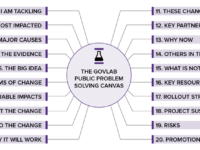
The GovLab's Public Problem Solving Canvas is an online interactive canvas based on twenty questions to create and develop your public interest project. These twenty questions are designed to help you refine your understanding of the problem and those whom it affects; express your Big Idea; and turn that idea into an actionable strategy in the real world to the end of improving people's lives.
The term data collaborative refers to a new form of collaboration, beyond the public-private partnership model, in which participants from different sectors — including private companies, research institutions, and government agencies — can exchange data to help solve public problems.
This resource outlines 8 Phases for designing and implementing a data collaborative (partnership) at an institutional level. The online resource includes examples, enablers, tools, and resources for…