
Skip to content
An official website of the OECD. Find out more
Created by the Public Governance Directorate

This website was created by the OECD Observatory of Public Sector Innovation (OPSI), part of the OECD Public Governance Directorate (GOV).

How to validate authenticity

Validation that this is an official OECD website can be found on the Innovative Government page of the corporate OECD website.

Toolkit

Virtual circular design course: Tool guide

Champion CHAMPION:
Can be remixed
This toolkit offers a starting point and a framework for uncovering circular potentials and barriers and to potentially identify new circular business models. The tools in this toolkit focus specifically on mapping a company's circular potentials in the value chain it operates within. And it gives priority to understanding, framing and re-fining the value businesses create in the value chain, exploring the interaction with both customers, collaborators and influential stakeholders. The toolkit…
Toolkit

Living Futures: Scenario Kit

Champion CHAMPION:
Can be remixed
Living Futures: Scenario Kit is a design tool for understanding, discussing, and shaping the future. It consists of four alternative versions of year 2050 explored through narrated stories from future citizens, themed analyses, and other media files, as well as a set of design tools that puts the scenarios to work. The kit can be used to future proof business models, develop new strategy, and understand and discuss important trends and developments in the present. The kit is flexible and can be…
Toolkit

Strategic Futurist Tools and Frameworks

Champion CHAMPION:
Can be remixed
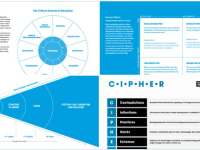
This resource contains 11 frameworks and methods used by the Future Today Institute, including: The FTI Forecasting Model How To Think About Time Identifying Key Stakeholders Assumptions vs Knowledge CIPHER Axes of Uncertainty Scenario Planning Guide and Templates Four Laws of Tech Trends 11 Macro Sources of Disruption Velocity of Change: Calculation Guide Futures States Each resource includes guidance and instructions on its use.
Toolkit

Living Guide to Social Innovation Labs

Basic BASIC:
Allows reuse
A living compilation of social innovation lab theory, templates, and tools to help address complex system problems and design a social innovation lab. This web-based resource includes sections Seeing, Doing, and Being, each with links to additional guidance, tools, and videos.
Toolkit

Paraffin Tools

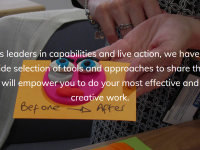
The Paraffin toolbox consists of a wide selection of tools and approaches that focus on capacity building and active facilitation methods alongside work on creative projects. It contains a selection of 16 presentation templates that can be used when a workshop planner or facilitator needs inspiration, guidance or concrete methods within building workshops. The resource also includes articles and best practice guidance on running workshops, including virtual workshops. Many of the downloadable…
Toolkit

The Design Thinking Canvas

Champion CHAMPION:
Can be remixed
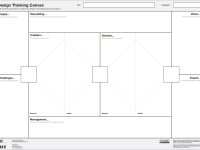
The Design Thinking Canvas is a template and a structured approach to plan a design-led strategy and process. It provides an overview of the different elements in a design process and is a systemic technique to collect inputs from a project. This is helpful for the internal communication within a project team as well as externally towards stakeholders. The tool contains 8 elements: People, Storytelling, Challenges, Vision, Impact, Management, Problem, and Solution. The latter two refers to the…
A library with over 150 different canvases and tools, all in relation to the Business Model Canvas and other visual design canvases. The canvases within the library focus on generating insights, strategic business development, value creation, value chains and user insight. The library contains quick tutorials and canvases in many languages and organises canvases by how they are licensed for reuse and remixing. The tools themselves are accessed by the canvas publisher's websites, which are linked…
Toolkit

Google Design Sprints

The Design Sprint is a methodology for quickly solving problems through developing a hypothesis, prototyping an idea, and testing ideas with users. Design Sprints quickly align teams under a shared vision with clearly defined goals and deliverables. The Design Sprint methodology was developed at Google from a vision to grow user experience (UX) culture and the practice of design leadership across an organisation. The length of time for Design Sprints will be based on the goals and the needs of…
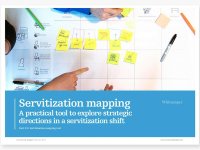
The Servitization Mapping canvas is a practical tool intended for business-to-business manufacturers to explore strategic directions in a servitization shift, that is shifting from a product focus to a service focus. While this resource is oriented toward the private sector, public sector organisations, being primarily service organisations, may find it helpful for refining their service portfolios and being more service user-focused. The canvas is a template to map an existing product and…
Toolkit

Platform-way-of-working toolkit

Hero HERO:
Editable source files available
This toolkit allows organisations to change their mindset and move from a project-oriented approach towards a platform-way-of-working that is designed to tackle complex problems. The toolkit was developed and tested by the Danish Design Centre in collaboration with United Nations Development Programme (UNDP) and 40+ country offices. The toolkit consists of several mapping exercises. After using the integrated Mission Statement Generator to create an ambitious yet realistic mission statement,…