
This resource is a guide to amplify global health impact from the perspective of a development organisation. It builds on the successes of USAID's work and lays out practical ways to identify opportunities to apply innovation to solve real problems using a portfolio approach. The resource has been co-developed with significant input from USAID colleagues across their health offices, and captures best practices and innovation opportunities, dispels myths and highlights examples of and resources…
Country Territory: United States
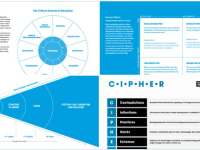
This resource contains 11 frameworks and methods used by the Future Today Institute, including:
The FTI Forecasting Model
How To Think About Time
Identifying Key Stakeholders
Assumptions vs Knowledge
CIPHER
Axes of Uncertainty
Scenario Planning Guide and Templates
Four Laws of Tech Trends
11 Macro Sources of Disruption
Velocity of Change: Calculation Guide
Futures States
Each resource includes guidance and instructions on its use.
Toolkit
 CHAMPION:
Can be remixed
New Metaphors: A Creative Toolkit for Generating Ideas and Reframing Problems
CHAMPION:Can be remixed
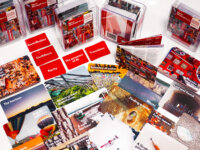
This resource is a generative tool for creating new metaphors to help understand the world in new ways, reframe problems, generate new ideas, and imagine different futures.
New Metaphors has been developed by the Imaginaries Lab, a design research studio based at Carnegie Mellon University, and working internationally. New Metaphors is a set of 150 cards and a number of simple, fun workshop formats which enable idea generation and new ways of thinking about issues creatively, from specific…
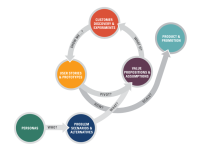
The Venture Design Process offers set of templates, tutorials, and templates for systematic execution of continuous design and delivery. It covers the phases: Personas, Problem Scenarios & Alternatives, Value Propositions, Assumptions & Experiments, Customer Discovery & Experiments, User Stories & Prototypes, Product & Promotion, as well as modules covering agile management and business model generation. The resource is targeted at private sector entrepreneurs and focuses on digital products and…
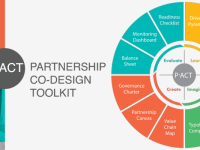
This toolkit is targeted towards impact entrepreneurs, intrapreneurs, partnership brokers and facilitators, and accelerators supporting impact entrepreneurs who are initiating value chain partnerships, partnerships where organizations seek to integrate existing or create new value chains. The Partnership Co-design Toolkit (P.ACT) includes four stages of co-design and 12 tools, each building on the previous, to bring partners closer, to developing a complete partnership model, and get ready to…
The current big shift in management - both public and private - is from linear models to circular models. This resource was designed to help innovators create more elegant, effective and creative solutions for circular economy. This resource allows users to explore new ways to create sustainable, resilient, long-lasting value in the circular economy. While it is oriented towards private sector manufacturing and products, it can also be helpful for public sector organisations to think about…
The Design Thinking Handbook is a comprehensive guide to the practice of design thinking and framework popularized by the Stanford d.school. The resource is organised into sections Why We Need Design Thinking, Empathize, Define, Ideate, Prototype, Test and it can be downloaded as an epub, PDF, or audiobook, or can be read in a web-based format. The text is supplemented with links to podcasts, videos, interactive exercises, and other related resources to build practice along with knowledge of…
This is a collection of tools developed through transforming leading innovation management theory into hands-on, easy-to-use, actionable innovation tools. The tools are organized in the categories: Culture, Business model, Validation, Pitching, Technology, Strategy, Problem discovery and Ideation. Each tool contains a description and a step-by-step guide telling how to approach it. The resource also includes guides, videos, posters, quizzes, etc., which provide knowledge within the field of…

The Design Sprint is a methodology for quickly solving problems through developing a hypothesis, prototyping an idea, and testing ideas with users. Design Sprints quickly align teams under a shared vision with clearly defined goals and deliverables. The Design Sprint methodology was developed at Google from a vision to grow user experience (UX) culture and the practice of design leadership across an organisation. The length of time for Design Sprints will be based on the goals and the needs of…
This resource is for creating equitable change in schools and learning environments. It helps build the capacity of school communities and learning coordinators to set and pursue equity aspirations, so that every student is future-ready, no matter their background, circumstances, or learning preferences. The resource is based on a design thinking process and includes an overview, methods, and instructions that are specifically tailored to learning environments. The resource includes sections:…