
This resource gives the real story of how government innovation labs develop in the development context in Eurasia, Asia and Middle East: organic and people-driven, often operating under the radar until safe to emerge. It shares a truthful examination of the twists and turns of seeding, starting up and scaling labs, covering the challenges UNDP faced and their failures, as much as their successes. It includes in-depth histories and lessons regarding 4 UNDP innovation labs.
The resource is meant…
Toolkit Features: Techniques
This resource is developed by and for open government influencers - civil servants and civil society representatives seeking to collaboratively make governance processes transparent, participatory and accountable. It is intended for those who want to be an open government influencer.
The original guidance includes recommendations and experiences from experienced leaders in Europe and Central Asia. It follows the publishers' joint journeys in navigating challenges to creating an enabling…

The Do-it-Yourself (DIY) Open Data Toolkit provides a step-by-step guidance on how to develop an open data initiative. The Toolkit is primarily intended for municipalities that have not yet begun an open data project and need some guidance on how to implement one. It can also be referenced by other governments or organizations who are considering initiating an open data initiative.
The toolkit includes: Open data orientation, Planning considerations, Publishing sample data sets, Adopting an open…
Toolkit
 CHAMPION:
Can be remixed
Legal Leaks Toolkit – A Guide for Journalists on How to Access Government Information
CHAMPION:Can be remixed

A toolkit targeting journalists and includes concrete guidance on how to use their rights to access information. It is based on a comparative analysis of the access to information laws in the region covered by the Organization for Security and Cooperation in Europe, which has 56 participating states in Europe, Central Asia and North America; of these 45 have legal provisions on the right of access to information held by public bodies which are reviewed in this analysis. It is available in 13…
The resource is intended for those working in the international development or social impact space to assesses the future impact that innovation can deliver in a system. It focuses on three "systems": The Problem Space, The Innovation Space, The Context.
It's goals are to precipitate better understanding of the problem of focus and the context in which it exists, assess enablers and barriers
to innovation, track system change over time, and assess the impact of a program ex post facto. It…
The Sustainable Livelihoods Approach (SLA) is a method of analysing and changing the lives of people experiencing poverty and disadvantage. It is a participatory approach based on the recognition that all people have abilities and assets that can be developed to help them improve their lives.
The SLA Toolkit For Wales provides practical tools to help people with participatory community development. The toolkit describes what the SLA approach is and how it can be used. The appendices then contain…
This resource focuses on inclusive design, a methodology that enables and draws on the full range of human diversity, including those with limited abilities. The resource includes a guide on inclusive design, multiple short-films and a 20-minute documentary, as well as activity cards that follow 5 phases of a design process.

There is a free and paid version of this toolkit and an associated workshop offered by the publishers. The free version of the kit provides tools to structure your thinking when designing a service that includes machine learning elements. The core idea is that you first describe a user journey in a physical or digital space, and then use the materials from the kit to brainstorm service concepts in that space.
The core materials include:
- A booklet summarising key concepts for designing IA…
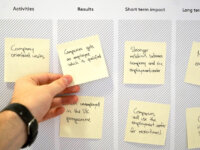
[Now defunct. Link goes to internet archive from 2018, when MindLab closed]. One of the pioneers of public sector design, Mindlab, developed a set of tools to find and define problems as well as new approaches to solving them. This toolset contains some of the most commonly used in the design practice (user journey, pattern recognition, etc).

Liberating Structures is a web resource that includes a collection of 33 results-oriented collaboration patterns have been developed and refined through field testing over a 10+ year period in a variety of sectors including healthcare and business.
They are intended to complement conventional practices for organisational design and strategy design. They are designed to be used in an inclusive collaborative setting.
Associated books (for sale) and video guidance is available to assist those…