Toolkit Features: Tips&Tricks
The toolkit provides an approach and methods those looking for a new way to tackle social and policy issues by making services more valuable to customers and users, easier to use, with fewer resources wasted on implementing the right ideas in the wrong way (or on the wrong ideas entirely).
This approach involves spending time understanding people’s experiences and resources on their own terms, taking methodical steps to analyse and address these with their active participation, and pushing for…
The Shift Surrey guide provides an overview of Surrey's design approach to date, including a summary of projects and suggestions for building an internal community of practice inside government. At the end of the guide, there are several typical design tools, tips and tricks learned through Surrey's experience and suggestions for related design resources.
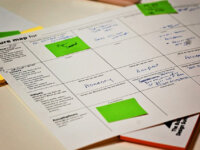
A tool that organizations can use to assess, map and transform their cultures. It is intended at a group activity to guide conversations around outcomes, behaviours, and enablers/blockers. The website also contains guidance for its use. It is intended for a private sector context but non-financial "outcomes" can also be considered when using it in the public sector.
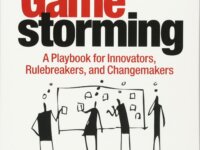
This website and blog containing a toolkit based on the book GameStorming (not free) and intends to bring a playful or game-like atmosphere to group problem solving activities for the purpose of creating an mindset conducive to innovation and change-making. The site contains games for different purposes, including vision and strategy, planning, problem-solving, and decision-making.
The online resources describe each method and technique in terms of: Object of Play, Number of Players, Duration of…
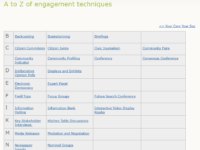
A collection of 55 different public/stakeholder engagement techniques, including an assessment of difficulty, engagement level, cost, when might be used, how many people might be needed to run, timeframes, innovation level and a step by step guide for using each.
A hands-on resource that provides practical advice, guidance, and an 8-phase process from concept development to implementation for building an open government program, with each step referencing principles, lessons learned, case studies, and a checklist for determining whether you are at the right phase. This resource complements Open Government Partnership Action Plans and and was developed as part of a year-long project with the Mexican government.
The publisher defines Open Policy Making as developing and delivering policy in a fast-paced and increasingly networked and digital world through collaborative approaches, new analytical techniques, and testing and iteratively improving policy.
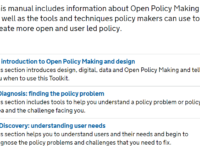
The manual includes information about Open Policy Making in the United Kingdom government as well as tools, step-by-step guidance and techniques policy makers can use to create more open and user led policy.
This resource distills the United Nations Development Programme's experience and lessons with running Social Innovation Camps into a "how-to" manual for others. The publisher intends it to broaden a project's results, attract donors, find new partners, source new perspectives on an issue, and/or place beneficiaries at the centre of project design. The resource was created within an international development and social innovation context but can be adapted for public sector use.
It is available…
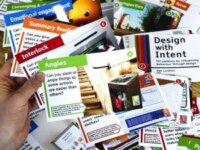
A collection of design patterns, or ‘gambits’, for influencing user behaviour through design. It’s applicable across product, service, interaction and architectural design, aimed particularly at socially and environmentally beneficial behaviour change. The patterns are drawn from a range of disciplines, and are phrased as questions or provocations to enable the toolkit’s use as both a brainstorming tool and a guide for exploring the field of design for behaviour change.
It includes…
A collection of cards describing methods for planning and executing design research, ideation, experimentation and creation within short iterations (sprints). They split the methods into tasks that follow SCREAM; a methodology which is a modified version of SCRUM, tailored to fit within the publisher's design process.
The card fronts contain basic information, such as activity type, category, and duration. The backs contain basic overviews of the methods and how-to instructions. These are…