Skip to content
An official website of the OECD. Find out more
Created by the Public Governance Directorate

This website was created by the OECD Observatory of Public Sector Innovation (OPSI), part of the OECD Public Governance Directorate (GOV).

How to validate authenticity

Validation that this is an official OECD website can be found on the Innovative Government page of the corporate OECD website.

Toolkit

A to Z of Engagement Techniques

A collection of 55 different public/stakeholder engagement techniques, including an assessment of difficulty, engagement level, cost, when might be used, how many people might be needed to run, timeframes, innovation level and a step by step guide for using each.
Toolkit

Government Innovators Network

The Government Innovators Network is a collection of ideas and examples of government innovation for policymakers, policy advisors, and practitioners. It contains news, articles, reports, descriptions of award-winning innovative programs, and events as well as online communities of practice. The publisher's goal is to stimulate new ideas and bring people and ideas together around innovations in government for the purpose of stimulating discourse on the principles and practices of innovation and…
Toolkit

Project Open Data

Hero HERO:
Editable source files available
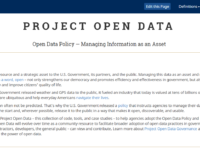
A collection of code, tools, and case studies to help United States federal agencies adopt the Open Data Policy and unlock the potential of government data. This project is meant to be a living document, so that collaboration in the open data ecosystem is fostered, and the continual update of technology pieces that affect update can happen at a more rapid pace. Edits to the content may be made by anyone. It could provide other governments with examples and starter content for its own open data…
Toolkit

User Centred Design Toolkit

Champion CHAMPION:
Can be remixed
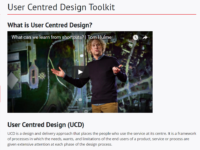
This resource contains a framework and guidance regarding the use of user-centred design. The publisher defines the UCD process in six phases - two planning and four delivery phases. The two planning phases focus on typical project planning aspects such as problem space, resources, agency readiness, team logistics, governance, etc. The four delivery phases are about action, talking to users to understand their real needs, prototyping potential solutions, and building the minimum viable product…
Toolkit

A Field Guide to Ethnographic Experiential Futures

Champion CHAMPION:
Can be remixed
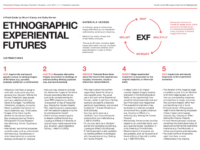
Ethnographic Experiential Futures, is a protocol for surfacing and documenting existing images of the future. It combines Ethnographic futures research, EFR, a protocol for surfacing and documenting existing images of the future. Experiential futures, XF, is a family of approaches for vivid multisensory, transmedia, and diegetic representations of images of the future. The hybrid approach puts together two modes of futures research and practice in a step-by-step guide. Its intent is to help…
Toolkit

Establishing, running and closing a public sector innovation lab

Champion CHAMPION:
Can be remixed
The DesignGov experiment was an 18 month initiative of the Australian Public Service to apply design-led innovation to cross-agency problems. This resource is based on the experience of DesignGov and is intended to be a resource for others that might be looking to establish and operate a public sector innovation lab. This resource is offered as a personal contemplation about what should be considered when establishing, running and, possibly, closing a public innovation lab.
Toolkit

Ideas to Impact

Basic BASIC:
Allows reuse
A curated set of resources on innovation by Tim Kastelle. This resource is primarily framed around private entrepreneurship, but some elements are transferable to a public sector context (i.e. cultivating a growth mindset). The resource is associated with a masterclass offered at the University of Queensland.
Toolkit

Adobe Kickbox

Champion CHAMPION:
Can be remixed
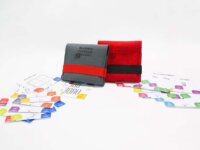
Kickbox is an innovation process that Adobe developed for its own use and then open-sourced so everyone can use it. It is both a process for individuals and a system for deploying that process across an organization at scale. It’s designed to increase innovator effectiveness, accelerate innovation velocity, and measurably improve innovation outcomes. It can also optimize innovation investments by reducing costs compared to traditional approaches. Adobe distributed 1000 physical boxes…
Toolkit

Design Method Toolkit

A collection of cards describing methods for planning and executing design research, ideation, experimentation and creation within short iterations (sprints). They split the methods into tasks that follow SCREAM; a methodology which is a modified version of SCRUM, tailored to fit within the publisher's design process. The card fronts contain basic information, such as activity type, category, and duration. The backs contain basic overviews of the methods and how-to instructions. These are…
Toolkit

Government Digital Service Design Principles

Hero HERO:
Editable source files available
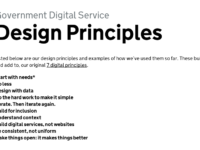
The United Kingdom government's design principles and examples of how they have been used. Each principle includes links to articles with additional explanation and reflections. 1. Start with user needs 2. Do less 3. Design with data 4. Do the hard work to make it simple 5. Iterate. Then iterate again 6. This is for everyone 7. Understand context 8. Build digital services, not websites 9. Be consistent, not uniform 10. Make things open: it makes things better