Toolkit Format: Web-based resource
Living Futures: Scenario Kit is a design tool for understanding, discussing, and shaping the future. It consists of four alternative versions of year 2050 explored through narrated stories from future citizens, themed analyses, and other media files, as well as a set of design tools that puts the scenarios to work. The kit can be used to future proof business models, develop new strategy, and understand and discuss important trends and developments in the present.
The kit is flexible and can be…
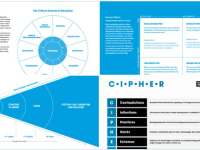
This resource contains 11 frameworks and methods used by the Future Today Institute, including:
The FTI Forecasting Model
How To Think About Time
Identifying Key Stakeholders
Assumptions vs Knowledge
CIPHER
Axes of Uncertainty
Scenario Planning Guide and Templates
Four Laws of Tech Trends
11 Macro Sources of Disruption
Velocity of Change: Calculation Guide
Futures States
Each resource includes guidance and instructions on its use.
This toolbox is a guide for shaping the future and developing organisational operations. It guides users through how to build an organisation’s future capability to ready it to deal with new phenomena. It guides users through all the steps of building a vision and for viewing, interpreting or shaping futures. It contains three phases: Trends and Signals, Interpretation and choices, and Shaping futures. Each tool includes step-by-step guidance and downloadable resources.
This resource is a generative tool for creating new metaphors to help understand the world in new ways, reframe problems, generate new ideas, and imagine different futures.
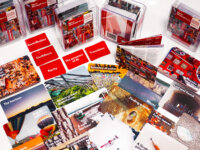
New Metaphors has been developed by the Imaginaries Lab, a design research studio based at Carnegie Mellon University, and working internationally. New Metaphors is a set of 150 cards and a number of simple, fun workshop formats which enable idea generation and new ways of thinking about issues creatively, from specific…
A living compilation of social innovation lab theory, templates, and tools to help address complex system problems and design a social innovation lab. This web-based resource includes sections Seeing, Doing, and Being, each with links to additional guidance, tools, and videos.
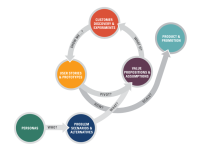
The Venture Design Process offers set of templates, tutorials, and templates for systematic execution of continuous design and delivery. It covers the phases: Personas, Problem Scenarios & Alternatives, Value Propositions, Assumptions & Experiments, Customer Discovery & Experiments, User Stories & Prototypes, Product & Promotion, as well as modules covering agile management and business model generation. The resource is targeted at private sector entrepreneurs and focuses on digital products and…
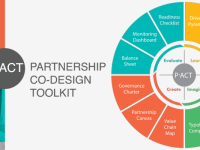
This toolkit is targeted towards impact entrepreneurs, intrapreneurs, partnership brokers and facilitators, and accelerators supporting impact entrepreneurs who are initiating value chain partnerships, partnerships where organizations seek to integrate existing or create new value chains. The Partnership Co-design Toolkit (P.ACT) includes four stages of co-design and 12 tools, each building on the previous, to bring partners closer, to developing a complete partnership model, and get ready to…
The Paraffin toolbox consists of a wide selection of tools and approaches that focus on capacity building and active facilitation methods alongside work on creative projects. It contains a selection of 16 presentation templates that can be used when a workshop planner or facilitator needs inspiration, guidance or concrete methods within building workshops. The resource also includes articles and best practice guidance on running workshops, including virtual workshops. Many of the downloadable…
The current big shift in management - both public and private - is from linear models to circular models. This resource was designed to help innovators create more elegant, effective and creative solutions for circular economy. This resource allows users to explore new ways to create sustainable, resilient, long-lasting value in the circular economy. While it is oriented towards private sector manufacturing and products, it can also be helpful for public sector organisations to think about…
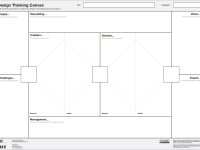
The Design Thinking Canvas is a template and a structured approach to plan a design-led strategy and process. It provides an overview of the different elements in a design process and is a systemic technique to collect inputs from a project. This is helpful for the internal communication within a project team as well as externally towards stakeholders. The tool contains 8 elements: People, Storytelling, Challenges, Vision, Impact, Management, Problem, and Solution. The latter two refers to the…