
The purpose of the standard is to provide guidance for those in the New Zealand government or anyone who designs or provides government services regarding the provision of accessible, integrated, inclusive public services. It includes principles, rationale, information on how to meet the standard, related implementation guidance and resources, and a glossary.
Toolkit Format: Web-based resource

The purpose of the standard is to provide guidance for those in the Australian government or anyone who designs or provides government digital services regarding the provision of simple, clear and fast services. It includes 13 criteria, rationale, information about meeting the standard, design principles, service design and delivery process, related training and guides, and a glossary.
The resource also includes downloadable posters.

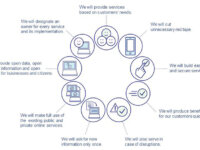
Established in 2016, these 9 principles provide guidelines for information sharing and interfaces, operating models, rapid service development and preparedness within the Finnish government and beyond.
This is a knowledge base containing existing societal and public sector needs, emerging trends, methods, tools, technologies and applications. They are filterable by asset type, need, and type of trend.
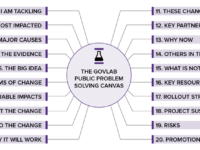
The GovLab's Public Problem Solving Canvas is an online interactive canvas based on twenty questions to create and develop your public interest project. These twenty questions are designed to help you refine your understanding of the problem and those whom it affects; express your Big Idea; and turn that idea into an actionable strategy in the real world to the end of improving people's lives.
The term data collaborative refers to a new form of collaboration, beyond the public-private partnership model, in which participants from different sectors — including private companies, research institutions, and government agencies — can exchange data to help solve public problems.
This resource outlines 8 Phases for designing and implementing a data collaborative (partnership) at an institutional level. The online resource includes examples, enablers, tools, and resources for…
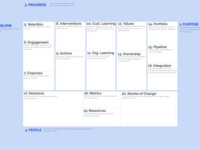
This is a LinkedIn article exploring what a canvas for an Experimentation System should include. It is a way to visualise an experimentation system in a one-page view. It's author says it bring hundreds if not thousands of actions and decisions into context and helps to translate nebulous terms like 'innovation culture' into practical actions. The article offers explanations of the 20 building blocks and offers the canvas via email request.
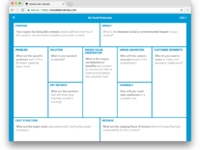
A mashup of the original Business Model Canvas with lean startup methodology built in, this canvas is intended for social entrepreneurs to validate their offering, prioritise what to develop, and message the offering. This could also be used by a government service provider.
The website includes a checklist to evaluate whether you will likely find value in using the canvas.

The Better Government Toolkit provides resources to build a better government through innovation. It focuses on four areas/verticals: Build a 21st Century Culture and Workforce, Improve Government Services Delivery, Solve Complex Problems, Collaborate with Innovators. It includes case studies within the United States Government. Each tool includes approach, actions and considerations, glossary of terms, related policies, and related resources.

This resource includes a method and guidance for developing and getting comfortable with storytelling to engage your audience and collaborators in your project. It includes an 8 step process to developing and creating a "sticky" story to inspire and persuade others into action. It includes a downloadable guide with examples and tips and tricks as well as a checklist for evaluating your story.