
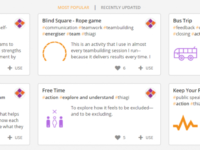
This online library contains over 400 facilitation resources, available with free login. Tools are organised by topic: Team, Energiser, Idea generation, Issue resolution, Explore and understand, Action. They include information such as time required, group size, difficulty, materials, step-by-step instructions, tips, and variations as well as user comments.
This private company also offers free and paid session planner software using the methods in the library.
Toolkit Format: Web-based resource
The SIC learning repository is an online, open resource available for innovators, researchers and policy makers to improve their skills in design for Social Innovation.
The tools section is organised by main activities/actions, including:
RECRUITING SOCIAL INNOVATORS
STAKEHOLDER ENGAGEMENT
IDEATION
PRODUCT/SERVICE DEVELOPMENT
PROTOTYPING
SUSTAINABLE GROWTH AND IMPACT
FUNDING OPPORTUNITIES
For each tool, time commitment and team requirements are listed and each can be downloaded as a PDF.

This playbook is an online crash course on service design. It works alongside the 14 points set out in the Digital Service Standard to provide the basics needed to get started on a digital service.
It covers: About service design, Discovery phase, Alpha phase, Beta phase, Live phase, and Team roles

DIY Learn is a set of online modules to help development practitioners understand and embed practical tools to support social innovation in their work. It contains a series of free, 2-hour courses as well as a trainers handbook. It was created for international development practitioners but is applicable for public sector staff as well.
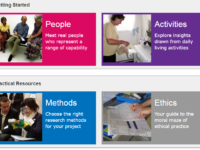
This web-based resource has been created by the Helen Hamlyn Centre for Design at the Royal College of Art to share ways to design inclusively for a range of physical and cognitive abilities. It includes personas representing different abilities, an overview of typical daily activities done by those personas, a selection of design methods, as well as a collection of ethics for designers. The research method selection describes each by input, output, suitability, and characteristics, including…
This website and blog containing a toolkit based on the book GameStorming (not free) and intends to bring a playful or game-like atmosphere to group problem solving activities for the purpose of creating an mindset conducive to innovation and change-making. The site contains games for different purposes, including vision and strategy, planning, problem-solving, and decision-making.
The online resources describe each method and technique in terms of: Object of Play, Number of Players, Duration of…
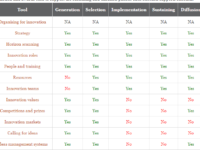
Toolkit developed by the Australian central government, this resource offers 28 pieces of guidance, methods, or techniques for different stages of an organisational innovation lifecycle.
The resource includes an Innovation Diagnostic to get a snapshot on which phase of the innovation cycle an agency might need to focus on.
Grounded Change is an approach and social innovation methodology used by the company InWithForward. It means flipping the order in which most social policies & services are made. Rather than start at the top, in boardrooms, they start at the bottom, with user needs. They have named 7 kinds of interactions that they believe are the most important to weave into policy, procurement, service delivery, and community activities. This resource contains the context, reasons, and mechanisms of Grounded…
The Policy Methods Toolbox is a repository of policy development methods that helps policy practitioners identify and select the right approach for their policy initiative.
It is organised into four themes:
Start Right: a light touch approach to making the best start in policy projects.
Behavioural insights: the study of human behaviour, often drawing upon the empirical research in fields including economics, psychology and sociology.
Design thinking: also known as human-centred design,…
The MaRS Library contains articles, templates, reports, workbooks, reference guides and videos covering a range of topics, including accounting, funding, governance, intellectual property, leadership, legal issues, marketing, product management, selling, social innovation, strategy and talent.
It is intended for an entrepreneurial context, but it can be adapted for a public sector organisational context.