
Toolkit Navigator
A compendium of toolkits for public sector innovation and transformation, curated by OPSI and our partners around the world

In this booklet you will find tools to implement the CO-CRE-AR methodology in its three phases: Understanding, Creating and Arming.
CO-CRE-AR moves in spaces of divergence and convergence. The first part invites you to UNDERSTAND in detail the challenge you want to face; the second to CREATE with openness and generate ideas without many restrictions, to then land them and make them concrete in work plans, including the necessary communication elements to "sell" the solution in the organization.
The National Centre for Public Sector Innovation in Denmark has developed this guide to help public sector workplaces share their own innovations and reuse others. It is relevant for anyone who wants to collaborate on spreading an innovation from one context to another. The guide consists of six steps with recommended actions to take and associated tools that help structure the dialogue throughout the process.
This is one of the first collections of user experience methods. It describes and analyses user experience design methods by costs expended, time required, resources required, expertise required, and quality of data.
Toolkit
Demand for Health Services: A Human-Centred Field Guide for Investigating and Responding to…
This field guide introduces human-centred design as an approach to addressing challenges related to community demand for services (specifically immunization services, but it could be applied to others). This Field Guide exists to help investigate, understand and respond to challenges of demand. It draws on insights from behavioural science and employs human-centred methods to improve immunization outcomes. Includes a 170 page field manual, process map, and workbook with tools. Its process…
These guides, created by the Government Laboratory, systematize the best experiences and learning generated by servers and public institutions in recent years.
These tools of support and permanent consultation, are designed so that the different organisms of the State can develop innovation processes with a view from the user, that allows to generate services and solutions more connected with their needs. There are two options: Contests and Projects.
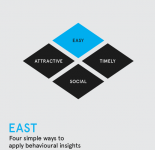
EAST is a framework and summary of the Behavioural Insights Team's knowledge of behavioural science, developed for busy policymakers. It is based around principles of making actions Easy, Attractive, Social and Timely (EAST) applied to a 4-step process: 1. Define the outcome, Understand the context, Build your intervention, and Test, learn, adapt.
It is a more simplified version of the publisher's prior MINDSPACE framework. The resource includes overall guidance and case studies.
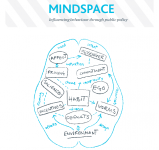
The MINDSPACE report is used by the Behavioural Insights Team as a framework to aid the application of behavioural science to the policymaking process. It is a predecessor of the more simplified EAST framework. It describes four actions that should underpin government‟s attempts to change behaviour: Enable, Encourage, Engage and Exemplify. It includes a users guide for understanding what affects human behavior and describes the MINDSPACE framework through several case studies.
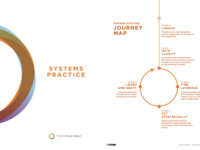
This resource walks you through a systems practice, and describes process phases (Launch, Gain Clarity, Find Leverage, Act Strategically, and Learn and Adapt) and methods for guiding the practice.
This resource has been developed in collaboration with teams across The Omidyar Group. This workbook aims to fill the gap between the promise of a systems approach for making social change and putting it into practice. It was created alongside curriculum as part of a paid course.
For each method,…
The toolkit addresses the many complexities of devising and advancing digital skills at policy level. It maps out how digital skills take their place within a wider framework of soft, twenty-first century skills. It offers guidance on bringing together – and leading – different stakeholders and moving forward under one clear and focused framework.
This playbook has been created for innovation practitioners who want to spread innovation skills, methods and tools or build an innovation capacity. It covers the design of effective learning experiences, identification and articulation of learning needs, pitching a learning offer at the right level, and connection of a team or innovation strategy with learning and development.
It contains overview of 35 methods that Nesta regularly uses in its practice. Each method description includes a short…