
Toolkit Navigator
A compendium of toolkits for public sector innovation and transformation, curated by OPSI and our partners around the world


This resource contains tools around specific design methods and techniques, including facilitation, ideation, and synthesis. Some contain step-by-step guidance and guidance on the method while others are standalone canvases/worksheets.
This short guide aims to take a practical approach toward workplace innovation. It includes practical knowledge, case studies, self-assessment, and suggested pathways to change, as well as further sources of information and support. It is based around four elements:
Empowering jobs and self-managed teams.
Flexible organisational structures, people-centred management practices and
streamlined systems and procedures based on trust.
Systematic opportunities for employee-driven improvement and…
Evidence and Resource Library on Public Sector Reform which documents country experiences, good practices and challenges, shares a wide range of information on modalities /methodologies on peer learning, publicises original, empirical research when and where knowledge gaps are identified, and documents and disseminates stories of change. Hundreds of entries are tagged by problem type, theme, and keyword.
The toolkit provides step-by-step guidance for development practitioners to leverage new sources of data. It is a result of a collaboration of UNDP and UN Global Pulse with support from UN Volunteers, led by UNDP innovation teams in Europe and Central Asia and Arab States.
The guide is structured into three sections - (I) Explore the Problem & System, (II) Assemble the Team and (III) Create the Workplan. Each of the sections comprises of a series of tools for completing the steps needed to…
Challenge Prizes: A practice guide provides practical guidance and support to help explore challenge prizes and offers guidance on designing and running a challenge prize.
The resource covers what challenge prizes are, guidance on deciding whether a challenge prize is right for your situation, and scoping and planning a prize--including a Challenge Prize Design Worksheet and Challenge Prize Schedule Worksheet.
This toolkit is for officials and staff at governments and institutions that are interested in launching a participatory budgeting process. Its purpose is to build understanding of what it takes to start a participatory budgeting process and how to lay a foundation for success.
It answers the questions:
How does a typical PB process work?
What are the impacts of PB?
What budgets can be used for PB?
What staffing and other resources are needed to implement PB?
How do I get started?
The mission of TEN is to ensure a scientifically and ethically responsible dissemination of applied behavioural insights throughout Europe and beyond. This is done through a range of Open Access (OA) online resources and member activities.
TEN hosts the Nudge Database, a community-sourced collection and validation system for cases of behavioural insights, including everything from interesting hypotheses to laws that have been applied on the basis of large randomised experiments.
The database is…
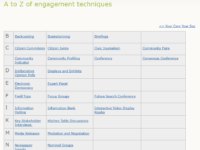
A collection of 55 different public/stakeholder engagement techniques, including an assessment of difficulty, engagement level, cost, when might be used, how many people might be needed to run, timeframes, innovation level and a step by step guide for using each.
An collection of communication tools used in service design processes that deal with complex systems, organised by design activities, representations, recipients, and contents. The website is the result of the research activity done by Roberta Tassi during her graduation thesis investigating the relation between communication design and service design, starting from the observation of the existing practices in the field of service design.
Each tool contains a description, how-to instructions,…
This is a starter kit covering signal spotting, or detecting early signs of change in several fields: Technology, Policy, Business model, Citizen action, Research finding, Design, Application, Idea / innovation. The online resource includes video guidance, examples of signals in the different fields, and exercises for practice with signal spotting. It also includes exercises for signal spotting in one's own context.