

DIY Learn is a set of online modules to help development practitioners understand and embed practical tools to support social innovation in their work. It contains a series of free, 2-hour courses as well as a trainers handbook. It was created for international development practitioners but is applicable for public sector staff as well.
User Type: Practitioner
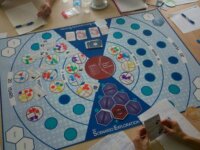
The Scenario Exploration System (SES) is a serious game for future simulation (2035 and 2050). It involves participants exploring their long-term objectives in contrasting scenario-related contexts while interacting with other stakeholders. By creating a realistic journey towards the future, the SES generates a safe space to simulate possible responses connected to any issue of interest to the participants.
There are two editions: "Sustainable Transitions" and "Food Safety and Nutrition…

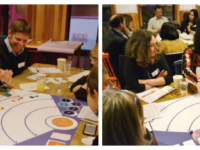
The Game of Life 2050 draws on scenarios for a sustainable European society in 2050. It is an interactive board game in which players consider four scenarios that describe the radical changes needed to be living within key environmental boundaries by 2050.
The game takes a minimum of 2 hours to run (ideally 4 hours) and involves 5-7 actors (each played by one person or in pairs) and one Games Master.
Play consists of three ‘rounds’ in which actors are given a set of circumstances that have…
The Hackers’ Kit supports different types of discussions around project and program design. It's aim is to normalise innovation in a large organization by embedding new practices in key project management business processes. Worked on and tested with over 25 project teams in the United Nations Development Programme, the toolkit is intended for an international development context but could be applied to any large organisation with a desire to innovate.
It includes a wall map of the process,…
The toolkit provides an approach and methods those looking for a new way to tackle social and policy issues by making services more valuable to customers and users, easier to use, with fewer resources wasted on implementing the right ideas in the wrong way (or on the wrong ideas entirely).
This approach involves spending time understanding people’s experiences and resources on their own terms, taking methodical steps to analyse and address these with their active participation, and pushing for…
The Shift Surrey guide provides an overview of Surrey's design approach to date, including a summary of projects and suggestions for building an internal community of practice inside government. At the end of the guide, there are several typical design tools, tips and tricks learned through Surrey's experience and suggestions for related design resources.
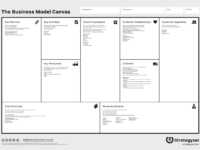
This canvas and associated guidance is is a strategic management and lean startup template that can be used the to describe, design, challenge, and pivot a business model to deliver different values or in different ways. It consists of 9 elements: value proposition, customer segments, customer relationships, channels, key partners, key resources, key activities, cost structure, and revenue streams.
It can be used individually or in a group. It works in conjunction with the Value Proposition…
This resource describes a comprehensive method for the BC Public Service (BCPS) to design services for British Columbians, although it is also applicable to other governments.
The Playbook is intended to help ensure public service designers have the necessary tools and corporate support to make change.
It includes an overview of service design, a discussion of when and how to use it, as well as detailed guidance and tools for the various methods used in service design. The methods are organised…
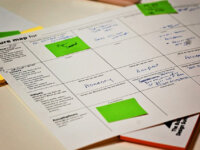
A tool that organizations can use to assess, map and transform their cultures. It is intended at a group activity to guide conversations around outcomes, behaviours, and enablers/blockers. The website also contains guidance for its use. It is intended for a private sector context but non-financial "outcomes" can also be considered when using it in the public sector.
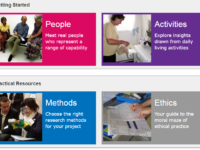
This web-based resource has been created by the Helen Hamlyn Centre for Design at the Royal College of Art to share ways to design inclusively for a range of physical and cognitive abilities. It includes personas representing different abilities, an overview of typical daily activities done by those personas, a selection of design methods, as well as a collection of ethics for designers. The research method selection describes each by input, output, suitability, and characteristics, including…