
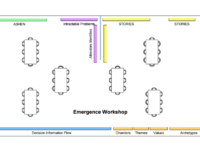
The author provides step-by-step guidance on how to conduct a short term strategic planning workshop based on knowledge management and contextualisation frameworks used by the private company Cognitive Edge. The publisher's suggests that it can be used to conduct pre-hypothesis research project to understand a complex problem. The outputs are comprehensive sets of cultural indicators, knowledge objects (comprising both codified and experiential knowledge artefacts), and large volumes of tangible…
User Type: Stakeholder outside of government

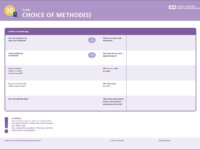
This resource is a series of tools to help clarify, plan, collect, and use data, information and evidence to evaluate an innovation as well as spread the learnings and results. It is intended to be used throughout a project to incorporate evaluative and intentional processes and feedback loops.
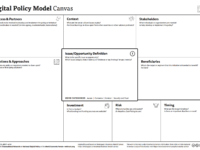
This canvas guides policy makers to derive specific policies and regulatory mechanisms in an agile and iterative manner – integrating both design thinking and evidence based policy making. An associated White Paper provides background on the approach.

14 methods and 3 recipes suggesting how to combine them, associated with a guide book available for sale by the toolkit publisher.
Accompanying each method: Purpose, Outcomes, How to do it, and Tips as well as a worked example, to help readers understand how the method and associated template can be used at the early stage of designing an innovative service.
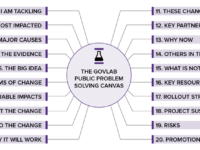
The GovLab's Public Problem Solving Canvas is an online interactive canvas based on twenty questions to create and develop your public interest project. These twenty questions are designed to help you refine your understanding of the problem and those whom it affects; express your Big Idea; and turn that idea into an actionable strategy in the real world to the end of improving people's lives.
The term data collaborative refers to a new form of collaboration, beyond the public-private partnership model, in which participants from different sectors — including private companies, research institutions, and government agencies — can exchange data to help solve public problems.
This resource outlines 8 Phases for designing and implementing a data collaborative (partnership) at an institutional level. The online resource includes examples, enablers, tools, and resources for…
The resource was designed to help organisations: develop a clearer understanding of the range of purposes of collaborations, reflect on the partnerships they have established, and focus on ways to strengthen new and existing partnerships by engaging in discussion about issues and ways forward. The resource contains guidance as well as an interactive partnership assessment tool.
Although it was created with the health sector in mind, it is relevant for other sectors as well.
For innovation…
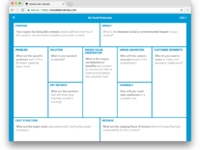
A mashup of the original Business Model Canvas with lean startup methodology built in, this canvas is intended for social entrepreneurs to validate their offering, prioritise what to develop, and message the offering. This could also be used by a government service provider.
The website includes a checklist to evaluate whether you will likely find value in using the canvas.

This resource includes a method and guidance for developing and getting comfortable with storytelling to engage your audience and collaborators in your project. It includes an 8 step process to developing and creating a "sticky" story to inspire and persuade others into action. It includes a downloadable guide with examples and tips and tricks as well as a checklist for evaluating your story.

Liberating Structures is a web resource that includes a collection of 33 results-oriented collaboration patterns have been developed and refined through field testing over a 10+ year period in a variety of sectors including healthcare and business.
They are intended to complement conventional practices for organisational design and strategy design. They are designed to be used in an inclusive collaborative setting.
Associated books (for sale) and video guidance is available to assist those…