

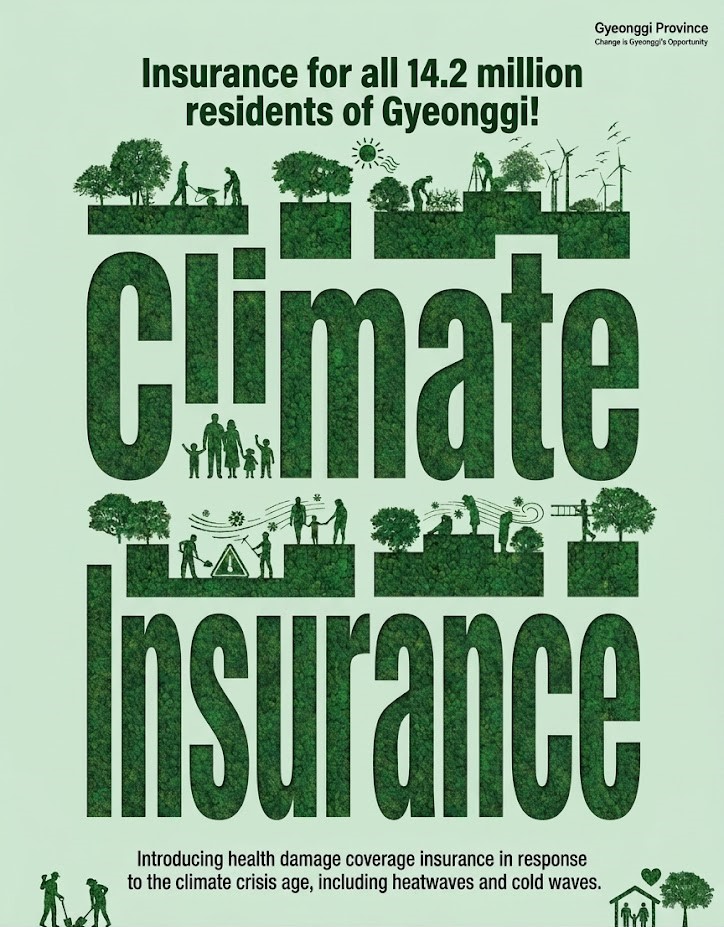
Gyeonggi Climate Insurance is a universal public climate insurance program that automatically covers all 14.2 million residents of Gyeonggi Province without requiring enrollment or premium payments. Fully funded by the provincial government, the program provides financial protection against health damage caused by climate-related risks such as heatwaves, cold waves, infectious diseases, and climate-related accidents.
Innovation Summary
Innovation Overview
Climate change is increasing the frequency and severity of extreme weather events worldwide. Heatwaves, cold waves, and climate-related disasters are creating new public health risks and economic burdens for governments and communities. Vulnerable populations, including elderly citizens and people with underlying health conditions, are particularly exposed to these risks.
Traditional disaster response policies generally focus on post-disaster relief. While these approaches provide important support after disasters occur, they often do not offer sufficient protection against the growing health risks associated with climate change.
To address this gap, the Gyeonggi Provincial Government launched Gyeonggi Climate Insurance in 2025, a universal public insurance program designed to protect residents from climate-related health risks. The program automatically covers 14.2 million residents, including registered foreign residents and overseas Koreans living in Gyeonggi Province. Residents do not need to apply for the insurance or pay premiums because the provincial government fully funds the program.
The insurance provides financial protection for several climate-related health risks, including heat-related illnesses, cold-related illnesses, infectious diseases, climate disaster accidents, and medical visits during severe weather alerts. Additional provisions provide enhanced protection for climate-vulnerable populations.
Since its introduction, the program has processed 51,550 insurance claims, providing approximately KRW 1.24 billion in compensation. The initiative demonstrates how regional governments can proactively strengthen climate resilience while expanding social safety nets.
Innovation Description
What Makes Your Project Innovative?
The innovation lies in applying a public insurance approach to climate risk protection at the regional government level. Unlike traditional disaster assistance programs that primarily provide relief after disasters occur, Gyeonggi Climate Insurance offers proactive protection against climate-related health risks.
The program also introduces automatic universal coverage, eliminating administrative barriers and ensuring that all residents receive protection regardless of income, awareness, or administrative capacity.
By combining climate adaptation policy with public health protection and social safety nets, the program demonstrates a new governance model for responding to climate risks.
What is the current status of your innovation?
The Gyeonggi Climate Insurance program has already been designed and introduced and is currently in operation, providing insurance coverage and payouts to residents. In addition, continuous improvements are being made, including streamlining the claims process, strengthening public outreach, and enhancing operational efficiency. Therefore, it is in the implementation stage.
Innovation Development
Collaborations & Partnerships
The program was developed through collaboration among multiple institutions including financial regulators, insurance institutions, healthcare providers, local governments, and community organizations.
- Financial institutions: Provided policy advice.
- Insurance companies: Responsible for claims payments and overall operations.
- Medical institutions: Support residents’ access to healthcare services.
- Local governments/public health centers: Responsible for policy guidance and regional outreach.
Users, Stakeholders & Beneficiaries
The main users and beneficiaries of the Gyeonggi Climate Insurance program are residents. In cases of climate-related health impacts, such as heat-related illnesses, rapid insurance payouts have helped reduce financial burdens. Local governments and public health centers have improved accessibility through policy guidance and outreach, while Gyeonggi Province has strengthened policy effectiveness through program management and continuous improvements.
Innovation Reflections
Results, Outcomes & Impacts
Since its implementation, Gyeonggi Climate Insurance has processed 51,599 insurance claims, providing approximately KRW 1.24 billion in compensation. The program has improved accessibility to climate risk protection by removing administrative barriers through automatic enrollment and government-funded premiums.
One important lesson from the program is that integrating climate adaptation policies with social protection systems can provide an effective public policy tool for protecting citizens from climate risks. The experience of Gyeonggi Province suggests that regional governments can play a critical role in developing innovative climate governance models.
Challenges and Failures
In the early stage of implementation, the Gyeonggi Climate Insurance program faced limitations such as low initial payout rates due to limited public awareness and difficulties in the claims process. To address these challenges, outreach has been strengthened through local governments, public health centers, and community organizations, and efforts have been made to simplify the claims process, including the introduction of an easy claims system using social media platforms.
Conditions for Success
The success of the Gyeonggi Climate Insurance program was supported by strong policy backing and a solid institutional foundation. Under the active leadership and commitment of Gyeonggi Province, stable financial support was secured, and an effective collaboration system was established among insurance companies, local governments, and public health centers. In addition, user-centered operations, such as automatic enrollment and simplified claims procedures, improved accessibility for residents. Continuous outreach and community engagement also contributed to raising awareness and ensuring the stable implementation and positive outcomes of the program.
Lessons Learned
The most important lesson learned from this experience is the significance of preparation and collaboration. While implementing a new policy such as climate insurance, I encountered unforeseen situations and the diverse demands of stakeholders. I confirmed that close communication within the team and collaboration among relevant institutions are essential to address these effectively. Furthermore, I realized once again that incorporating field feedback and data from the policy design stage is key to enhancing the policy’s effectiveness.
Project Pitch
Status:
- Implementation - making the innovation happen
Innovation provided by:

Media:
Files:
Date Published:
29 September 2026