

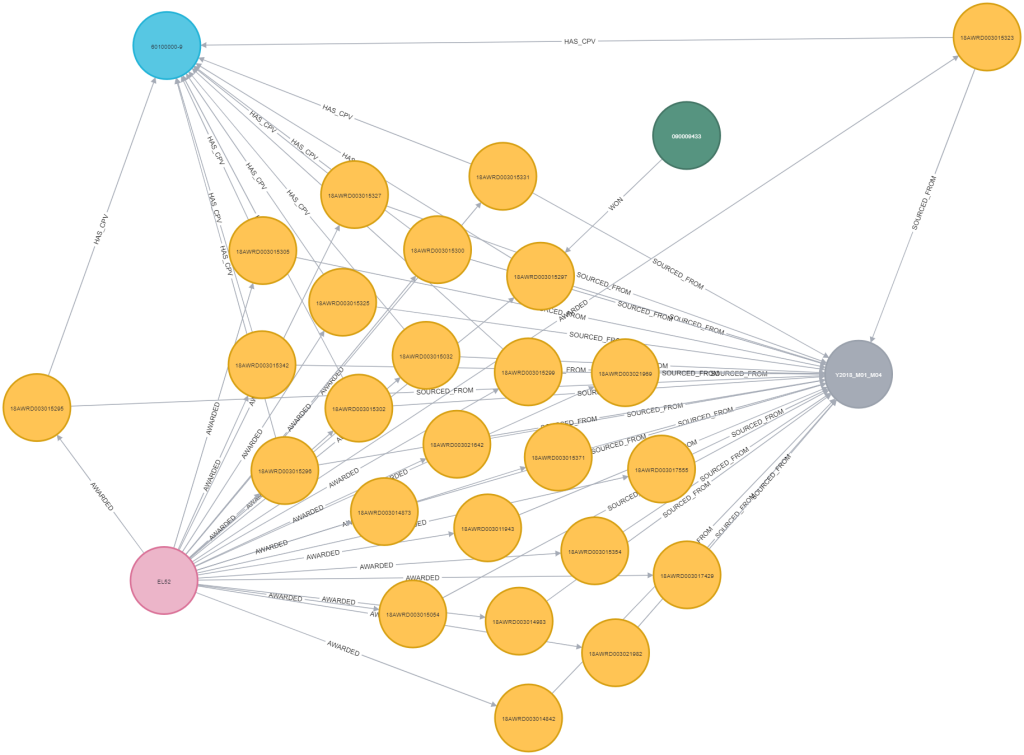
A sample graph visualisation from the pilot, showing contracting authorities and suppliers as nodes connected by contract award edges within a single procurement domain.
When a government agency repeatedly hires the same supplier, is that efficient or problematic? Until now, oversight bodies had no systematic way to tell the difference. Greece built an analytics framework that reads patterns in over 2 million public awards for over eight years to distinguish routine habit from market concentration and legitimate specialisation. The national procurement authority (HSPPA) is piloting it, turning existing compliance records into actionable oversight intelligence.
Innovation Summary
Innovation Overview
Public procurement oversight faces a recurring blind spot: repeated buyer–supplier relationships may reflect efficient continuity, but they can also signal dependence on particular suppliers and reduced opportunities for competition. Oversight bodies typically lack a consistent way to interpret these repeated relationships across different sectors and contracting authorities, especially when patterns vary widely within the same procurement domain.
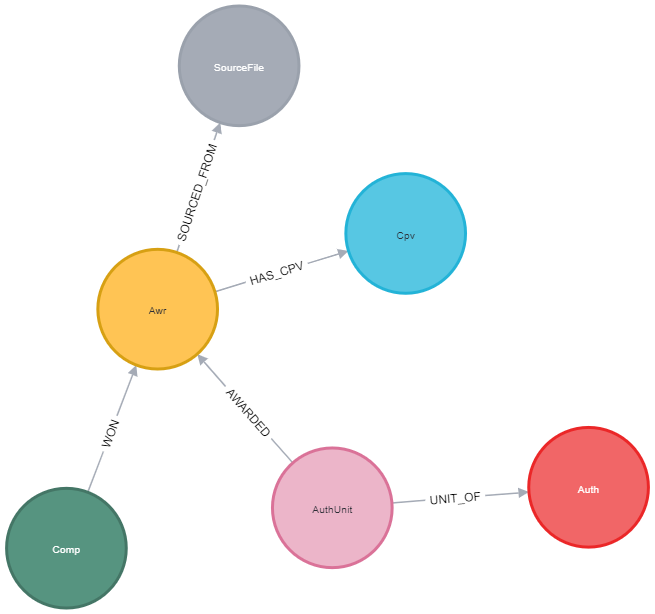
HSPPA, Greece’s national procurement authority, is piloting a diagnostic analytics framework that addresses this gap by combining network analysis and machine learning. Contract award data from the Central Electronic Registry of Public Contracts (KIMDIS), spanning over 2 million awards across eight years (2018–2025), is structured as a buyer–supplier network stored in a graph database (Neo4j). This maps which authorities award contracts to which suppliers, and how these relationships evolve over time.
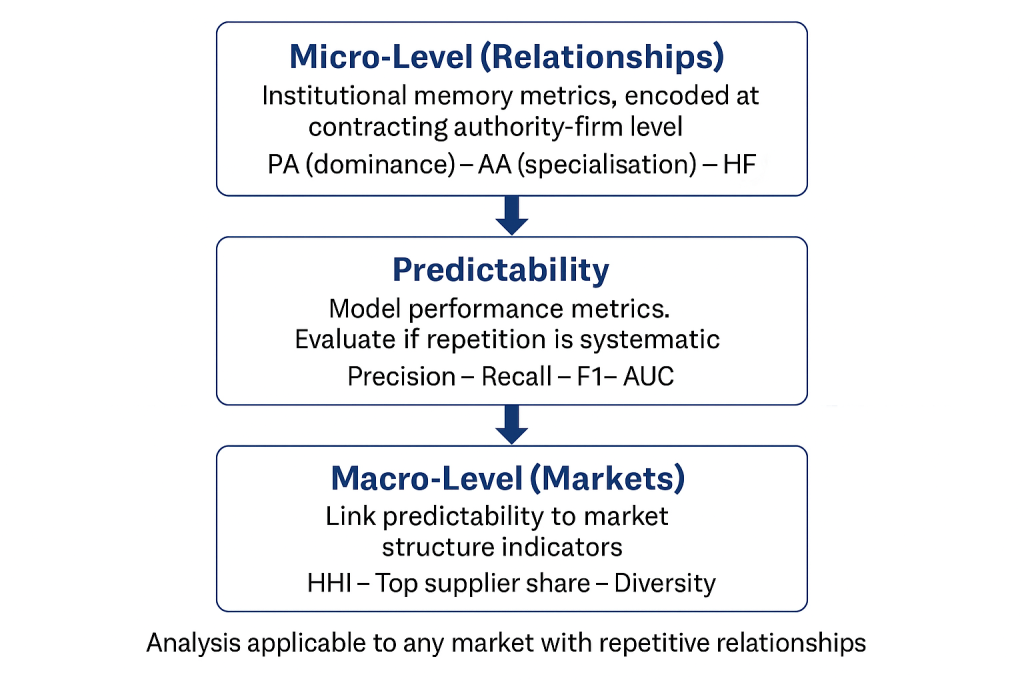
Three interpretable prediction algorithms (Historical Frequency, Preferential Attachment, and an adapted Adamic–Adar index) generate signals intended to capture different possible drivers of recurrence: institutional habit, or repeated use of familiar suppliers; structural concentration around dominant suppliers; and context-bound specialisation, or suppliers serving particular procurement needs. These signals feed into a machine learning classifier (XGBoost) that predicts recurring buyer–supplier relationships. Analysis of their relative importance in the model indicates which signals are most useful for predicting recurrence in each procurement domain, and how this changes over time. For instance, it can highlight domains where recurrence becomes more strongly associated with supplier concentration than with the history of previous awards, signalling a potential change in governance risk.
A key strength of the framework is its capacity to examine procurement patterns at different levels. At the micro level, it examines recurrence for specific authority–supplier pairs. At the macro level, it reveals variation across time and across procurement domains, but also within the same domain. Among authorities operating under identical rules, the number of suppliers used ranges from one to over 300, while the concentration of awards ranges from near-zero to complete reliance on a single supplier. This within-domain variation suggests that sector-level oversight needs to be complemented by authority-level diagnostics that benchmark each contracting body against its domain peers. Potential beneficiaries include HSPPA and audit bodies, through targeted reviews of unusual procurement patterns; contracting authorities, through actionable self-assessment; and suppliers, through efforts to strengthen competition and fairer access.
Looking ahead, the framework’s data architecture is designed for alignment with the eProcurement Ontology (ePO), the EU’s standard model for defining procurement concepts and their relationships. docs.ted.europa.eu This would provide common definitions and structures for the data, supporting standardised cross-border comparisons and making it easier to integrate procurement data from other EU member states. Such alignment could help establish the framework as a replicable, scalable governance tool beyond Greece.
Innovation Description
What Makes Your Project Innovative?
Most oversight approaches either rely on simple red flags (e.g. “many repeat awards”) or on black box models that produce scores without explaining why patterns occur. Our project is innovative because it treats recurrence in buyer–supplier relationships as a diagnostic signal and explains its drivers, rather than just predicting repeats. It separates repetition driven by institutional routines, by supplier dominance in the market, or by genuine specialisation, and it shows how these drivers change over time.
It is also innovative in how it supports proportionate oversight. Instead of applying one uniform threshold to an entire sector, the framework moves from micro patterns (specific authority–supplier relationships) to authority level benchmarking within the same domain, revealing strong within domain heterogeneity. This enables targeted, explainable interventions (e.g., contestability reviews or specification improvements) and is designed to scale through semantic interoperability.
What is the current status of your innovation?
The framework is in pilot implementation and evaluation within Greece’s national procurement authority (HSPPA/EADHSY). It has been applied to KIMDIS award data (2018–2025; 2M+ awards), producing domain- and authority-level diagnostics that are being reviewed for operational use (e.g., targeting contestability checks). Next steps: expand coverage, integrate procedural metadata, and prepare ePO-aligned data structures.
Innovation Development
Collaborations & Partnerships
The methodology was developed through doctoral research at the Department of Economics, Aristotle University of Thessaloniki (AUTH), using available data accessed directly via the KIMDIS. HSPPA, Greece's national procurement oversight authority and the body responsible for monitoring the public contracts market, showed immediate interest in the framework and accepted to piloting it, with the goal of evaluating the results and exploring how they can be integrated into its oversight operations.
Users, Stakeholders & Beneficiaries
HSPPA and audit bodies: gain a diagnostic tool for targeted, evidence-based oversight instead of uniform auditing. Contracting authorities: receive domain-calibrated benchmarks showing how their procurement patterns compare to peers (self-assessment). Suppliers and SMEs: benefit from stronger contestability when concentration or specification barriers are identified. Citizens and taxpayers: benefit indirectly through improved transparency, competition, and more accountable use of public funds.
Innovation Reflections
Results, Outcomes & Impacts
Intended impact: help oversight teams focus on the right cases by explaining why repeat awards happen, so reviews are targeted and proportionate rather than one-size-fits-all. Observed results so far: using KIMDIS awards (2018–2025) across 12 domains, the framework discriminates recurring from non recurring ties with AUC 0.80–0.96, and the contribution of different drivers shifts over time. Authority level outputs reveal extreme within domain heterogeneity (vendor diversity 1–300+, HHI 0.008–1.0), showing why uniform thresholds can be miscalibrated. How measured: temporal bipartite network modelling + HF/PA/adapted AA signals, evaluated with XGBoost, results are robust across three negative-sampling specifications.
Challenges and Failures
Challenges included errors and inconsistent metadata in KIMDIS. Awards below €2,500 are not published, so a small slice of procurement activity is missing. Modifications may appear as new contracts and be double-counted, and multiple CPV codes are often listed without a clear split of value per CPV. We responded by aiming for diagnostics, not accounting: relying mainly on count-based indicators, treating value-based metrics cautiously, and checking robustness by varying negative-sample ratios. We documented these limits, while HSPPA is improving and cleaning the registry so the method can run on higher-quality data later.
Conditions for Success
Success depended on three enabling conditions. First, strong digital infrastructure: Greece’s procurement registry (KIMDIS) provides nationwide, time-stamped award records that make system-level diagnostics possible. Second, a clear institutional need and mandate for proportionate oversight, which created demand for an interpretable tool rather than another “score”. Third, the combination of research capacity and operational ownership: the method was developed through doctoral research at AUTH and is now piloted within HSPPA, aligning methodological rigour with practical constraints. Personal motivation and leadership support helped connect the work from research to pilot implementation.
Lessons Learned
First, start diagnostic, not prescriptive: oversight bodies are more receptive to a tool that helps them ask the right questions than to one that claims to provide answers. Second, imperfect data can still yield useful diagnostics if you design for it: by focusing on count-based network metrics rather than monetary totals, we extracted robust patterns despite registry inconsistencies. Third, a key insight was that high discrimination paired with low point prediction is itself the most actionable signal: when recurrence is clearly patterned but not well explained by observable market structure, it points to external drivers that deserve the closest oversight attention. This diagnostic gap helped prioritise the necessary further investigation
Anything Else?
The methodology was developed as part of doctoral research at the Department of Economics of AUTH, and the results have been submitted as a working paper to the GreeSE Working Paper Series at the London School of Economics (LSE). The framework uses exclusively open-source tools (Python, Neo4j, XGBoost) and publicly available registry data accessed via the KIMDIS API, making it fully replicable. Looking ahead, the data architecture is being designed for alignment with the eProcurement Ontology, the EU's standard semantic model for procurement data. This will enable standardised cross-border comparisons and integration with procurement databases of other EU member states, positioning the framework as a scalable governance tool beyond Greece.
Status:
- Implementation - making the innovation happen
- Evaluation - understanding whether the innovative initiative has delivered what was needed
Innovation provided by:

Media:
Date Published:
20 November 2026