OECD Call for Government Innovations: Deadline extended to 14 April!
 Written by Toby Baker | 24 February 2026

Want to share your innovative work with a global audience? Submit your government innovation by 14 April and help inspire others around the world!
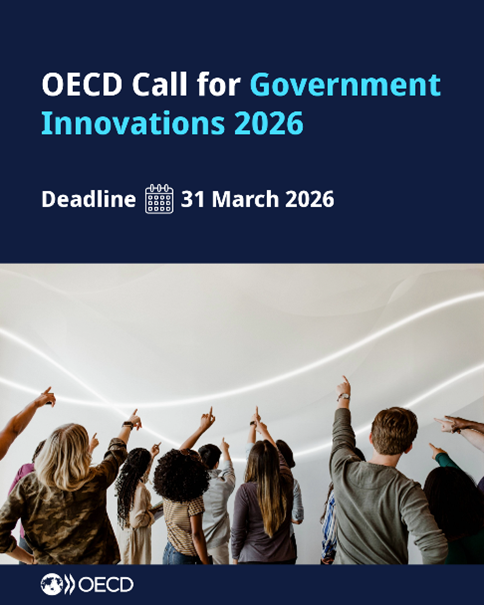
The OECD Observatory of Public Sector Innovation (OPSI) is excited to launch the 8th Call for Government Innovations!
As the world changes – from advances in technology to shifts in citizens’ expectations – government changes. This global call will help to identify and share the innovations enabling governments to meet citizens needs in a fast-paced world.
What are we looking for?
The call is open to examples of innovation in government that meet the OECD definition of a public sector innovation. That means they are:
- New or novel: Innovations must be significantly new or novel to the context where they are implemented (and many innovations involve adapting approaches from one context to another). That might mean using new technologies, skills, processes, collaborations, or financing to tackle a problem.
- Implemented: Innovations must be implemented (not just an idea), even if only reaching intended users or beneficiaries at a small scale.
- Impactful: Innovations aim to have impact. In the public sector this involves a shift in public value, such as effectiveness, efficiency, transparency, integrity, participation, lawfulness and more.
What does that look like in practice?
Innovations can take different forms – including policies, products, services, or processes. In a context where governments can be stuck between “business as usual” and the need to act more decisively in a fast-changing economic, societal and technological landscape – innovation is critical.
This year, we are particularly interested in identifying examples across three themes:
- Simplifying government: What innovations, including new methodologies and tech solutions, are reducing unnecessary administrative burdens (e.g. processes, internal rules, structures) and building capacity to deliver policy objectives efficiently?
- Citizen-government relationship: What innovations are helping governments adapt to the rising expectations of citizens for greater voice in decision making in a more efficient and effective way?
- Measuring efficiency and effectiveness: What innovations are helping governments to measure and track impact?
You can browse the Case Study Library to find examples of cases submitted previously.
Innovations may be submitted from any level of government (national, municipal), any policy area of government, and any geography. Submissions are welcome from public servants and those working closely with the public sector (including in international organisations, civil society, academia and the private sector). However, the public sector must be integrally involved in the design, delivery, or evaluation of the innovation.
Why should you take part?
Sharing your innovative work can incentivise, inspire, reassure and guide public servants around the world. Those who submit cases can also benefit from:
- Outstanding shortlisted cases will be invited to a global government innovation showcase event in Paris.
- 100+ cases will be published in the OECD OPSI Case Study Library.
- 20+ cases will be featured in the 2026 OECD report on government innovation trends.
In addition, it is hoped that recognition provided to innovators featured in any of the outputs above can help to build additional support for their work, both at home and internationally.
Anyone working in or with government is invited to take part. Your participation will help to:
- Showcase and recognise innovative work in government.
- Inspire governments to work in new and creative ways.
- Fuel research into cutting-edge practices in governments around the world.
Since 2017, the OECD’s “Call for Government Innovations” has documented new and exciting government practices. With your help, the OECD has published 1000+ innovations in the Case Study Library, featured detailed cases and analysis in 7 annual “Global Innovation Trends” reports, and invited dozens of shortlisted submissions to present their experiences at high-profile events around the world.
How do you take part?
It’s easy.
- Step 1: Register on the OPSI website (or login if you already have an account).
- Step 2: Submit an innovation through our online form by 14 April 2026.
The form is designed to capture concise information about your innovation that could be useful for others, including: a clear description of the innovation; intended or demonstrable results; and factors that contributed to your success.
You can preview the submission questions and share them with your team using the doc version available here.
You are (very) welcome to submit multiple cases!
Please note: In parallel, the OECD has launched the Global Call for Governing with AI (deadline 20 March). This is a separate call focused only on AI. It aims to build a stronger evidence base for public sector AI adoption by collecting relevant use cases, policy initiatives, and hands-on implementation tools in a public-facing repository (OECD.AI Policy Observatory). These two calls are complementary. If your innovation is applicable to both calls, don’t worry. You can submit via either call.
What happens after you submit a case?
Every submission will be reviewed by an analyst in the OECD team. Most cases will be published in the three months following the Call for Innovations. Following this, some submissions may be invited to share more information via email to inform further analysis.
Findings from the analysis of all cases will be published in the OECD’s Trends in Government Innovation report later in 2026, along with invitations to participate in relevant events.
Now, submit your innovations to make this year’s call even more successful!