Good For: Acceptance testing
The toolkit provides an approach and methods those looking for a new way to tackle social and policy issues by making services more valuable to customers and users, easier to use, with fewer resources wasted on implementing the right ideas in the wrong way (or on the wrong ideas entirely).
This approach involves spending time understanding people’s experiences and resources on their own terms, taking methodical steps to analyse and address these with their active participation, and pushing for…
The Shift Surrey guide provides an overview of Surrey's design approach to date, including a summary of projects and suggestions for building an internal community of practice inside government. At the end of the guide, there are several typical design tools, tips and tricks learned through Surrey's experience and suggestions for related design resources.
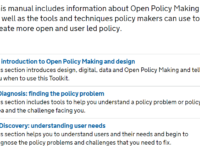
The publisher defines Open Policy Making as developing and delivering policy in a fast-paced and increasingly networked and digital world through collaborative approaches, new analytical techniques, and testing and iteratively improving policy.
The manual includes information about Open Policy Making in the United Kingdom government as well as tools, step-by-step guidance and techniques policy makers can use to create more open and user led policy.
This resource distills the United Nations Development Programme's experience and lessons with running Social Innovation Camps into a "how-to" manual for others. The publisher intends it to broaden a project's results, attract donors, find new partners, source new perspectives on an issue, and/or place beneficiaries at the centre of project design. The resource was created within an international development and social innovation context but can be adapted for public sector use.
It is available…
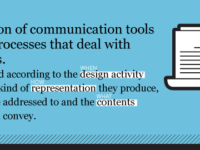
An collection of communication tools used in service design processes that deal with complex systems, organised by design activities, representations, recipients, and contents. The website is the result of the research activity done by Roberta Tassi during her graduation thesis investigating the relation between communication design and service design, starting from the observation of the existing practices in the field of service design.
Each tool contains a description, how-to instructions,…
The toolkit provides step-by-step guidance for development practitioners to leverage new sources of data. It is a result of a collaboration of UNDP and UN Global Pulse with support from UN Volunteers, led by UNDP innovation teams in Europe and Central Asia and Arab States.
The guide is structured into three sections - (I) Explore the Problem & System, (II) Assemble the Team and (III) Create the Workplan. Each of the sections comprises of a series of tools for completing the steps needed to…
Information and resources to guide United States federal employees working on challenges and prizes. It includes guidance on each challenge phase, from preparation to execution and also provides guidance on different types of challenges. It includes case studies and a list of resources for more detailed guidance and support.
Challenge Prizes: A practice guide provides practical guidance and support to help explore challenge prizes and offers guidance on designing and running a challenge prize.
The resource covers what challenge prizes are, guidance on deciding whether a challenge prize is right for your situation, and scoping and planning a prize--including a Challenge Prize Design Worksheet and Challenge Prize Schedule Worksheet.
A guide intended for the Australian government for designing public services in user-centered and iterative ways. This resource is intended to help teams start small and learn fast, and to create services that can be delivered quickly and to save money by reducing service failure.
It is organised into 4 design and delivery stages, each with an associated guide: Discovery, Alpha, Beta, Live.
This is a report produced in conjunction with IDEO after a 2-year initiative of the Rockefeller Foundation called Paper Prototyping, an effort to better inform investment decisions of the Foundation. While this resource is not a typical innovation toolkit, it was included because it describes an often implicit and invisible process of developing and testing proposals for innovative solutions to complex problems.