
Good For: Break habits and rituals
This playbook defines smart cities through human experiences, including 3 "mindsets" (lenses to understand) and 6 "plays" (ways to start). Originally developed for the City of Calgary, Canada, it offers ways to document, prioritize and advocate for individual human experiences at the nexus of networked technology, data and urbanism. It promotes embracing complexity and designing responsive systems, policies and governance around people for people-centered smart cities. Both PDF and slide deck…

“Scenes” is a tool and a method to create visual stories about products and services fast, collaboratively and iteratively. It is intended for leaders and professionals of all industries to shape their ideas and scenarios in the form of fun illustrative storyboards without the need of refined drawing skills. It uses storytelling instead of long functional specifications for new or redesigned services or concepts.
It contains free, downloadable and printable templates for professionals to…
The Open Data Board Game is a board game built around the creation of tools using data. A physical board game journey might involve clearing datasets for release as open data, achieving a certain data quality, and ultimately connecting data sets with a start up, SME or government to deliver economic, social and environmental benefits.
It is a Github code repository that contains all the things that are needed to create the game. It is a work in progress, according to the publisher. Requires some…
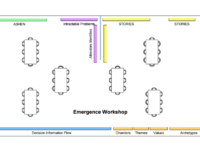
The author provides step-by-step guidance on how to conduct a short term strategic planning workshop based on knowledge management and contextualisation frameworks used by the private company Cognitive Edge. The publisher's suggests that it can be used to conduct pre-hypothesis research project to understand a complex problem. The outputs are comprehensive sets of cultural indicators, knowledge objects (comprising both codified and experiential knowledge artefacts), and large volumes of tangible…
Liberating Structures is a web resource that includes a collection of 33 results-oriented collaboration patterns have been developed and refined through field testing over a 10+ year period in a variety of sectors including healthcare and business.
They are intended to complement conventional practices for organisational design and strategy design. They are designed to be used in an inclusive collaborative setting.
Associated books (for sale) and video guidance is available to assist those…
[Now defunct. Link goes to internet archive from 2018, when MindLab closed]. One of the pioneers of public sector design, Mindlab, developed a set of tools to find and define problems as well as new approaches to solving them. This toolset contains some of the most commonly used in the design practice (user journey, pattern recognition, etc).
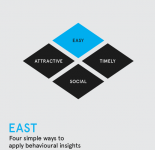
EAST is a framework and summary of the Behavioural Insights Team's knowledge of behavioural science, developed for busy policymakers. It is based around principles of making actions Easy, Attractive, Social and Timely (EAST) applied to a 4-step process: 1. Define the outcome, Understand the context, Build your intervention, and Test, learn, adapt.
It is a more simplified version of the publisher's prior MINDSPACE framework. The resource includes overall guidance and case studies.
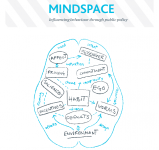
The MINDSPACE report is used by the Behavioural Insights Team as a framework to aid the application of behavioural science to the policymaking process. It is a predecessor of the more simplified EAST framework. It describes four actions that should underpin government‟s attempts to change behaviour: Enable, Encourage, Engage and Exemplify. It includes a users guide for understanding what affects human behavior and describes the MINDSPACE framework through several case studies.
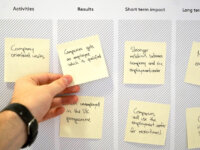
This report identifies five common pitfalls that organisations fall into when using theory of change, and walks through five rules of thumb that will help organisations to use the approach to tackle complex problems. The report includes case studies demonstrating these pitfalls and rules of thumb in practice.