Skip to content
An official website of the OECD. Find out more
Created by the Public Governance Directorate

This website was created by the OECD Observatory of Public Sector Innovation (OPSI), part of the OECD Public Governance Directorate (GOV).

How to validate authenticity

Validation that this is an official OECD website can be found on the Innovative Government page of the corporate OECD website.

Toolkit

A Handbook for the Experiment Co-Creation Platform

Basic BASIC:
Allows reuse
The Experiment Co-Creation Platform (ECP) is a model for collaboration and experimenting dedicated in delivering sustainable solutions to wicked urban problems. The ECP model was developed and prototyped by Demos Helsinki. In the model, cities, higher education institutions and non-academic collaborators such as companies and foundations together define a desirable shared vision to work towards to as well as identify the challenges preventing the vision from happening. Research-based teams…
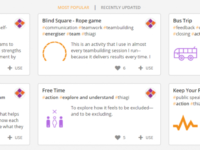
This online library contains over 400 facilitation resources, available with free login. Tools are organised by topic: Team, Energiser, Idea generation, Issue resolution, Explore and understand, Action. They include information such as time required, group size, difficulty, materials, step-by-step instructions, tips, and variations as well as user comments. This private company also offers free and paid session planner software using the methods in the library.
Toolkit

Improved Innovation Decision Making

Basic BASIC:
Allows reuse
The IIDM Toolset was designed as a guide for organisations and individuals seeking to build the capacity of problem solvers to innovate and collaborate more effectively. The Toolset addresses two key components: (1) cultivating an innovator’s mindset, and (2) improving the processes that support decision making along the journey from idea to impact. The publisher asserts that both of these ingredients are vital for decision making to yield improved innovation. The Toolset offers users…
Toolkit

The Brains, Behavior & Design Toolkit

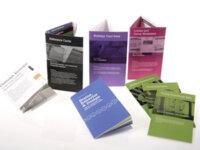
The toolkit is designed to be both informative and actionable - helping integrate the latest research in human behavior and decision making into practice. The toolkit features five tools to help designers apply findings from the field of behavioral economics to their practice in order to provide a head start on framing research as well as developing new strategies for solving user problems. The toolkit includes: Reference Cards: behavioral economics research findings organized and…
Toolkit

18F Method Cards

Hero HERO:
Editable source files available
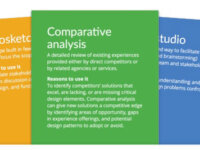
A collection of tools that describe how 18F digital service teams put human-centered design into practice. These cards are focused on design in the context of digital services, but can be adapted to non-technical design projects as well. The resource is online and also available as printable cards. The card set includes simplified information on various design methods according to an overall methodology: Discover, Decide, Make,Validate. There are also "Fundamentals" cards related to incentives,…
Toolkit

Models of Impact

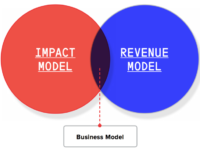
A Role-Playing and Ideation Game That Simulates The Process Of Launching A Social Enterprise. The game walks players through a series of activities in order to simulate the process of ideating and launching a social enterprise in four steps: Learn, Invent, Program, and Report. It is available via a pay-what-you-want digital download, and includes instructions for gameplay, a glossary of 200+ business models, and a suite of other resources.
Toolkit

DIY Learn

Champion CHAMPION:
Can be remixed
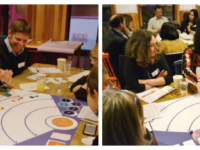
DIY Learn is a set of online modules to help development practitioners understand and embed practical tools to support social innovation in their work. It contains a series of free, 2-hour courses as well as a trainers handbook. It was created for international development practitioners but is applicable for public sector staff as well.
Toolkit

Game of Life 2050

Basic BASIC:
Allows reuse
The Game of Life 2050 draws on scenarios for a sustainable European society in 2050. It is an interactive board game in which players consider four scenarios that describe the radical changes needed to be living within key environmental boundaries by 2050. The game takes a minimum of 2 hours to run (ideally 4 hours) and involves 5-7 actors (each played by one person or in pairs) and one Games Master. Play consists of three ‘rounds’ in which actors are given a set of circumstances that have…
Toolkit

Stanford d.school Tools for Taking Action

Hero HERO:
Editable source files available
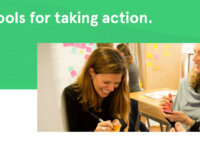
This is a curated collection of 30+ resources from Stanford d.school classes and workshops, including activities, tools, and how-to guides. They are intended for anyone who wants to become more familiar with design thinking or unlocking creative thinking in whatever challenge being tackled. Some are full-fledged workshops that for guiding others through. Other resources are short worksheet-based activities.
Toolkit

The Social Design Methods Menu

Champion CHAMPION:
Can be remixed
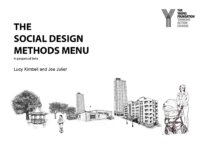
The toolkit provides an approach and methods those looking for a new way to tackle social and policy issues by making services more valuable to customers and users, easier to use, with fewer resources wasted on implementing the right ideas in the wrong way (or on the wrong ideas entirely). This approach involves spending time understanding people’s experiences and resources on their own terms, taking methodical steps to analyse and address these with their active participation, and pushing for…