Good For: Build shared understanding
A curated set of 18 canvases that walk you through the steps needed for creating services & products using the combined principles and methodologies of agile development, lean startup, and design thinking. The publisher's intent is for you to reach business objectives in an iterative and human-centric way. In adapting to a public sector context, "customers" may need to be re-framed as stakeholders or service users. GitHub source content available. Includes how-to videos.
A playbook of 13 key “plays” drawn from successful practices from the private sector and government that the publisher believes, if followed together, will help governments build effective digital services.
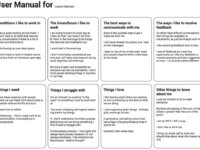
A canvas for individual sharing about work preferences, meant for building good teams and working relationships. The publisher intends for this to be used for making preferences explicit but not for making demands. PDF and Adobe Illustrator file available.
This playbook defines smart cities through human experiences, including 3 "mindsets" (lenses to understand) and 6 "plays" (ways to start). Originally developed for the City of Calgary, Canada, it offers ways to document, prioritize and advocate for individual human experiences at the nexus of networked technology, data and urbanism. It promotes embracing complexity and designing responsive systems, policies and governance around people for people-centered smart cities. Both PDF and slide deck…
“Scenes” is a tool and a method to create visual stories about products and services fast, collaboratively and iteratively. It is intended for leaders and professionals of all industries to shape their ideas and scenarios in the form of fun illustrative storyboards without the need of refined drawing skills. It uses storytelling instead of long functional specifications for new or redesigned services or concepts.
It contains free, downloadable and printable templates for professionals to…
This kit discusses the fundamentals of innovation - immersion (understanding the context), problem definition, ideation, prototyping and testing
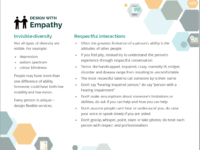
Inclusive design is designing for the full range of human diversity in ability, language, income, culture, gender, age and other characteristics. This toolkit includes a series of cards to use early in a design process to help sketch, plan, prototype and design content, interactions and processes. It covers inclusive physical, audio, visual, and thought experiences. PDF and editable Word document available via the publisher's Github page.
Principles and guidance for developing digital services in Argentina and beyond. The resource is available in a Github repository and includes 9 principles, indicators, and standards for API's, website, mobile applications, and others.
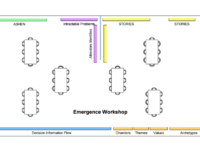
The author provides step-by-step guidance on how to conduct a short term strategic planning workshop based on knowledge management and contextualisation frameworks used by the private company Cognitive Edge. The publisher's suggests that it can be used to conduct pre-hypothesis research project to understand a complex problem. The outputs are comprehensive sets of cultural indicators, knowledge objects (comprising both codified and experiential knowledge artefacts), and large volumes of tangible…
The resource contains tools for visualizing and anticipating future risk of technology products, acknowledging that once technology is released and reaches scale it may be used for purposes beyond the original intention. The toolkit contains foresight methods, including 14 scenarios, for kicking off important conversations with product teams--including examples of current signals of future trends. It also contains a Risk Mitigation Manual with 8 risk
zones where hard-to anticipate
and unwelcome…