Good For: Collaboration
This resource tells the stories of 20 teams, units and funds established by governments and charged with making innovation happen. i-teams, short for innovation teams, are dedicated teams, units and funds, to structure and embed innovation methods and practice in government. They are largely affiliated with Bloomberg Philanthropies and its associated i-teams program and usually within local governments.
This resource analyses the diversity of structures and approaches, their impacts, and the key…
The Design Kit resource is both a downloadable PDF as well as online guidance on the different phases of a human-centered design process, organised by Mindsets, Methods (Inspiration, Ideation, Implementation), and Tools. The PDF is only downloadable from the website after creating a user account at IDEO. Website includes instructional videos on the techniques of various user-centered design methods and techniques.
This is a collection of methods and activities, based on Hyper Island’s core methodology, for creative collaboration and realising potential in teams or organisations. It’s a collection of methods and activities, based on Hyper Island’s core methodology and is focused on Learning-by-doing (or Experiential Learning), Reflection (or Reflective Practice), and workshop or group facilitation. It includes Hyper Island tools as well as tools from others.
An introduction to service design for public servants, and a set of practical ways to include design methods in your work. This resource was developed for the City of New York but is relevant to other cities, governments, and innovation labs as well.
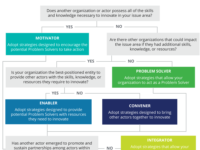
This resource covers five key roles in a public innovation ecosystem: Problem Solver, Enabler, Motivator, Convener, and Integrator. For public administrations wanting to make an impact on a societal challenge, it helps identify where to start, and how the administration fits in with other actors already focused on the same or similar challenges. By understanding which of these five roles to assume when launching an initiative, organisations may be able to more effectively deploy their resources,…
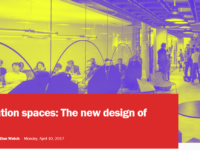
Authors Julie Wagner and Dan Watch draw from nearly 50 in-depth interviews with global-reaching and local-serving architects and innovation space managers to analyze the continuum of modern innovation-oriented workspaces. They find the role of well-designed innovation spaces in improving firm competitiveness, company culture, and the formulation of new products and ideas, offers important lessons for companies, universities and other drivers of the innovation economy on how to re-imagine space…
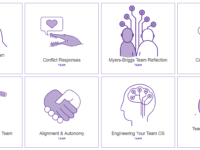
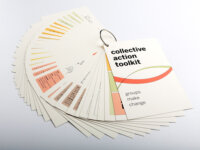
The Collective Action Toolkit (2nd edition) is a set of activities and methods that enables groups of people anywhere to organize, collaborate, and create solutions for problems affecting their community.
It guides users through methods according to six action areas, with suggested pathways from one method to the next. For each method, step-by-step instructions are given, in addition to the time, roles, and materials needed. Some methods include canvasses to guide activity.
The toolkit is…