
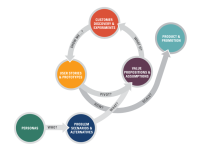
The Venture Design Process offers set of templates, tutorials, and templates for systematic execution of continuous design and delivery. It covers the phases: Personas, Problem Scenarios & Alternatives, Value Propositions, Assumptions & Experiments, Customer Discovery & Experiments, User Stories & Prototypes, Product & Promotion, as well as modules covering agile management and business model generation. The resource is targeted at private sector entrepreneurs and focuses on digital products and…
Good For: Insight finding

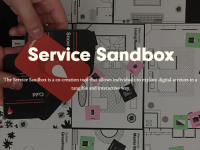
The Service Sandbox is a visual, playful, co-creation tool that allows individuals to explore digital services in a tangible and interactive way. The sandbox can be used to test an existing service or to create new ones. The resource is oriented toward designing interior environments, especially digitalising environments, but could be used more broadly. The tool consists of three phases (build, ideate and define), plus a pitch template for taking the process one step further. According to the…
The current big shift in management - both public and private - is from linear models to circular models. This resource was designed to help innovators create more elegant, effective and creative solutions for circular economy. This resource allows users to explore new ways to create sustainable, resilient, long-lasting value in the circular economy. While it is oriented towards private sector manufacturing and products, it can also be helpful for public sector organisations to think about…
This toolkit is a guide on how to carry out prototyping and testing. The purpose of the process is to test and improve the ideas at an early stage, before committing a lot of resources to it. The tool provides a step by step guide with simple descriptions on the techniques in each phase and things to watch out for.
The prototyping process is divided into the phases:
- Doing the Groundwork
- Prototyping phase 1
- Prototyping phase 2
- Learn and Evaluate.
The document contains short…
The Design Sprint is a methodology for quickly solving problems through developing a hypothesis, prototyping an idea, and testing ideas with users. Design Sprints quickly align teams under a shared vision with clearly defined goals and deliverables. The Design Sprint methodology was developed at Google from a vision to grow user experience (UX) culture and the practice of design leadership across an organisation. The length of time for Design Sprints will be based on the goals and the needs of…
Toolkit
Servitization Mapping – A practical tool to explore strategic directions in a servitization…
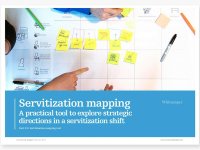
The Servitization Mapping canvas is a practical tool intended for business-to-business manufacturers to explore strategic directions in a servitization shift, that is shifting from a product focus to a service focus. While this resource is oriented toward the private sector, public sector organisations, being primarily service organisations, may find it helpful for refining their service portfolios and being more service user-focused. The canvas is a template to map an existing product and…
This resource is for creating equitable change in schools and learning environments. It helps build the capacity of school communities and learning coordinators to set and pursue equity aspirations, so that every student is future-ready, no matter their background, circumstances, or learning preferences. The resource is based on a design thinking process and includes an overview, methods, and instructions that are specifically tailored to learning environments. The resource includes sections:…
The Design for Policy toolkit PROMPT is targeted toward policymakers who wish to identify where design can add value to the policy cycle process by enhancing user and citizen participation. The majority of the design tools included in the resource are common qualitative research and design methods and follow a gradual shift in emphasis from data-centred policy to people-powered policy, according to the publishers.
PROMPT has been collaboratively developed by PDR - International Design and…

This toolkit allows organisations to change their mindset and move from a project-oriented approach towards a platform-way-of-working that is designed to tackle complex problems. The toolkit was developed and tested by the Danish Design Centre in collaboration with United Nations Development Programme (UNDP) and 40+ country offices. The toolkit consists of several mapping exercises. After using the integrated Mission Statement Generator to create an ambitious yet realistic mission statement,…

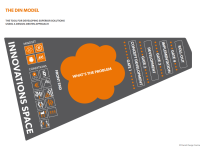
The DIN model is a methodology for developing solutions using a design-driven approach with the goals of achieving better and more innovative processes and outcomes, increasing probability of implementation, and improving user satisfaction. The model helps explore all the potential pitfalls, possibilities and limitations, particularly in the "front end" or early stage of projects. The DIN model consists of a series of phases and four ‘gates’. Each phase contains a variety of activities and…